
Ever found yourself pondering the distinction between a horse and a pony but hesitated to ask? Worry no more! While both belong to the same genetic family, ‘Equus’, the primary differentiating factor boils down to their height. This distinction, rooted in millions of years of evolution, has shaped these magnificent creatures into the forms we recognize today.
Measuring Equine Height: Hands High Explained
The measurement of horses and ponies utilizes a unique unit called ‘hands’, abbreviated as ‘hh’ (hands high). This system dates back to ancient Egypt, marking one of the earliest recorded methods of measurement. It wasn’t until 1541, under Henry VIII, that a standard ‘hand’ was established to be equivalent to four inches.
To determine an equine’s height, measurement is taken from the ground to the wither – the arch at the top of the shoulder where the neck begins. This is done using a specialized measuring stick or tape. If you’re unsure, your veterinarian or a local riding instructor can assist with this process.
For instance, a horse measuring 16hh (64 inches at the wither) would be described as “sixteen hands-high.” Conversely, a pony at 14.1hh (56.4 inches at the wither) would be referred to as “fourteen-one hands-high” or simply “fourteen-one.” The measurement system counts in fourths: 15.0hh is “fifteen hands,” 15.1hh is “fifteen-one,” and so on, up to 15.3hh, after which it resets to “sixteen hands” at 16.0hh. Many equestrian competitions often list height limits in centimeters, with 147cm being equivalent to just over 14.2hh. Generally, equines measuring up to 14.2hh are classified as “ponies,” while those exceeding this height are considered “horses.”
Foals, Fillies, Colts, and More: Understanding Equine Terminology
It’s a common misconception that a foal is a type of pony due to its small stature. However, a foal is simply a young horse or pony under one year of age, regardless of its ultimate size, type, or breed. Similarly, a stallion is not automatically a large horse. To clarify the terms:
- Foal: A young horse or pony under one year old.
- Pony: Measures below 14.2hh at maturity (around 6-7 years old).
- Horse: Measures above 14.2hh at maturity (around 7-8 years old).
- Filly: A female horse or pony under four years old.
- Colt: A male horse or pony under four years old that has not been gelded.
- Mare: A female horse or pony over four years old.
- Stallion: A male horse or pony over four years old that has not been gelded.
- Gelding: A male horse or pony that has been gelded.
Interestingly, miniature horses, measuring up to 34 inches at the wither, are classified as ‘horses’ rather than ‘ponies’.
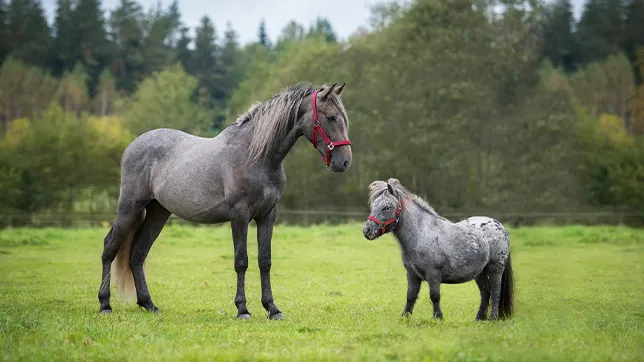 Image of a horse and a pony standing side-by-side.
Distinguishing Features: Appearance, Attitude, and Appetite
While telling apart a 14.3hh light horse from a 14.2hh heavier-set pony can sometimes be challenging, several key features can help differentiate them.
Ponies often exhibit:
- A longer back in proportion to their height.
- Straighter shoulders, contributing to a “choppy” trot.
- Shorter cannon bones (the lower leg section below the knee or hock).
- Smaller hooves.
Horses, on the other hand, tend to have:
- A back more proportionate to their leg length.
- More sloped shoulders, allowing for smoother movement.
- Longer cannon bones.
- Hooves proportional to the width of their legs.
It’s important to remember that every equine is unique. Breed and crossbreed variations mean some heavy horses, like the Ardennes, may possess short, stocky legs akin to a pony, while the British Riding Pony shares sleek characteristics with the Thoroughbred.
Beyond physical traits, attitude plays a role. Little ponies, such as Shetlands, are often known for their big personalities, while large horses like Shires have a reputation as “gentle giants.” However, you’re equally likely to encounter an angelic pony or a horse with a mischievous streak, adding to their individual charm.
Regarding appetite, the phrase “eat like a horse” holds true. Larger horses require substantial daily intake, potentially up to 2% of their body weight in forage, to maintain health and energy for their activities. While all equines need ample forage, bigger horses consume significantly more than smaller ponies.
Ponies, despite their ability to appear eager eaters, should not be overfed. Excess weight increases their risk of health issues like laminitis, equine metabolic syndrome (EMS), and respiratory problems. The primary reasons ponies have smaller appetites than horses are their size and generally lighter workloads. Nevertheless, some ponies undertake demanding tasks, such as carriage driving, while some horses may have very light workloads. Equine diets should always be tailored to their individual needs and circumstances. For specific feeding advice, consulting your veterinarian is recommended.
Therefore, the next time the question arises, you can confidently articulate the fascinating differences between a horse and a pony.
