
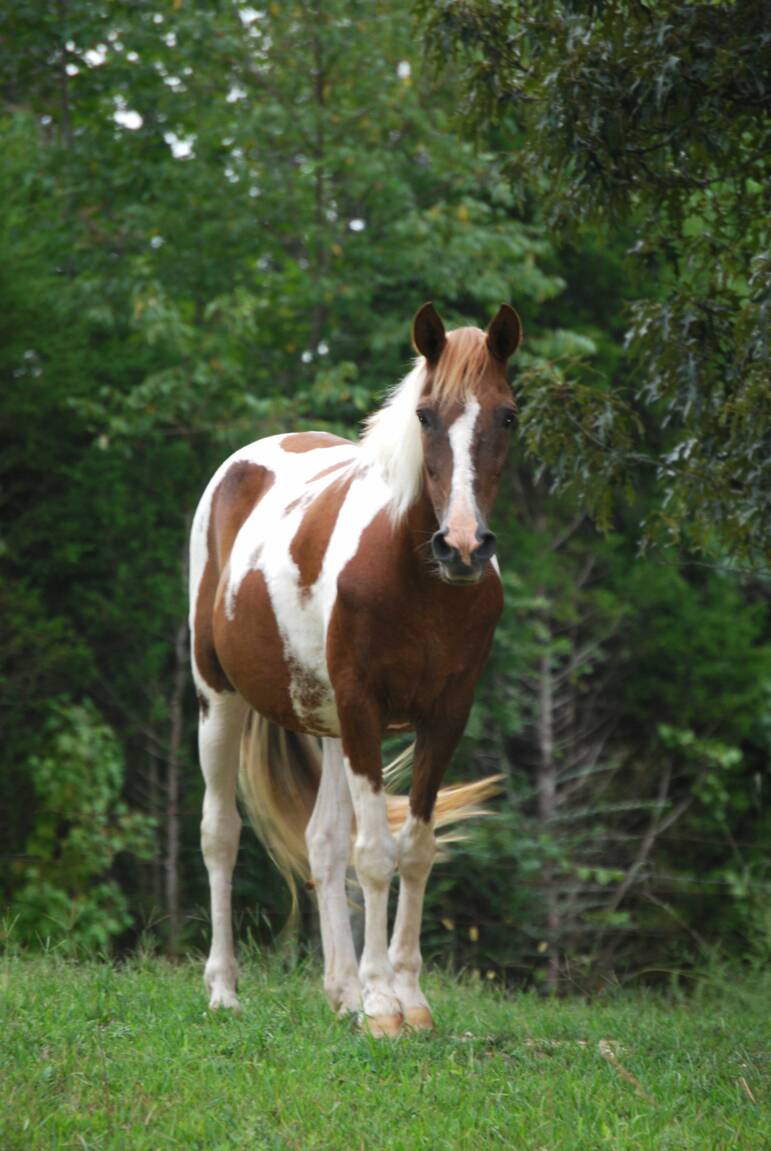
The Pinto horse is a unique breed recognized not by its lineage but by its striking coat patterns. In America, Pintos are considered a distinct breed, characterized by a dark base coat adorned with random patches of white. This distinctive coloration can appear in horses of any breed or conformation. However, the Pinto Horse Association of America (PtHA) has specific exclusions, not accepting horses with Appaloosa, Draft, or mule breeding or characteristics. Historically, in the American West, the Pinto was a favored war horse of Native Americans, its camouflage coloring providing a significant advantage in battle.
Physical Description and Conformation Types
The Pinto’s conformation is not uniform due to its primary breeding for color. When the dark color is black, the horse is referred to as Piebald; when the dark color is anything other than black, it’s termed Skewbald. Pintos can stem from a wide variety of breeds, from Thoroughbreds to Miniatures.
The PtHA acknowledges four distinct types of conformation: Saddle, Stock, Hunter, and Racing. The classification of a horse’s type is determined by its conformation and pedigree.
- Stock Type: Predominantly of Quarter Horse and Paint breeding and conformation, suited for Western riding.
- Hunter Type: Primarily of Thoroughbred breeding and conformation, ideal for English riding disciplines.
- Pleasure Type: Typically of Arabian or Morgan breeding and conformation, offering a comfortable ride.
- Saddle Type: Reflects the breeding and conformation of American Saddlebred, Tennessee Walking Horse, or Missouri Fox Trotter breeds, known for their animated gaits.
Pintos are also categorized by size. Horses mature to over 56 inches at the withers. Ponies measure 56 inches and under but over 34 inches. Animals 34 inches and under at maturity are classified as miniatures, with a further sub-classification for “Mini B” miniatures ranging from over 34 inches up to 38 inches. Each division operates with its own set of rules and standards, allowing for exhibitions among horses of similar conformation and style.
Distinguishing Pinto from Paint
A common question is the difference between Pinto and Paint horses. Essentially, the American Paint Horse Association (APHA) registers only those horses with documented and registered Paint, Quarter Horse, or Thoroughbred breeding. The distinction lies in bloodlines rather than color or pattern. While most Paints are eligible for double registration as Stock or Hunter type Pintos, the PtHA’s broader eligibility allows registration for miniature horses, ponies, and crosses with breeds like Arabians, Morgans, Saddlebreds, and Tennessee Walking Horses.
Origin of the Pinto
Although often associated with Native American culture and its legendary battlefield prowess, the Pinto horse was introduced to North America by European explorers, primarily from Spain. These explorers brought Barb stock, which had previously been crossed with native European breeds. It is believed that Pinto patterns may have reached Europe through Arabian strains, as Pinto markings appear in ancient art from the Middle East. Furthermore, the prevalence of the Tobiano pattern among wild horses of the Russian Steppes suggests Pinto coloring might have been present in Europe as early as the Roman Empire.
Following the introduction of these European horses, large wild herds exhibiting the distinctive color patterns began to develop across America. These herds were eventually domesticated by Native Americans. European settlers continued to import established and stylish breeds as their foundation stock. Over time, as Native American culture and westward expansion progressed, it often became necessary to cross these more refined breeds with the hardy wild mustang stock. This crossbreeding aimed to enhance size, attractiveness, and suitability for the strenuous working conditions of the era. The resulting Western-bred horse, particularly the uniquely marked Pinto, became an iconic fixture in America, adding a touch of glamour to parades and films.
Pinto Color Patterns
The PtHA recognizes two primary Pinto color patterns:
- Tobiano: Characterized by white areas overlaying a dark base coat. White markings typically originate from the head, chest, flanks, and buttocks, often extending to the tail. Legs are usually white, creating the appearance of a white horse with large or flowing colored spots. A key characteristic is that white often crosses the center of the horse’s back or topline. A Tobiano foal generally requires at least one Tobiano parent.
- Overo: Typically appears as a dark horse with irregular white markings that usually begin on the animal’s sides or belly and extend towards the neck, tail, legs, and back. The colored areas often frame the white spots, resulting in a dark tail, mane, legs, and topline. Bald or white faces are common with the Overo pattern. Some Overos display white legs and splashy white markings with rounded or lacy edges. White rarely crosses the back or topline. A horse with Pinto coloration descended from two solid-colored parents of another typically solid-colored pure breed is termed a “crop-out” and is considered an Overo pattern.
The Pinto Horse Association of America (PtHA)
Established in 1956, the Pinto Horse Association of America (PtHA) was initially founded as a color registry but has since evolved to include four conformation types. The association offers divisions for horses, ponies (over 34″ but not exceeding 56″ at maturity), miniatures (not exceeding 34″ at maturity), and Mini “B” miniatures (exceeding 34″ up to and including 38″). The PtHA also offers a Breeding Stock Division for solid-colored horses or those with insufficient color for registration, horses with documented color in their pedigree, or those exhibiting two or more Pinto characteristics. The association does not accept animals with Appaloosa, Mule, or Draft horse breeding.
In 2004, the PtHA relocated its headquarters from Fort Worth, Texas, to Bethany, Oklahoma. This move brought new opportunities and initiatives for current and prospective members. The association boasts a registry of over 124,000 horses, ponies, and miniatures across the U.S., Canada, Europe, and Asia, with continuous growth in both numbers and membership. Numerous local Charter organizations affiliated with the PtHA are active throughout the United States and Canada.
References
Kentucky Horse Park, 4089 Iron Works Pike, Lexington, KY 40511
Pinto Horse Association of America Inc., 7330 NW 23rd Street, Bethany, OK 73008, Phone: (405) 491-0111
Additional information is available from the National Pinto Horse Registry, P.O. Box 486, Oxford, NY 13830-0486, Phone: (607) 334-4964
