
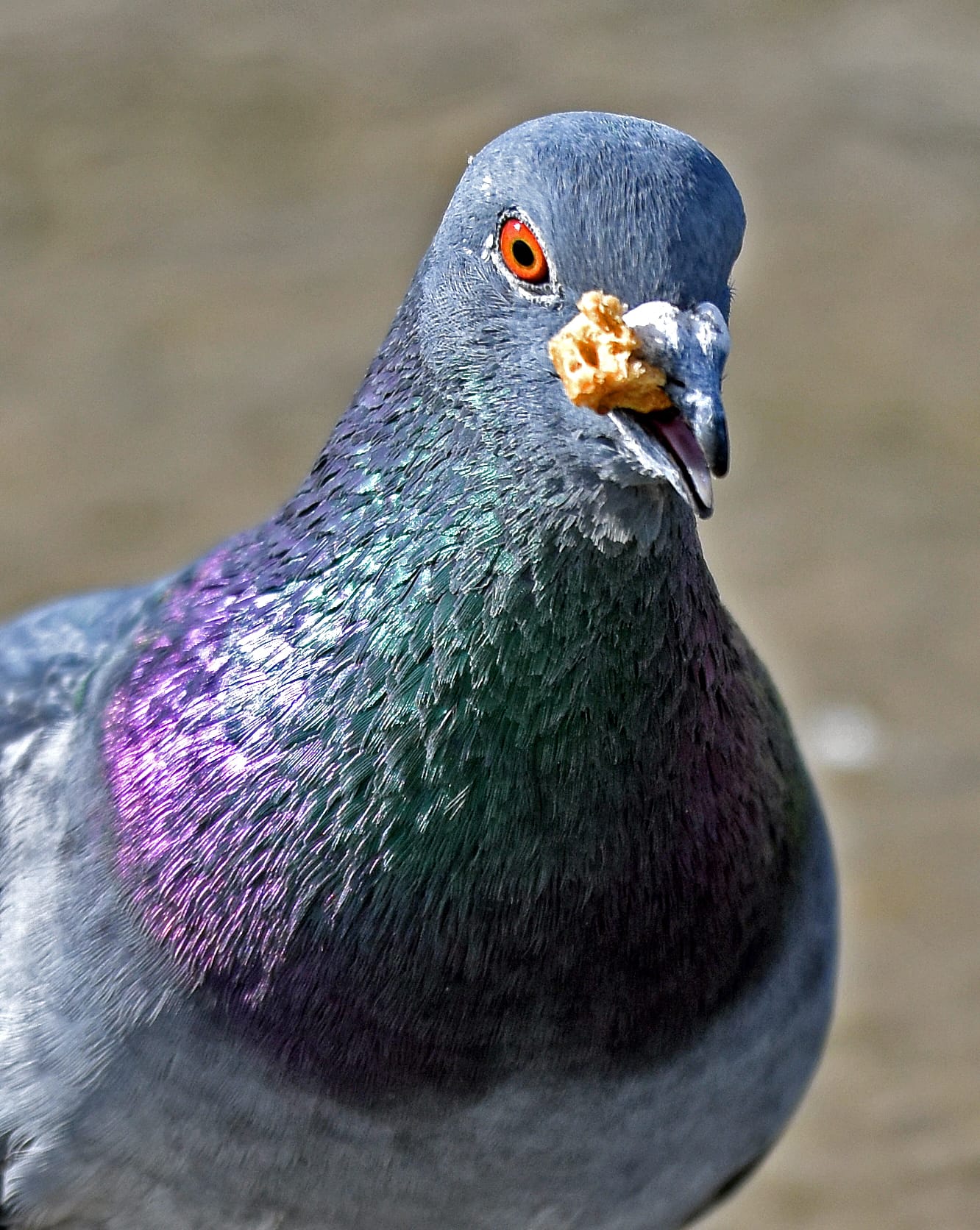
Welcoming a new feathered friend into your life, or simply fascinated by the avian world? Pigeons, also known as rock doves (Columba livia), offer a captivating glimpse into animal courtship and the marvel of natural coloration. While distinguishing between male and female domestic pigeons can be challenging based on physical traits alone, their behavior, particularly during mating season, reveals a fascinating dynamic. This exploration delves into the intricate courtship rituals of pigeons and the stunning role of their iridescent feathers.
Understanding Pigeon Courtship
The process of identifying a pigeon’s sex can be difficult for humans. Although differences exist in body size, neck and leg length, nasal knob shape, head and forehead structure, and the degree of iridescence, these features overlap significantly and are not reliable indicators for sex determination in pigeons. However, when it comes to courtship, the roles of male and female become distinctly observable.
The male pigeon engages in elaborate displays to attract a mate. These rituals include circle walking, bowing, cooing, tail dragging, and preening. A key characteristic of the male’s display is puffing out his chest and strutting with a rapid walking pace, all while emitting repetitive cooing sounds and bowing. The male often exhibits the most pronounced iridescent feathers, adding to his visual appeal during these displays.
While these displays are a crucial part of pigeon courtship, the female’s receptiveness is the ultimate deciding factor. Though most courting males are initially ignored, a successful courtship culminates in the female’s acceptance, typically occurring in the spring. The exact criteria for her choice remain a subject of wonder, but it’s speculated that she evaluates potential mates in her vicinity. Her readiness to mate is signaled by drooping wings and adopting a submissive posture, ducking down.
The Magic of Iridescent Feathers
Cooing is undoubtedly a significant aspect of dove courtship, but the iridescence of their feathers is equally captivating. These feathers are responsible for the birds’ striking green and purple colors, achieved through structural coloration rather than pigments. In the animal kingdom, such feathers, much like the scales on butterflies, are physiologically costly to produce. This suggests a strong evolutionary advantage for their existence.
The iridescent feathers on a pigeon’s neck are notably distinct from the rest of its body feathers. As the bird moves in the sunlight, these colors shift and change, creating a magical visual effect. This phenomenon is even more remarkable when considering the pigeon’s ultraviolet vision, which likely perceives these colors in ways humans cannot fully comprehend.
The conventional scientific explanation for such structural colors is that they convey information about the individual’s quality, similar to the peacock’s tail used by females in mate selection. However, in pigeons, both sexes possess these iridescent feathers to some degree, prompting questions about what information they might be communicating between individuals.
While scientists have made significant strides in understanding the mechanisms behind the production of iridescent colors, less is known about how organisms utilize these features in their lives. Observing pigeons in their natural behavior, particularly how they interact with their own flashy feathers, offers a unique opportunity to gain further insights into this fascinating aspect of their biology.
References
- Nakamura, T., Ito, M., Croft, D. B., & Westbrook, R. F. (2006). Domestic pigeons (Columba livia) discriminate between photographs of male and female pigeons. Learning & behavior, 34(4), 327-339.
- Yin, H., Shi, L., Sha, J., Li, Y., Qin, Y., Dong, B., … & Zi, J. (2006). Iridescence in the neck feathers of domestic pigeons. Physical Review E, 74(5), 051916.
- Ghiradella, H. T., & Butler, M. W. (2009). Many variations on a few themes: a broader look at development of iridescent scales (and feathers). Journal of the Royal Society Interface, 6(suppl_2), S243-S251.
