
The world of equestrian training is filled with tools and aids designed to enhance communication and physical development. Among the most discussed is the Pessoa Horse Training System, a device invented by the legendary Brazilian showjumper Nelson Pessoa. When used correctly, this intricate system of ropes, pulleys, and straps can be a powerful asset for developing a horse’s topline and encouraging self-carriage. However, misuse can lead to problems, making education paramount.
This comprehensive guide will demystify the Pessoa system, exploring its mechanics, benefits, and potential drawbacks. We will provide a clear, step-by-step process for its correct application, ensuring you can make an informed decision for your equine partner’s training program.
What is the Pessoa Horse Training System?
The Pessoa horse training system is a lunging aid designed to encourage a horse to work in a correct frame, promoting the development of back and core muscles. It operates on a pressure-and-release principle. The system consists of a lunging surcingle, a breeching strap that goes around the hindquarters, and a series of ropes and pulleys that connect the surcingle, the bit, and the breeching strap.
This setup creates a connection from the horse’s hind end to their mouth, encouraging them to step further under themselves with their hind legs. This engagement lifts the back and strengthens the abdominal muscles, forming the coveted “topline” that is essential for carrying a rider effectively and athletically.
How Does the Pessoa System Work?
The genius of the Pessoa system lies in its dynamic nature. Unlike static side reins, it allows for movement and gives feedback to the horse based on its posture.
- Pressure Application: When a horse raises its head too high or works in a hollow frame, the ropes apply gentle pressure to the bit. Simultaneously, the breeching strap creates awareness of the hindquarters, encouraging the hind legs to engage.
- Instant Release: The moment the horse responds by lowering its head and lifting its back into a longer, rounder frame, the pressure is immediately released. This instant reward is a highly effective training tool, as the horse quickly learns which posture is comfortable.
This system essentially guides the horse into a state of self-carriage, helping it discover a more efficient and biomechanically correct way of moving without the weight or potential imbalance of a rider.
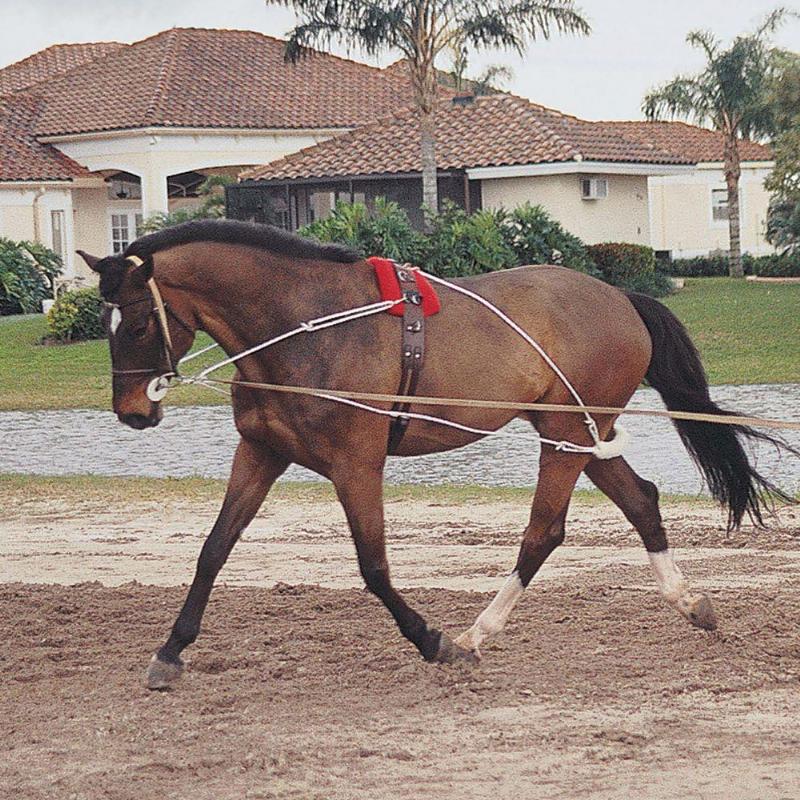 A diagram showing the components of the pessoa horse training system fitted on a horse for lunging.
The Benefits of Using a Pessoa Training Aid
When incorporated thoughtfully into a training regimen, the Pessoa system can offer significant advantages for both young, developing horses and experienced equine athletes.
- Develops Topline Muscle: The primary benefit is the strengthening of the longissimus dorsi (back muscles) and abdominal muscles, creating a strong “bridge” to support the rider.
- Improves Hindquarter Engagement: It teaches the horse to step deeper under its center of gravity with its hind legs, which is the engine for all athletic movement.
- Enhances Balance and Suppleness: By working correctly on a circle, the horse learns to balance itself and becomes more supple through its back.
- Encourages a Correct Frame: It promotes a “long and low” frame, which stretches the back muscles and is the foundation for higher levels of collection later in training.
- Provides Variety in Training: Lunging in a Pessoa system offers a valuable alternative to ridden work, allowing the horse to work its body without the stress of carrying a rider.
“The Pessoa system, when used with empathy and precision, acts like a Pilates session for the horse,” explains Dr. Alistair Finch, an equine biomechanics specialist. “It activates the deep core musculature that is so crucial for soundness and performance, teaching the horse body awareness in a way that is difficult to replicate under saddle.”
Potential Drawbacks and Criticisms
No training aid is without its critics, and the Pessoa system is no exception. The potential for harm comes not from the device itself, but from improper use.
- Risk of Incorrect Fitting: A poorly fitted system can create discomfort, place pressure on the wrong areas, and encourage the horse to adopt an incorrect posture, such as curling behind the vertical.
- Overuse or Overtightening: Using the system for too long or adjusting it too tightly can cause muscle soreness and fatigue. The work is physically demanding, similar to a human starting a new gym routine.
- Forcing a Headset: An inexperienced handler might be tempted to crank the system tight to force the horse’s head down. This creates a false frame, tension, and anxiety, and it completely defeats the purpose of the aid.
- Mouth-Hindquarter Connection: Some critics argue that connecting the hind end’s action directly to the bit can be confusing for the horse, potentially dulling the mouth if not used with finesse.
It is absolutely crucial that the system is introduced slowly and used by an experienced handler who understands equine biomechanics.
How to Fit and Use the Pessoa System Correctly
Proper application is key to unlocking the benefits of the Pessoa system while avoiding its pitfalls. Always prioritize the horse’s comfort and introduce the equipment gradually.
Equipment Needed
- A well-fitted bridle with a simple snaffle bit.
- A lunging surcingle with multiple D-rings.
- A saddle pad for under the surcingle.
- The Pessoa horse training system.
- A lunge line.
- A lunge whip.
Step-by-Step Guide
- Warm-Up: Always begin by lunging your horse without the Pessoa system attached. Allow the horse to walk and trot on both reins for at least 5-10 minutes to warm up its muscles.
- Introduce the System Loosely: The first few times, attach the system on a very loose setting. Let the horse get used to the feel of the breeching strap and the movement of the ropes.
- Attach the Breeching Strap: Gently place the breeching strap over the horse’s back and slide it down over the quarters, ensuring it sits comfortably below the point of the buttock, not down on the hocks.
- Set the Ropes for a Low Outline: For initial training, use the lowest setting. The ropes should run from the breeching strap, through the D-rings on the surcingle, to the bit, and then down between the horse’s front legs to a low D-ring on the surcingle.
- Check the Tension: The ropes should be loose when the horse is standing still. There should only be gentle tension when the horse moves and puts its head up. You should be able to fit a hand’s width between the rope and the horse’s side.
- Begin with Short Sessions: Start with short sessions of no more than 15-20 minutes, including the warm-up. This is strenuous work. Focus on walk and trot.
- Observe the Movement: Watch your horse closely. You are looking for a relaxed, swinging back, a lowered head and neck, and active, engaged hind legs. The horse should be reaching forward into the contact, not curling behind it.
Is the Pessoa Horse Training System Right for Your Horse?
This system is most beneficial for horses that are tense, hollow in their back, or struggle with engaging their hindquarters. It can help young horses understand the concept of working into a contact and can assist in the rehabilitation of horses needing to rebuild their topline.
However, it may not be suitable for horses with certain physical issues, very green horses who are not yet balanced on the lunge, or horses who panic when they feel restriction. Always consult with a trusted trainer or an equine physiotherapist before introducing a new training aid like the Pessoa.
Frequently Asked Questions (FAQ)
How often should I use the Pessoa system?
For best results, aim for short, frequent sessions, perhaps 2-3 times per week for 15-20 minutes. Consistency is more effective than one long, demanding session. Avoid using it every day to allow muscles time to recover and grow.
Can I canter my horse in a Pessoa system?
Yes, but only once the horse is strong, balanced, and comfortable working in walk and trot. Canter work is very demanding in this system and should be introduced gradually with higher rope settings. It is generally not used for building muscle but for improving balance.
Is the Pessoa system cruel?
When used incorrectly, overtightened, or as a shortcut, any training aid can be detrimental. However, when used as intended—as a tool to guide the horse into a more comfortable and sustainable posture with a pressure-and-release method—it is not cruel. The onus is on the handler to use it with skill and empathy.
What’s the difference between a Pessoa and a Chambon?
A Chambon primarily encourages the horse to lower its head by applying poll and bit pressure, focusing on stretching the neck and back muscles. The Pessoa system is more comprehensive, connecting the hindquarters to the front end to promote full-body engagement, not just a lowered head position.
Can I use a Pessoa system on a young horse?
It can be beneficial for young horses who already know how to lunge, as it can help guide them into the correct shape without the weight of a rider. However, it must be introduced very slowly and on the loosest settings.
Conclusion
The Pessoa horse training system is a sophisticated tool, not a magic bullet. It cannot replace correct, patient training, but it can be a valuable supplement to it. By encouraging the horse to engage its core and lift its back, it builds the specific muscles required for collection and self-carriage, paving the way for a stronger, more athletic equine partner.
Success hinges on a deep understanding of its purpose and mechanics. When you prioritize gradual introduction, correct fitting, and short, focused sessions, the Pessoa horse training system can help you and your horse achieve new levels of strength, balance, and harmony.
