
The thundering sound of hooves, the roar of the crowd, and the flash of silks crossing the finish line—horse racing is a sport of unparalleled excitement. But for many, the thrill is deeply connected to the art of wagering. Understanding the Payout On Horse Racing is the key that unlocks the financial excitement of a day at the races. It’s not just about picking a winner; it’s about understanding the potential return on your investment and deciphering the complex language of odds and betting pools.
This guide will demystify the entire process, from how odds are set to how your winnings are calculated. Whether you’re a first-timer clutching a two-dollar ticket or a seasoned handicapper, a clear understanding of the payout system is your best tool. This knowledge separates casual observers from strategic bettors, much like understanding the nuances of pick six horse racing can elevate a betting strategy from simple to sophisticated.
The Heart of the Payout: Pari-Mutuel Wagering
Unlike betting against a casino, horse racing in most of the world operates on a pari-mutuel system. This is a French term meaning “to wager amongst ourselves.” It’s a fundamental concept to grasp because it directly dictates the payout.
Here’s how it works:
- All Bets Go into a Pool: All the money wagered on a specific type of bet (like a “Win” bet) for a particular race goes into a single pool.
- The “Takeout” is Removed: The racetrack and various governing bodies take a percentage of the total pool off the top. This “takeout” or “vigorish” covers race purses, operational costs, and profits. It typically ranges from 15% to 25%, depending on the track and the type of wager.
- The Remainder is Shared: The money left in the pool after the takeout is distributed evenly among all the winning tickets.
This means you aren’t betting against the house; you’re betting against all the other people who placed a bet. Your payout depends on how many other people also picked your horse. If you bet on a longshot that wins, you’ll share the pool with fewer people, resulting in a much larger payout. If you bet on the heavy favorite (the “chalk”), you’ll share the winnings with many others, leading to a smaller return.
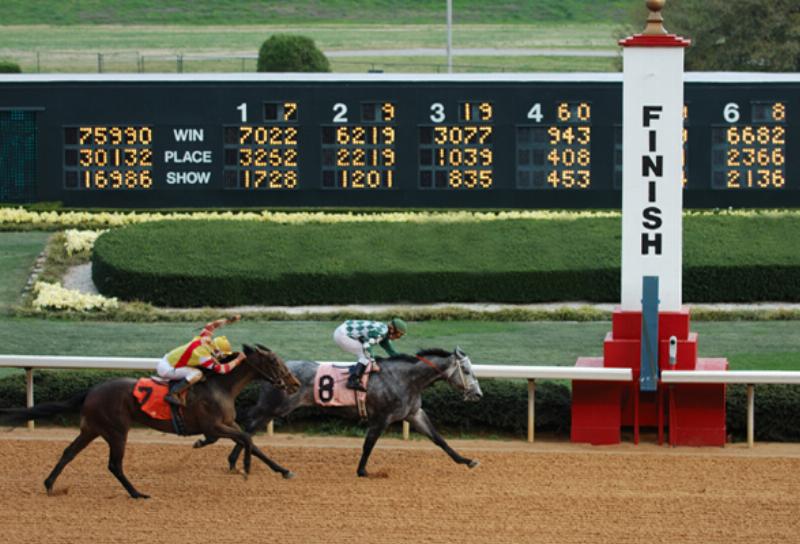 An electronic tote board at a horse racing track showing the odds, pool totals, and probable payouts for an upcoming race
How Odds Reflect Potential Payouts
The odds you see on the tote board are a direct reflection of how much money has been bet on each horse. They are not set by oddsmakers in the same way as in other sports. Instead, they are a real-time calculation of the betting pool.
- Low Odds (e.g., 2-1, 8-5): A lot of money has been bet on this horse relative to the others. This is the favorite. The potential payout is lower.
- High Odds (e.g., 20-1, 50-1): Very little money has been bet on this horse. This is a longshot. The potential payout is much higher.
To get a rough idea of a potential winning payout for a $2 bet, you can use this simple formula:
For odds of A-B (e.g., 5-1), the formula is:
($2 / B) * A + $2 = PayoutExample: For a horse at 5-1 odds, the calculation is
($2 / 1) * 5 + $2 = $12.00.
This calculation is an approximation because the final odds aren’t locked in until the moment the betting windows close.
Understanding Different Bet Types and Their Payouts
The type of bet you place has the biggest impact on your potential payout. Bets are broadly categorized into “straight” wagers and “exotic” wagers. For a deeper look at specific track events, seeing the mahoning horse racing results can provide real-world examples of how different bets paid out.
Straight Wagers: The Foundation of Betting
These are the simplest bets to make and the easiest to understand in terms of payout on horse racing.
- Win: You’re betting your horse will finish in first place. You only collect if it wins.
- Place: Your horse must finish first or second. The payout is lower than a win bet because there are two ways to win, and the pool is split between backers of the first and second-place finishers.
- Show: Your horse must finish first, second, or third. This is the safest bet and therefore has the lowest payout, as the pool is divided among ticket holders for the top three horses.
Exotic Wagers: High Risk, High Reward
Exotic wagers involve betting on multiple horses in a single bet, either in one race or across several races. They are much harder to win, but the payouts can be life-changing.
Single-Race Exotics
- Exacta: You must pick the first and second-place finishers in the exact order.
- Quinella: You pick the first and second-place finishers in any order. The payout is the same regardless of which of your horses wins.
- Trifecta: You must pick the first, second, and third-place finishers in the exact order.
- Superfecta: You must pick the top four finishers in the exact order. The payouts on these can often be in the thousands of dollars for a $1 bet.
The pools for these bets are separate, and because they are so much harder to hit, the winning tickets are split among a tiny fraction of bettors, leading to massive payouts.
According to Dr. Richard Carmichael, a statistician specializing in equine sports, “The allure of the trifecta and superfecta is rooted in combinatorial mathematics. The number of possible outcomes is immense, so when a longshot cracks the top three, it often creates a payout hundreds, if not thousands, of times the original wager by wiping out the majority of tickets.”
Just as you might make strategic los alamitos horse racing picks to cover multiple possibilities, bettors often “box” their exotic wagers. An “exacta box,” for example, means your chosen horses can finish in any order, increasing your chances of winning but also increasing the cost of the ticket.
Factors That Influence the Final Payout
Several dynamic factors can affect the final payout on horse racing, making every race a unique statistical event.
Field Size
The number of horses in a race is a crucial factor.
- Large Fields (10+ horses): More horses mean more possible outcomes and a more diluted betting pool. This generally leads to higher odds and better payouts, especially for exotic wagers.
- Small Fields (5-7 horses): Fewer horses make outcomes more predictable. This often results in a heavy favorite and lower payouts across the board.
The “Smart Money” Effect
Late money from professional gamblers or syndicates can dramatically shift the odds in the final minutes before a race. A horse that was 8-1 might drop to 4-1 just before the gates open. This is why the “probable payout” on the tote board is just an estimate. Watching the odds change can give you insight into where the high-volume bettors are placing their confidence.
Scratches
When a horse is “scratched” (removed) from a race, all the money bet on that horse is refunded. However, for exotic wagers, this can trigger complex rules about “also-rans” or alternate selections, which can alter the structure and final payout of the bet.
For those who enjoy the excitement of live racing, venues like plainridge casino horse racing offer a chance to see these dynamics play out in real-time, where a late scratch can send bettors scrambling back to the windows.
Frequently Asked Questions (FAQ)
What is a good payout for a horse race?
A “good” payout is subjective. For a simple $2 win bet, anything over $10 (4-1 odds) is generally considered a decent return. For exotic bets like a trifecta, a payout in the hundreds of dollars is common, and a “good” one could easily be over $1,000, depending on the odds of the horses involved.
Why did my payout seem lower than the odds suggested?
This is usually due to two factors: the track’s takeout percentage and “breakage.” Breakage is a rounding-down rule where tracks round the final payout to the nearest dime or nickel per dollar. Both of these reduce the total pool of money available to be paid out to winners.
What does it mean when a horse is “odds-on”?
An odds-on favorite is a horse whose odds are less than even money (e.g., 4-5, 1-2). This means you would have to bet $5 to make a $4 profit. It indicates that an overwhelming majority of the betting pool is on that single horse.
How are payouts for Place and Show bets calculated?
It’s more complex than a Win bet. For a Place payout, the place pool (minus takeout) is divided in two. Half is shared among those who bet on the first-place horse to place, and the other half is shared among those who bet on the second-place horse to place. Show bets are even more complex, with the pool split three ways.
Can you lose money on a winning bet?
Yes, in a rare scenario called a “minus pool.” This happens when a huge amount of money is bet on one horse to Show, often in a small field. If that horse finishes in the top three, the track is legally obligated to pay a minimum payout (usually $2.10 or $2.20 for a $2 bet). If the calculated payout is less than this minimum, the track has to pay the difference out of its own pocket, resulting in a loss for them but a (very small) profit for the bettor. This can be seen at various tracks, from small circuits to major ones like golden gate horse racing.
Conclusion: Betting Smarter
Understanding the payout on horse racing transforms wagering from a game of chance into a game of strategy. By grasping the pari-mutuel system, the meaning behind the odds, and the payout potential of different bet types, you empower yourself to make more informed decisions. You learn to spot value, weigh risk against reward, and appreciate the complex interplay of money and probability that makes horse racing so compelling. The next time you’re at the track, look at the tote board not just as a list of numbers, but as a map to potential winnings, waiting to be decoded.
