
The American Paint Horse embodies a vibrant piece of American Western heritage, evoking a sense of simpler times and the allure of open spaces. These uniquely colored equines offer a living connection to the roots of the American West, providing an opportunity to explore its history on the back of a distinctive and living legend.
The origins of the Paint Horse in North America trace back to the two-toned horses brought by Spanish explorers, with ancestry rooted in North African and Asian Minor breeds. Over time, some of these colorful horses escaped, forming wild herds on the Great Plains. Gentled and captured, they became integral to the lives of Native Americans and cowboys, participating in buffalo hunts and cattle drives. Their hardiness and striking coloration made them highly sought after by the finest horsemen of the Western frontier. Over generations, selective breeding enhanced their conformation and athletic abilities, solidifying the unique coat patterns that define the American Paint Horse. Today, their stock-type conformation, intelligence, and willing nature make them ideal partners for a wide range of equestrian activities, from pleasure riding and showing to ranching, racing, rodeo, and trail riding, as well as being cherished companions for children.
A Distinctive Blend of Color and Conformation
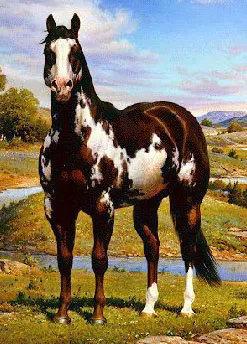 A brown and white Paint horse portrait standing on a grassy hill and stream in the background.While the characteristic colorful coat pattern is fundamental to the American Paint Horse’s identity, the breed also adheres to strict bloodline requirements and possesses a distinctive body type. To be eligible for registry, a Paint Horse must have documented lineage from stock registered with the American Paint Horse Association (APHA), the American Quarter Horse Association (AQHA), or The Jockey Club (Thoroughbreds). This results in an intelligent, stock-type horse renowned for its versatility, power, athleticism, and unparalleled beauty. American Paint Horses are typically stockier and more powerfully muscled compared to some other light horse breeds. Although generally short-coupled with strong bone structure and good balance, they also exhibit a notable refinement and beauty, particularly in their head and neck.
The distinguishing feature of the American Paint Horse lies in its color patterns, which set it apart from other stock-type breeds. Each horse displays a unique combination of white markings across a base coat of any color within the equine spectrum, including black, bay, brown, chestnut, dun, grullo, sorrel, palomino, gray, or roan.
Understanding “Paint” vs. “Pinto”: A Matter of Bloodlines
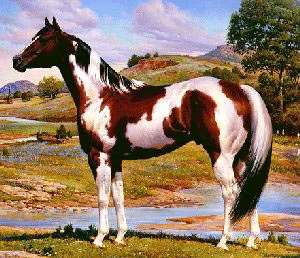 A side view of a brown and white Paint horse in front of mountains.Confusion often arises between the terms “Paint” and “Pinto” when describing horses with light and dark coat patterns. However, these terms have distinct meanings. The Pinto Horse Association serves as a color registry, accepting horses of any breed exhibiting Pinto coloring. In contrast, American Paint Horses are registered with the APHA and must demonstrate parentage from one of the three approved registries (AQHA, TB, or APHA), in addition to meeting minimum color requirements. A horse with striking coloration could potentially be dual-registered if it met the breed standards of both registries, but the two organizations operate independently.
For registration and breeding purposes, American Paint Horses are classified based on their specific color patterns. The tobiano pattern is characterized by head markings resembling those of a solid-colored horse; their heads can be solid or feature a blaze, stripe, star, or snip. Typically, all four tobiano legs are white, at least from the knees and hocks downward. Their spots are generally regular, oval, or round, extending down the neck and chest in a shield-like fashion. Tobianos often exhibit dark coloration on one or both flanks, though they can be predominantly dark or white. The tail is frequently bicolored.
The overo pattern, conversely, can also be predominantly dark or white. However, the white markings on an overo usually do not cross the horse’s back between the withers and the tail. Generally, one or all four legs will be dark. Overos are also noted for bold white head markings, such as a bald face, and their markings are typically irregular and scattered. The horse’s tail is usually a single color.
Recognizing that not all coat patterns fit neatly into these two categories, the APHA expanded its classifications to include “tovero” to describe horses exhibiting characteristics of both tobiano and overo patterns.
An Association Reflecting Its Members
The American Paint Stock Horse Association was established in 1962 by individuals passionate about the abilities of the Western stock-type horse and the unique color patterns of the American Paint. The organization has experienced significant growth, expanding from an initial registry of 3,800 horses to a global population exceeding a quarter of a million. With over 25,000 foals registered annually, the APHA stands as the third-largest equine registry in the United States based on foal registrations.
While the APHA’s primary focus is pedigree recording, the association is also committed to promoting the history, breeding, training, showing, racing, sales, and overall enjoyment of American Paint Horses. The core of the APHA lies in its members, whose interests and love for the breed shape the association’s mission and sponsored programs. Consequently, the APHA offers programs catering to all levels of interest and skill. For those seeking competition, whether youth, amateur, or professional, teaming up with a natural athlete offers opportunities from local shows to world championships. For leisure riders, the “Ride America” program encourages exploration on Paint horses, complemented by an annual APHA-sponsored trail ride. Those aiming for advanced performance levels in disciplines like eventing or team penning will find a Paint horse capable of reaching those goals. The association also features the Outside Competitive Activities Program to acknowledge achievements in these areas.
References
American Paint Horse Association, P.O. Box 961023, Fort Worth, TX 76161-0023
Phone: (817) 834-2742
