
As winter’s chill sets in, a fascinating natural phenomenon begins: owl nesting season. Both the Barred Owl and the Great Horned Owl are embarking on their crucial domestic duties during these colder months. Males typically select a nesting site by January, and despite the frost, eggs are laid through March. This timing is strategic, allowing the owlets ample time to develop before the arrival of spring. Let’s explore the intriguing world of these nocturnal hunters and their remarkable nesting habits.
Understanding Barred and Great Horned Owls
Barred Owls are slightly smaller than Great Horned Owls and are distinguished by their attractive white-and-brown striped plumage. These owls are known for their active hunting during daylight hours in February and March, providing sustenance for incubating females. Their calls, often heard in the early morning and at night, are a classic forest sound: “Who cooks for you? Who cooks for you all?” Remarkably, they can navigate through the air with an almost silent flight, often surprising those nearby.
The Great Horned Owl, on the other hand, represents a significant predatory threat to the Barred Owl. While both species often share the same habitats, Barred Owls tend to relocate within their territory when a Great Horned Owl is present. Barred Owls are not migratory and generally remain within a few miles of their established mating grounds.
The Art of Owl Nesting
Neither the Barred Owl nor the Great Horned Owl typically constructs its own nest from scratch. Instead, they prefer to repurpose old nests built by other animals, refurbishing them with materials like bark, feathers, animal fur, and leaves. By the end of a nesting season, these once elaborate structures often degrade into a simple collection of sticks. It’s important to remember that owls become highly territorial when nesting. Any owl that swoops near you is likely focused on protecting its mating and nesting site and will attempt to drive away intruders with loud hoots.
The Great Horned Owl commonly utilizes tree nests abandoned by other birds, such as hawks, crows, squirrels, and Great Blue Herons. They are also adaptable and will occupy tree cavities, the snags of broken trees, wooden platforms, and sometimes even structures like buildings or barns. The nest of a Red-tailed Hawk is a frequent choice.
Barred Owls often favor natural cavities found in trees, typically at heights of 20 to 40 feet. They may also inhabit stick platform nests constructed by other animals like hawks, crows, ravens, and squirrels, or utilize human-made nest boxes.
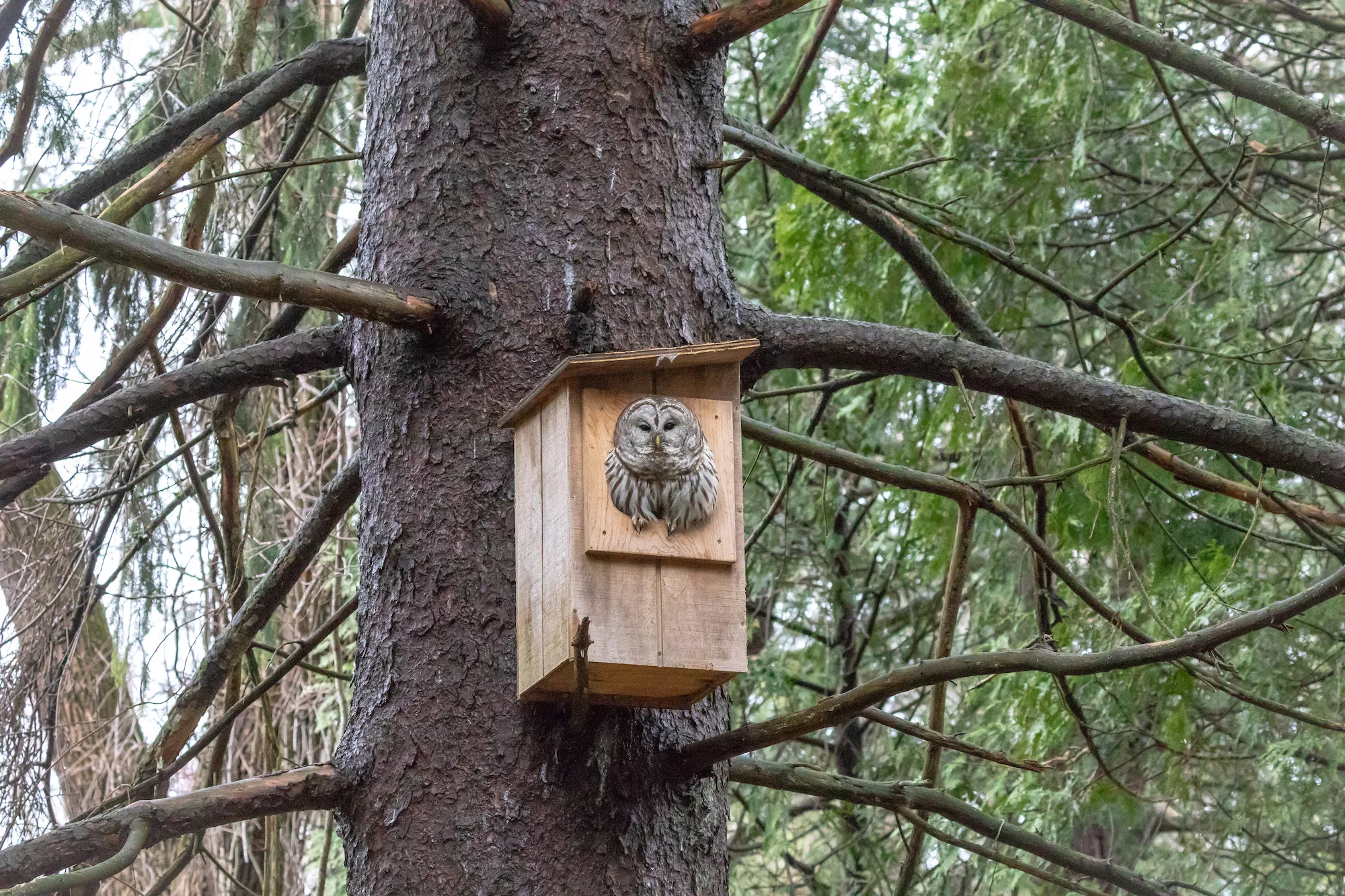 Barred Owl House *A Barred Owl house, designed to attract breeding pairs. Credit: Michael Kralik.*
Consider installing a nest box to encourage a breeding pair to settle in your area. It’s advisable to place the box well before the breeding season, which usually begins in late winter or early spring. Attaching a predator guard can help protect the eggs and young from being raided.
A Glimpse into Barred Owl Nest Livestream
Michael Kalik of Ridgefield, Connecticut, experienced the rewarding outcome of his patience when a pair of Barred Owls began showing interest in an online-purchased owl house. After five years of other creatures inhabiting the box, his dedication paid off. In a typical year, adult Barred Owls start scouting nesting locations in January and February. The female usually lays her eggs in early March, with the owlets emerging in April and May. Michael describes the experience of observing the owls hunt and deliver a variety of food—from worms and snakes to turtles, chipmunks, and squirrels—to their young as truly amazing.
The Process of Egg Laying and Incubation
For both the Great Horned Owl and the Barred Owl, the nesting process typically involves laying 2 to 3 eggs, with intervals of two to four days between each. Female owls possess a remarkable ability to incubate eggs even in temperatures as low as -35°F (-37°C). Anecdotal evidence suggests eggs can withstand temperatures of -25°F (-31°C) for up to 20 minutes if the female briefly leaves the nest.
The incubation period lasts approximately 33 days. During this time, the female diligently incubates the eggs, while the male actively hunts and brings food back to the nest. For Great Horned Owls, skunk is a preferred prey item, which is why a skunk-like odor might be noticeable near their nests. Barred Owls, conversely, tend to favor mice and smaller birds.
Owls are equipped with thick feathers, covering even their legs and feet, to keep their young warm. Newly hatched owlets are also covered in a layer of fluffy down for insulation. This early nesting strategy allows the young owls sufficient time to hone their hunting skills before the onset of the next winter. However, in years with scarce populations of mice or squirrels, many eggs may not hatch, and a significant number of young owls may not survive.
Interestingly, approximately every third year, female owls may forgo egg-laying, seemingly deciding that a rest from motherhood is necessary.
Nurturing the Owlets
Young owls experience rapid growth, increasing their weight from about 35 grams (0.77 lbs.) at birth to approximately 1000 grams (2.2 lbs.) for females and 800 grams (1.76 lbs.) for males in less than a month (25 days). Within about 40 days, they are ready to leave the nest and begin their independent lives.
While still in the nest, the mother owl meticulously tears food into small, manageable pieces to feed her owlets. She hunts throughout the day, with peak activity often occurring at dusk. She is a patient hunter, capable of waiting for hours to catch her prey before gliding silently through the air to secure it.
Fortunately, if an adult owl perishes, the remaining parent is usually capable of successfully raising the young on its own. By seven weeks of age, young owls are already developing the ability for short flights.
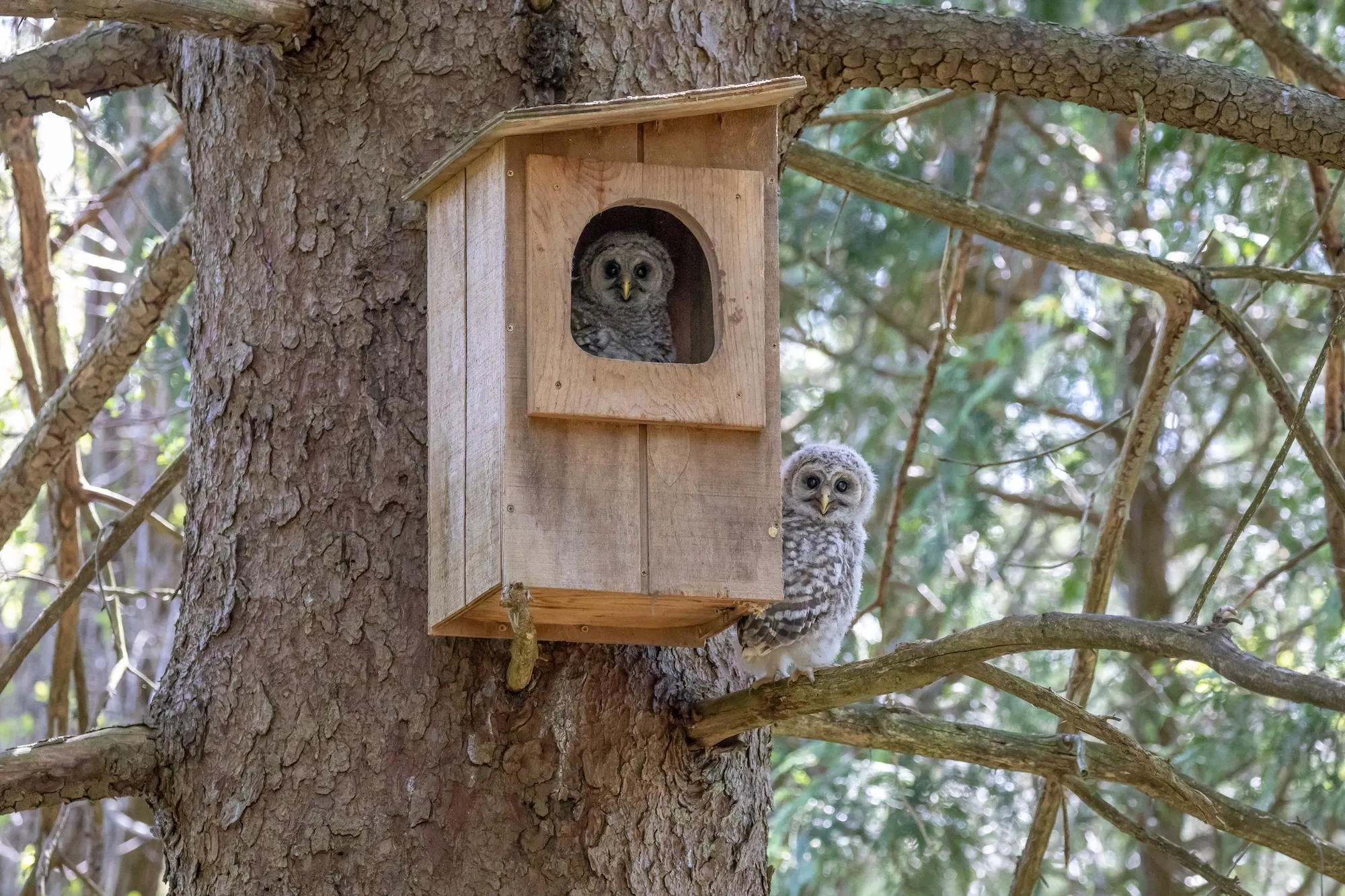 Barred Owlets *Young Barred Owls learning to fly. Credit: Michael Kralik.*
By late October and November, driven by their adult counterparts, young owls depart from their natal territories to embark on their own life journeys.
→ Discover More Fascinating Facts About Owls.
