
Every dog owner knows the frustration of unexpected indoor “accidents.” Whether it’s a puppy still learning the ropes or an older dog reacting to a sudden downpour, house training challenges can quickly put a beloved pet, metaphorically, “out of the dog house” with their human companions. At Dog Care Story, we believe that understanding the roots of dog training can provide valuable insights into effective modern practices. We’ve delved into historical texts to see how dog owners and experts approached what we now call Out Of The Dog House Training, revealing timeless principles alongside outdated methods. Join us on a journey through time to uncover lessons on canine cleanliness from the 19th and early 20th centuries.
Early Perspectives: Francis Butler’s 1865 Insights
One of the earliest comprehensive guides to dog care in America, Francis Butler’s Breeding, Training, Management, Diseases, Etc. of Dogs, published in 1865, offers a fascinating glimpse into Victorian-era house training philosophy. Butler’s advice, while reflecting the societal norms of his time, contains surprisingly “fair-minded” principles that resonate even today. He emphasized that dogs, particularly those kept indoors, require regular exercise after meals, as this is when they typically need to relieve themselves. A well-exercised dog, he noted, “will seldom even dirt around his kennel, and a healthy house-pet is rarely troublesome, except after eating.”
The most striking aspect of Butler’s guidance on addressing indoor soiling was the insistence on immediate correction. He stated, “It is important to catch him in the act, and administer summary chastisement.” While the suggested punishment of being “sufficiently twigged” and “unceremoniously scolded into the yard” is unacceptable by modern standards of humane training, the underlying principle of timing is profound. Butler believed that punishment was only justly administered if the animal had “a fair opportunity of avoiding it” and was caught in the very moment of infringement. This highlights an early understanding that dogs associate consequences with immediate actions, a concept still central to effective dog training. Even for young puppies, who “are incapable of self-restraint,” Butler advocated gentle correction and early initiation into cleanliness habits. This foundation of setting expectations and providing opportunities for success is key to keeping your dog “out of the dog house” and maintaining a happy household. Beyond basic manners, teaching your dog fun tricks to do with your dog can also strengthen your bond and improve overall obedience.
The Humorous Side of Canine Misbehavior: A 1907 Postcard’s Tale
Moving into the early 20th century, cultural attitudes towards dog behavior are often reflected in popular media. A 1907 comic postcard by publisher Robert McCrum, titled “Now They’ll Blame Me for This!”, humorously captures a common scenario. The image depicts a family dog looking worriedly at a puddle left by an improperly stored umbrella, seemingly fearing punishment for something it didn’t do. The implication is clear: this dog has likely made similar puddles in the past, and its owners have punished it after the fact.
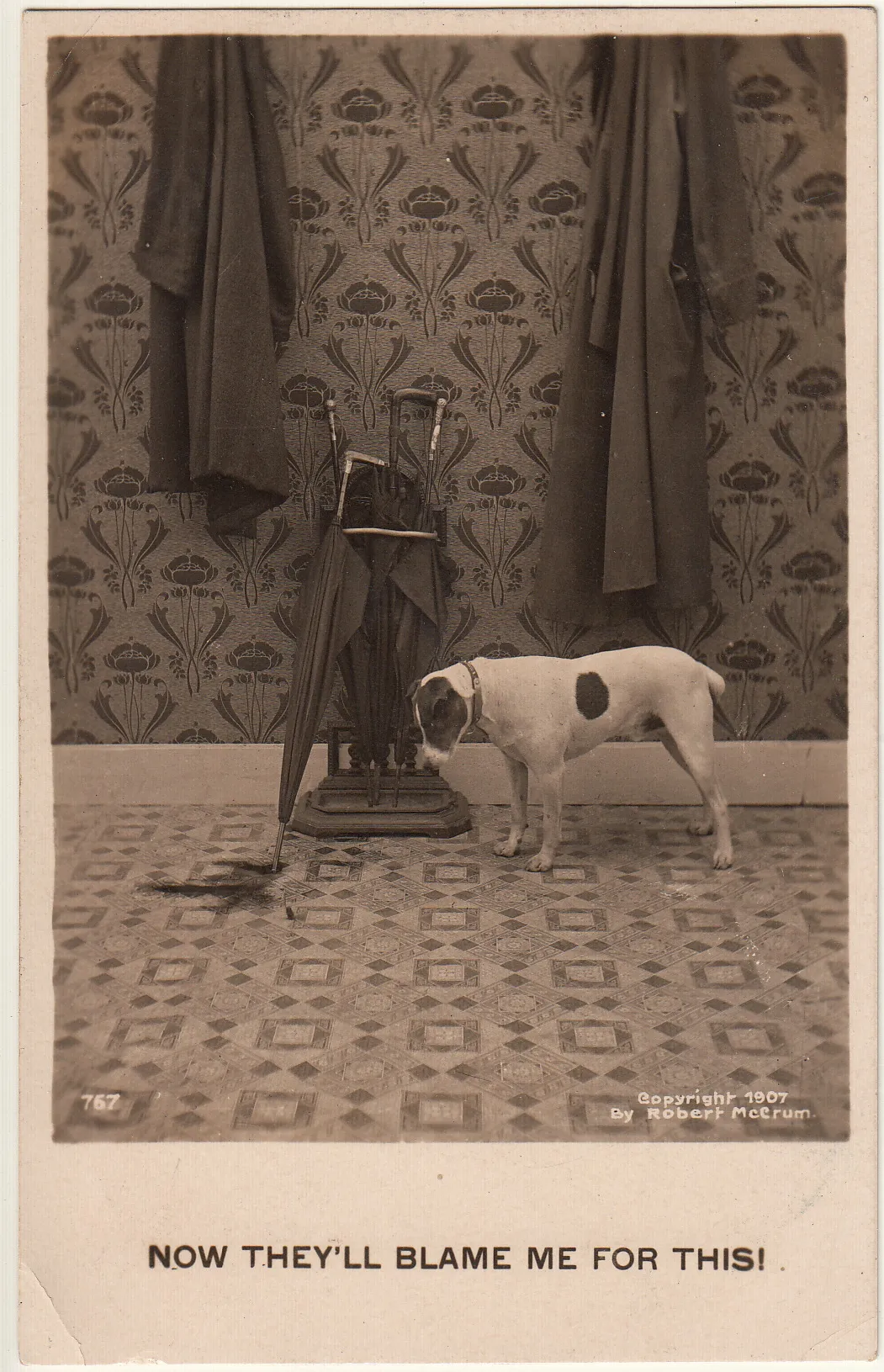 1907 comic postcard of a dog worrying about blame for an indoor puddle, illustrating common dog house training challenges
This postcard serves as a poignant reminder of a critical element in out of the dog house training: the danger of punishing a dog for past transgressions. Dogs live in the moment, and punishment delivered even minutes after an “accident” is ineffective and can lead to anxiety and confusion, rather than preventing future incidents. The postcard’s humor relied on owners recognizing their own dogs’ behaviors and their own often-misguided reactions, demonstrating that the challenge of proper timing in dog training has long been understood. Understanding canine communication and avoiding punitive measures after the fact is essential for a trusting relationship. For further insights into addressing specific behavioral issues, you might explore resources on things you can train your dog to do effectively.
Dr. Spaulding’s 1921 Advice for City Dogs
As cities grew and apartment living became more common, the challenges of house training adapted. Dr. Roy H. Spaulding, a resident veterinarian at the New York Women’s League for Animals, addressed these concerns in his 1921 book, Your Dog and Your Cat: How to Care for Them. His advice was tailored for city dwellers, emphasizing the necessity of teaching a puppy “where he is to clean himself, for they have no other way of knowing.”
Spaulding recommended providing a designated “pan of sawdust or newspaper” in apartments, ensuring it was always accessible and kept in the same location. He advised taking a new puppy directly to this spot upon arrival and keeping it there until it used the area. The soiled paper or sawdust was then left to attract the puppy by scent, encouraging repeated use. This method, a precursor to modern “wee-wee pads,” highlights the importance of consistency, scent cues, and designated areas in indoor house training. Regarding mistakes, Spaulding acknowledged that a puppy “is bound to misbehave,” but insisted that correction, which involved “severely scold[ing]” the dog, must be “associated with the misbehavior.” This again underscores the importance of immediate, contextual feedback. While the methods and severity of correction have evolved significantly, the principles of clear communication, designated areas, and consistent routine remain pillars of successful house training today, helping dog owners keep their pets firmly “in the good books.” Addressing behavior effectively extends to managing excitement, such as learning how to stop your dog from jumping up on people.
Enduring Principles for Modern “Out of the Dog House Training”
Analyzing these historical perspectives reveals enduring principles that are still foundational to effective “out of the dog house training.” The need for consistency, providing ample opportunities for appropriate elimination, and the crucial timing of feedback (whether positive reinforcement or correction) have been recognized for centuries. While the physical punishments of the past, like “twigging” or “severe scolding,” are thankfully replaced by humane, positive reinforcement methods today, the core understanding of canine learning remains. We now know that rewarding desired behaviors is far more effective and builds a stronger bond than punishing mistakes. Modern out of the dog house training focuses on prevention, supervision, regular potty breaks, and positive reinforcement to guide dogs toward acceptable elimination habits. This not only resolves house soiling but also fosters a happier, more confident dog and a harmonious home environment. If your dog struggles with specific unwanted behaviors, learning how to teach my dog not to jump up offers further guidance.
Conclusion
The journey through historical dog care literature illustrates that while tools and techniques evolve, the underlying challenges and desired outcomes of house training remain remarkably constant. From Francis Butler’s emphasis on timing to Dr. Spaulding’s urban-dog solutions, the goal has always been to integrate dogs harmoniously into human households, preventing them from being “out of the dog house” due to undesirable behaviors. Today, our understanding of canine psychology and humane training methods has advanced considerably, allowing us to build on these historical foundations with empathy and effectiveness. By applying consistent, positive reinforcement strategies, and ensuring our dogs have every opportunity to succeed, we can prevent accidents and foster a lifelong bond built on trust and mutual understanding. Embrace modern training techniques to ensure your furry friend always has a comfortable, well-deserved spot within your home and heart.
References
- Butler, Francis. Breeding, Training, Management, Diseases, Etc. of Dogs. 3rd ed., New York City, 1865.
- McCrum, Robert. “Now They’ll Blame Me for This!” Photographic postcard, 1907.
- Spaulding, Roy H. Your Dog and Your Cat: How to Care for Them. D. Appleton and Company, New York, 1921.
