
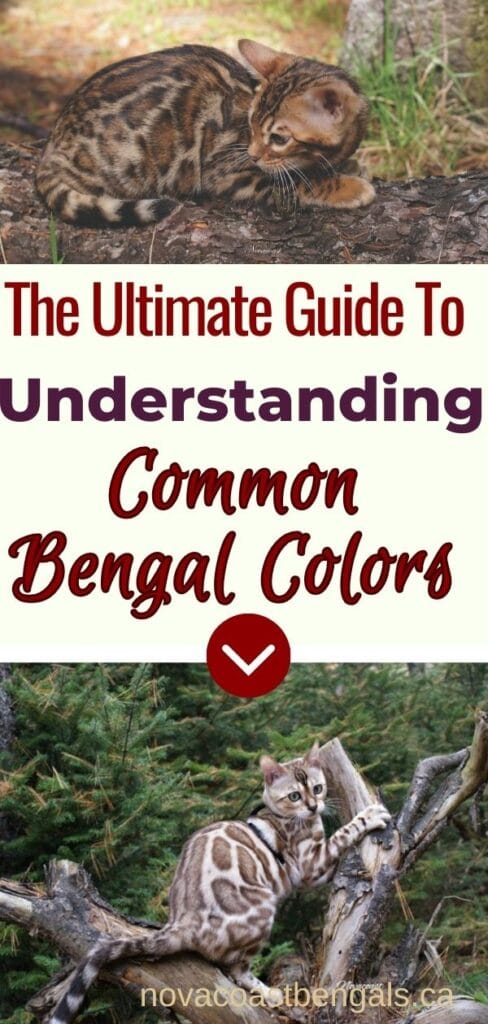
Bengal cats are renowned for their striking resemblance to wild leopards, and their diverse coat colors and patterns are a significant part of their allure. From rich browns and exotic silvers to elusive snow and charcoal shades, the Bengal breed offers a stunning spectrum of appearances. This guide delves into the recognized and non-recognized colors, patterns, and unique coat characteristics that make Bengal cats so captivating.
The International Cat Association (TICA) recognizes several Bengal cat colors, broadly categorized into standard and non-standard. The standard colors include Brown, Snow, and Silver. Non-standard, though equally beautiful, colors are Charcoal, Blue, and Melanistic (Solid Black). However, the complexity of Bengal cat aesthetics extends far beyond these basic classifications, with the crucial element being the high degree of contrast in their patterns, regardless of the specific color.
The Richness of the Brown Bengal Cat
The Brown Bengal cat, genetically represented by C,C color genes, is the most popular and was the first recognized by TICA in 1983. These cats typically sport green or gold eyes. Their ground color can vary widely, from a subtle gray-tawny to a vibrant orange-gold. The markings, which can be spots, rosettes, or marbling, range in color from black and light brown to deeper, reddish-brown hues. Brown Bengals encompass a vast array of shades, including Golden, Cream, Tawny, Honey, Taupe, Tan, Beige, Caramel, and Cinnamon. While all shades are accepted, an orange-brown ground color is often preferred. Key characteristics of a Brown Bengal include markings from brown to jet black, a black-tipped tail, a red nose, and eyes that can be brown, copper, gold, green, or hazel. A preferred trait is a white belly.
The Allure of the Snow Bengal Cat
For those drawn to the mystique of a mini snow leopard, the Snow Bengal cat is an exceptional choice. These cats exhibit cream, ivory, and white colorations, stemming from Siamese and Burmese ancestry, a form of albinism. Contrary to popular belief, they are not pure white. Snow Bengals present in three genetically distinct varieties, each with unique characteristics: Seal Lynx, Seal Mink, and Seal Sepia. Differentiating between these can be challenging without genetic testing, though eye color offers a reliable clue.
A Snow Seal Lynx Bengal (Cs, Cs color genes) typically has a very light, white cream coat with dark or light seal markings and a dark seal brown tail tip. Their most distinctive feature is their blue eyes, which are always present.
The Snow Seal Mink Bengal (Cb,Cs color genes) possesses an ivory, cream, or light tan base coat, with markings in various shades of seal mink to dark seal mink. They also have a dark seal brown tail tip and exhibit blue-green or aqua eyes.
A Snow Seal Sepia Bengal (Cb, Cb color genes) shares the ivory, cream, or light tan base coat with the Mink variety. However, their markings are in shades of seal sepia to dark seal sepia, and they are distinguished by having green or gold eyes, along with a dark seal brown tail tip.
The Elegance of the Silver Bengal Cat
The Silver Bengal, recognized by TICA in 2004, is characterized by the presence of the inhibitor gene (I, i or I,I), which suppresses warm colors, resulting in a nearly white base coat dramatically contrasted by dark markings. The silver coat can range in shade from pure white to a deep steel color. Silver Bengals can also be found in combination with other color classes, such as Silver Snow, Silver Charcoal, and Blue Silver. Ideal silver Bengals exhibit minimal tarnish (yellowish or rusty brown hues), with markings ranging from dark gray to jet black. They typically have a black-tipped tail, a brick-red nose, and green or golden eyes.
The Exotic Appeal of the Charcoal Bengal Cat
The Charcoal Bengal (Apb, a or Apb,Apb agouti genes) presents a darker, more intense coloration than the traditional recognized Bengal colors. This deep, smoky charcoal hue was particularly prominent in early generations of the breed. The charcoal trait is inherited independently and can manifest across all color classes, including brown, silver, and snow Bengals (resulting in Lynx Charcoal, Mink Charcoal, and Sepia Charcoal). These cats often feature a dark grayish-brown or carbon-colored background with minimal to no reddish-brown (rufous) tones and strikingly dark spotted or marbled patterns. A characteristic often seen in Charcoals is a darker facial “mask” and a pronounced dorsal stripe, sometimes referred to as a “Zorro cape and mask.” This mask can be so dark that it merges with the dark body markings. The tail is typically dark brown, black, or grayish-black with stripes and a black tip. Charcoal Browns and Silvers may display “ghost markings” on a black body, which can be mistaken for solid colors. Solid black Bengals are known as “melanistics,” and solid silvers are termed “silver smoke.”
The Rarity of the Blue Bengal Cat
The Blue Bengal cat, a result of the d,d dilute gene, is a rare but increasingly sought-after variety. Breeders are actively working to gain championship status for this color. Blue Bengals feature a powder blue or gray coat with subtle cream undertones. Their spotted or marbled patterns appear in dark blue or metallic gray. As a recessive gene, both parents must carry the blue gene for a kitten to exhibit this coloration. Blue Bengals typically have a steely blue ground color with peachy undertones, dark blue markings that do not turn black, a dark gray tail tip, and eyes that can be gold, green, or hazel.
The Mystery of the Black (Melanistic) Bengal Cat
Solid black Bengals, influenced by the a,a agouti genes, exhibit black patterns against a black ground color, reminiscent of the melanistic variants of leopards and jaguars, commonly known as black panthers. The background and pattern colors are identical, with patterns often appearing as barely visible “ghost markings” or “ghost spots” that become apparent in natural sunlight, much like on a black panther. Black Bengals are rare and less commonly bred, as this color variation is not approved by major cat associations. The markings can range from faint dark brown to black and are sometimes only discernible in direct sunlight. A “smoke Bengal” is the silver counterpart to a melanistic Bengal. For those seeking a mini black panther, this Bengal color is the ultimate choice.
Understanding Patina and Ticking
Patina and ticking are two distinct coat characteristics that can influence a Bengal cat’s appearance. Patina refers to black or dark-tipped hairs that subtly blur the underlying pattern, extending from the shoulders down the back. Ticking, on the other hand, affects the entire coat, making it appear less defined due to a lack of contrast. This effect is caused by multi-colored hair shafts, giving the fur a “faded” or less bold look.
The Magical “Glitter” Effect
The “Glitter” is a unique and magical characteristic of Bengal cats, making them the first domestic cat breed to exhibit this trait. Not all Bengals possess it, but when present, it manifests as a shimmering, sparkling effect on the coat that is visible even in low light. This phenomenon is caused by translucent, hollow hair shafts that catch and reflect light, creating a dazzling sheen across the fur. The glitter effect adds an extra layer of enchantment to an already mesmerizing breed.
All information has been taken from https://www.bengalcats.co/.
