
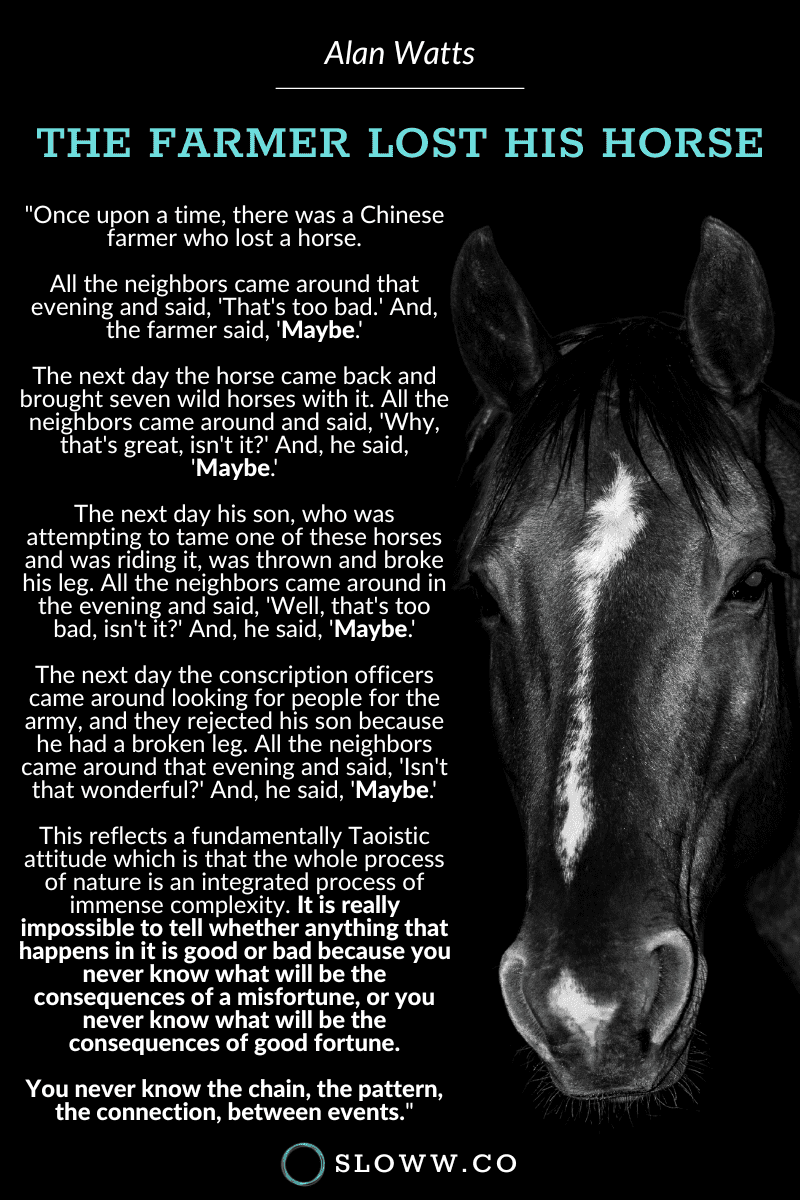
There’s a timeless tale that circulates through communities, a simple story about an old man and his horse that’s often used to illustrate the power of perspective. It’s a narrative that, while seemingly about a lost animal, delves into the deeper human condition and our tendency to immediately label events as good or bad. This story, in its many variations, serves as a profound reminder that what we perceive as misfortune can, in time, reveal itself to be a blessing, and vice versa. The core of this narrative centers around an old man who lives a humble life, his most prized possession being his loyal horse. This is not just any horse; it’s his companion, his mode of transport, and for many years, the backbone of his livelihood.
One morning, the unthinkable happens: the old man discovers his horse is gone. His neighbors, witnessing his distress, gather around to offer their sympathies. “This is terrible news!” they exclaim. “Losing your horse is such a misfortune! You must be devastated.” They lament his bad luck, convinced that this event will bring hardship and sorrow. The old man, however, with a quiet wisdom that has perhaps been honed by years of experience, simply shrugs and says, “Perhaps.” He doesn’t deny the loss, but he refrains from labeling it as purely negative. His stoicism is often misunderstood by those around him, who are quick to judge the situation based on immediate appearances.
Weeks turn into months, and the old man continues his life without his horse, his quiet demeanor remaining unchanged. Then, one evening, a commotion is heard. The missing horse returns, but it’s not alone. It trots back into the stable, leading with it a magnificent wild stallion. The neighbors, upon hearing the news, rush back to the old man’s home, their initial sympathy replaced by awe and excitement. “This is incredible!” they shout. “Your horse has returned, and with a wild stallion! This is such good fortune! You are a truly lucky man!” They celebrate his apparent windfall, envisioning the possibilities the new horse brings. Again, the old man, with his characteristic calm, simply offers, “Perhaps.” He acknowledges the return of his horse and the arrival of the stallion, but he remains reserved, not getting carried away by the sudden turn of events.
This newfound possession, however, does not bring the unadulterated joy the neighbors anticipate. The wild stallion, while magnificent, is untamed and difficult to handle. A few weeks later, while attempting to train the stallion, the old man’s son takes a fall and breaks his leg. The neighbors are back, their faces etched with concern. “Oh, this is truly awful!” they say. “Your son is injured because of that wild horse! Such terrible luck has befallen you. We feel so sorry for you.” The cycle of judgment and sympathy continues. The old man, observing his son’s recovery, merely states, “Perhaps.” He sees the injury, but he also sees that his son is alive and with him, which might not have been the case if he had been away, perhaps in a distant war.
The story often continues with further twists, illustrating the unpredictable nature of life. In some versions, a war breaks out, and all the young men in the village are conscripted into the army. The old man’s son, however, is unable to join the fight due to his broken leg. The neighbors, who were initially sympathetic about the injury, now see it in a different light. “Thank goodness your son’s leg is broken!” they exclaim. “He is safe at home, while all our sons have gone to war, where they may never return.” The very misfortune they had pitied has, in fact, saved his son’s life.
The enduring power of this narrative, often referred to as “The Old Man and His Horse,” lies in its profound simplicity and its ability to teach a valuable lesson about human perception. It suggests that we often make snap judgments, labeling events as unequivocally good or bad based on our limited understanding and immediate emotional responses. The old man’s consistent “Perhaps” is not a sign of indifference, but a deep-seated recognition that life is a complex tapestry of interconnected events, where the threads of fortune and misfortune are often intertwined in ways we cannot foresee.
This story resonates deeply because it mirrors our own experiences. How many times have we faced a setback, only to later realize it opened a door to a new, perhaps even better, opportunity? Conversely, how often has a stroke of apparent good luck led us down a path that ultimately brought challenges? The tale encourages us to pause before passing judgment, to consider the long game, and to cultivate a more balanced and resilient perspective on the inevitable ups and downs of life. It reminds us that true wisdom lies not in predicting the future, but in accepting the present with equanimity, understanding that even the most difficult circumstances can hold hidden blessings.
The narrative also subtly critiques our societal tendency to project our own anxieties and interpretations onto others. The neighbors, in their eagerness to label events, represent a common human reaction – the need to categorize and understand the world in simple, black-and-white terms. The old man, in contrast, embodies a more evolved understanding, one that acknowledges ambiguity and trusts in the unfolding of events. His quiet acceptance allows him to navigate life’s uncertainties with a grace that eludes his more excitable, judgmental neighbors.
Ultimately, the story of the old man and his horse is more than just a parable; it’s a mindfulness exercise. It prompts us to question our initial reactions, to challenge our assumptions, and to cultivate a sense of inner peace regardless of external circumstances. It’s a call to embrace the unknown, to trust the process, and to understand that sometimes, the greatest fortune lies in refraining from labeling anything as definitively “good” or “bad” until the full story unfolds. This narrative, with its simple yet profound message, continues to offer solace and wisdom to those who seek to understand the intricate dance of fate and fortune in their own lives. It’s a story that, like a well-loved companion, bears repeating, each time offering a fresh layer of insight into the human experience.
