
Ensuring your cat receives optimal nutrition is paramount for their overall health and happiness. A well-balanced diet provides the necessary components for growth, bodily maintenance, activity levels, and recovery from illness or injury. For devoted pet parents, understanding the intricacies of feline nutrition is key to selecting the best cat food. This comprehensive guide breaks down the essential nutrients that form the foundation of a healthy cat’s diet.
The Six Essential Nutrient Categories for Cats
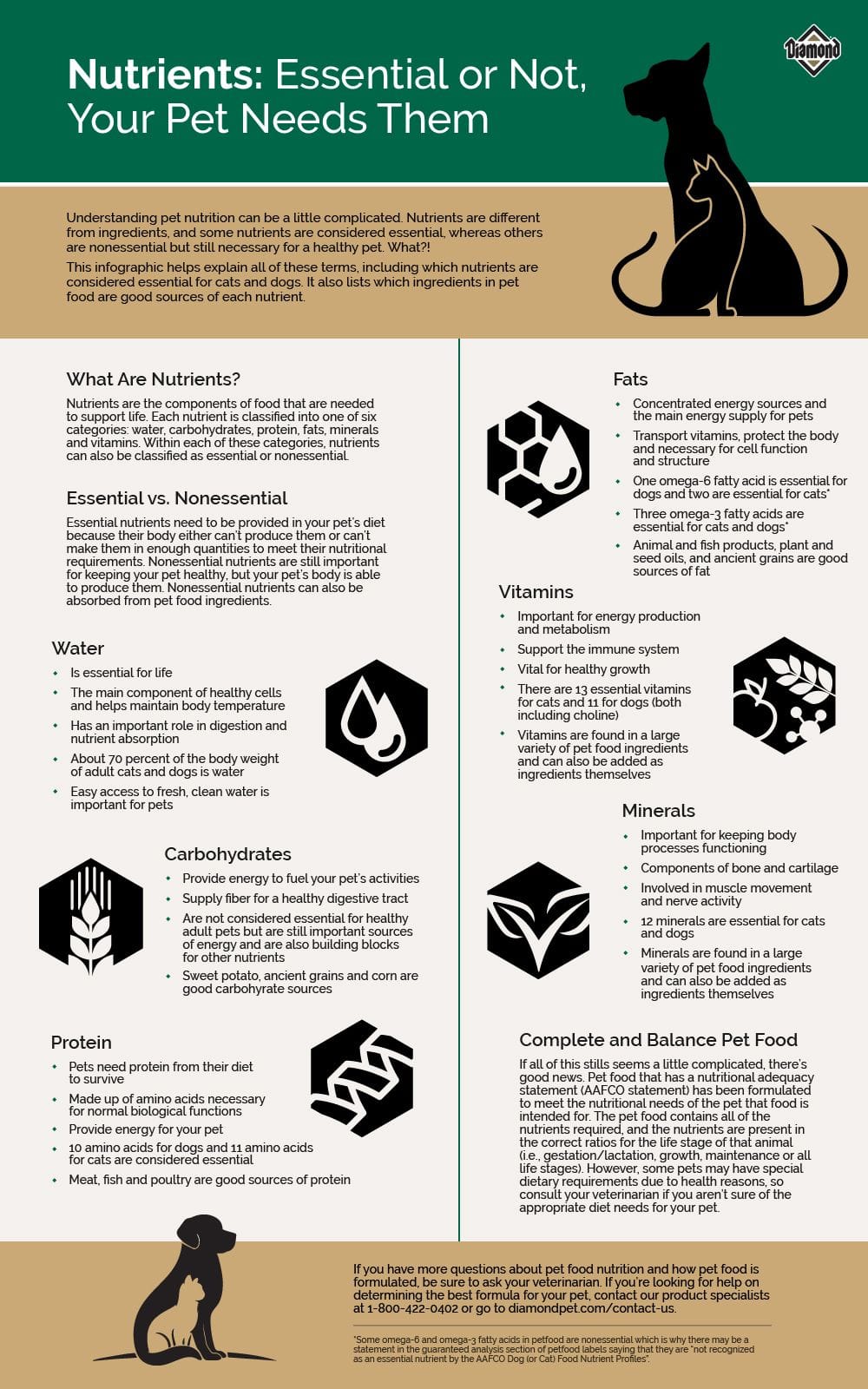
Nutrients are the vital elements within a cat’s diet that fulfill specific bodily functions. Cats can obtain these essential nutrients from a diverse range of ingredients. For instance, calcium, a critical nutrient, can be sourced from ingredients such as bone, bone meal, dairy products, organ tissues, meat, legumes, and mineral supplements.
These essential nutrients are broadly categorized into six main groups:
- Protein
- Fat
- Carbohydrate
- Vitamin
- Mineral
- Water
While energy itself isn’t classified as a nutrient, it plays a crucial role in a cat’s diet. Dietary energy, measured in kilocalories (calories), is derived from fats, proteins, and carbohydrates.
Ensuring Complete and Balanced Nutrition with Commercial Cat Food
The simplest method to guarantee your cat receives all the necessary nutrients is to exclusively choose cat foods that feature an Association of American Feed Control Officials (AAFCO) statement of nutritional adequacy on their packaging.
Look for one of the following statements on the product label:
- “Animal feeding tests using AAFCO procedures substantiate that [Product Name] provides complete and balanced nutrition for adult maintenance, growth and reproduction, or all life stages.”
- “[Product Name] is formulated to meet the nutritional levels established by the AAFCO Cat Food Nutrient Profiles for adult maintenance, growth and reproduction, or all life stages.”
Understanding the specific roles of these nutrients will further empower you to make informed dietary choices for your feline companion.
The Crucial Role of Protein in a Cat’s Diet
Cats are obligate carnivores, meaning their diet must be rich in protein compared to many other animals. Dietary protein is fundamental for developing and maintaining muscles, skin, fur, nails, tendons, ligaments, cartilage, enzymes, hormones, antibodies, and numerous other bodily structures. Furthermore, protein serves as a significant energy source for cats.
Animal Protein: The Preferred Source for Cats
Cats require animal-based protein because their bodies depend on the unique nutrients it provides. When a cat consumes protein, their digestive system breaks it down into amino acids, which are then reassembled to create the specific proteins the cat needs at any given time. While a cat’s body can synthesize many of the amino acids it requires (nonessential amino acids), there are 11 essential amino acids that cats cannot produce and must obtain from their diet:
- Arginine
- Histidine
- Isoleucine
- Leucine
- Lysine
- Methionine
- Phenylalanine
- Taurine
- Threonine
- Tryptophan
- Valine
These essential amino acids, along with other critical nutrients, are most effectively provided by meat and other animal tissues. This biological adaptation makes sense, as a cat’s body conserves energy by not having to produce nutrients that are readily available in the prey animals they evolved to hunt.
Understanding “Crude Protein” and Calculating Needs
Protein, particularly high-quality animal protein, can be costly. Some cat food manufacturers may opt for the minimum required protein levels to ensure survival rather than to promote thriving. The “crude protein” content, an estimation of the diet’s protein level determined by measuring nitrogen content, is listed in the guaranteed analysis on the cat food label.
Comparing crude protein levels on labels allows you to gauge the protein content of different cat foods. However, to accurately compare dry and wet foods, or to determine if a food meets a cat’s specific needs, calculations based on dry matter content are necessary.
According to AAFCO guidelines, a cat food formulated for adult maintenance must contain a minimum of 26% crude protein on a dry matter basis, while foods for growth and reproduction require a minimum of 30%. To convert the “as fed” crude protein percentage to a dry matter basis:
- Subtract the percentage of moisture (found in the guaranteed analysis) from 100 to determine the percent dry matter.
- Divide the crude protein percentage by the percent dry matter.
- Multiply the result by 100 to obtain the crude protein percentage on a dry matter basis.
A protein content exceeding the AAFCO minimum is generally beneficial for cats. Research suggests that diets where approximately half of the calories come from crude protein align with cats’ natural feeding preferences.
Protein Sensitivities and Allergies in Cats
While essential, protein can sometimes be problematic. Excessive protein intake, especially from lower-quality sources, can exacerbate symptoms in cats with kidney disease. Moreover, proteins are the most common triggers for food allergies in cats. If your cat has pre-existing health conditions, it is crucial to consult your veterinarian about the most appropriate type of cat food.
The Role of Fat in Feline Nutrition
While protein is a vital energy source, fat is the most energy-dense nutrient in a cat’s diet. Fats also play critical roles as transport molecules and are essential for conducting nerve impulses. Crucially, essential omega-3 and omega-6 fatty acids contribute significantly to skin and coat health, wound healing, and managing inflammation.
Sources and Calculation of Crude Fat
Fats and essential fatty acids are naturally present in ingredients commonly found in cat food, such as salmon, chicken, liver, and beef. In some instances, additional fats are incorporated, and these will be specifically listed in the ingredient list, for example, as beef fat, fish oil, or soybean oil. The “crude fat” content, an estimation derived by extracting fats using ether, is provided in the guaranteed analysis section of the packaging.
Fat Requirements for Cats
The AAFCO mandates a minimum of 9% crude fat on a dry matter basis for all cat foods. Cats with high activity levels or those struggling to maintain their weight may benefit from significantly higher fat content. Conversely, diets formulated for weight loss typically contain less fat compared to standard adult maintenance formulas.
Carbohydrates: A Minor Component in Cat Diets
While carbohydrates serve as important energy sources for many animals, their role in a cat’s diet is considerably less significant. Cats have evolved to derive the majority of their energy from protein and fat. Although they can digest and utilize small amounts of carbohydrates for energy, these should constitute only a minor portion of their overall diet.
Concerns with High-Carbohydrate Diets
A diet high in carbohydrates is unnatural for cats and may contribute to weight gain and associated health issues, such as diabetes. Studies also indicate that cats with food allergies might react negatively to certain carbohydrates, although this is less common than allergies to animal proteins like beef, chicken, or fish.
Ideal Carbohydrate Intake
Ideally, cats should obtain less than 10% of their daily calories from carbohydrates. This target is most achievable with wet foods, as dry kibble requires higher carbohydrate levels to maintain its structure. Exclusively feeding wet food is an effective strategy to reduce your cat’s carbohydrate intake.
Vitamins: Essential for Feline Metabolism
Vitamins are organic compounds, containing carbon, that are required in small quantities for a cat’s diet. They are crucial for the proper functioning of numerous enzymes – substances that facilitate chemical reactions – which are vital for normal feline metabolism.
Sources and Essential Vitamins
Vitamins are naturally present in various cat food ingredients, including animal tissues, vegetables, fruits, vegetable oils, seeds, and grains. However, achieving the precise levels of all necessary vitamins without incorporating a vitamin supplement during the manufacturing process is extremely challenging.
According to AAFCO, cat foods must contain the following vitamins:
- Vitamin A: Essential for vision, bone and tooth development, reproduction, and maintaining healthy skin and mucous membranes.
- Vitamin D: Crucial for increasing blood calcium and phosphorus levels, supporting bone growth and maintenance.
- Vitamin E: Acts as a potent antioxidant.
- Vitamin K: Necessary for normal blood clotting.
- Thiamin: Plays a key role in carbohydrate metabolism.
- Riboflavin: Aids in energy release from carbohydrates, fats, and proteins.
- Pantothenic Acid: Required for the metabolism of carbohydrates, fats, and certain amino acids.
- Niacin: Essential for processing fats, carbohydrates, and protein.
- Pyridoxine: Assists in the metabolism of amino acids, glucose, and fatty acids.
- Folic Acid: Needed for the synthesis of DNA and the amino acid methionine.
- Biotin: Contributes to the production of fatty acids, some amino acids, and DNA/RNA.
- Vitamin B12: Required for fat and carbohydrate metabolism and nerve conduction.
- Choline: Acts as a neurotransmitter, forms part of cell membranes, and is vital for lipid transport.
Vitamin Supplementation: When is it Necessary?
For healthy cats consuming a nutritionally complete and balanced cat food, additional vitamin supplementation is generally not required and can, in some cases, be harmful. If you suspect your cat might benefit from a vitamin supplement, consult your veterinarian for personalized advice.
Minerals: Building Blocks for Cat Health
Minerals are inorganic compounds, lacking carbon, that are essential for normal bodily function.
Sources and Essential Minerals
While some minerals can be obtained from animal and plant-based ingredients, such as bone meal, cat food manufacturers almost invariably add mineral supplements to their formulas to ensure nutritional completeness and balance. If your cat is healthy and eating a food with an AAFCO statement of nutritional adequacy, additional mineral supplementation is typically unnecessary.
AAFCO mandates that cat foods contain sufficient amounts of the following minerals:
- Calcium: Vital for the growth and maintenance of bones and teeth, and acts as an intracellular messenger.
- Phosphorus: Essential for bone and teeth development and maintenance, and critical for normal metabolism.
- Potassium: An electrolyte important for nerve function, muscle contraction, and heart rhythm.
- Sodium and Chloride: Electrolytes that support hydration, acid-base balance, nerve impulse transmission, and muscle contraction.
- Magnesium: Plays a role in enzyme function and the metabolism of carbohydrates, protein, and fats.
- Iron: Necessary for oxygen transport throughout the body.
- Copper: Involved in iron absorption and transport, skin pigmentation, and skeletal growth.
- Manganese: Important for metabolism, immune function, bone formation, and acts as an antioxidant.
- Zinc: Essential for the metabolism of carbohydrates, lipids, proteins, and nucleic acids.
- Iodine: Needed for the production of thyroid hormones.
- Selenium: A crucial antioxidant that works synergistically with vitamin E.
Chelated Minerals: Enhanced Absorption
Minerals, being inorganic, can sometimes be challenging for animals to absorb from their food. Chelation is a process that binds a mineral to an organic substance, such as an amino acid. Chelated minerals may offer improved absorption and utilization by cats compared to their non-chelated counterparts.
Water: The Most Critical Nutrient
Water is the most vital nutrient for cats, making up a significant portion of their body weight and playing a role in nearly every metabolic function. Domestic cats have evolved to obtain a substantial amount of their water intake from their food rather than solely from a water bowl. Cats tend to tolerate dehydration up to 8% before actively seeking water, compared to dogs at 4%.
Water Content in Cat Food
Certain ingredients, like whole meats, are naturally rich in water. Water is also intentionally added during the commercial cat food manufacturing process, often listed as “water sufficient for processing.” However, much of this water is removed from dry foods to enhance shelf stability. Canned foods, containing significantly more water than dry foods, are a better match for a cat’s natural hydration preferences and are generally considered a healthier choice. Feeding canned food is an excellent way to increase a cat’s water intake.
Daily Water Requirements
Healthy cats typically require approximately 4 to 5 ounces of water per 5 pounds of body weight daily, encompassing both food and water bowl intake. Cats exclusively fed canned food may require minimal additional water from a bowl.
Homemade Cat Food: Considerations and Recommendations
While feeding a high-quality, AAFCO-approved canned cat food is the safest and most straightforward approach to meeting your cat’s nutritional needs, homemade diets are also an option. Homemade cat foods can be nutritious but demand considerable effort, time, and financial investment.
If you are considering a homemade diet for your cat, it is highly recommended to consult with a veterinary nutritionist or utilize reputable services like Petdiets.com or BalanceIt.com, which are operated by veterinary nutritionists. Avoid using recipes found online or in books, as research indicates they are rarely nutritionally complete and balanced. Consulting a professional ensures your cat receives a diet that is both safe and optimally formulated for their specific health and life stage.
