
For many who grew up in the 80s, a single cinematic moment is etched into their minds as a core, formative memory of childhood trauma: the Neverending Story Sinking Horse scene. It was a sequence that felt shockingly real, deeply unfair, and profoundly sad. Decades later, the death of the beloved horse, Artax, in the Swamps of Sadness remains one of film’s most heartbreaking and debated moments. But why does this scene resonate so powerfully, and what deeper meanings are submerged in that murky swamp?
This article delves into the unforgettable demise of Atreyu’s faithful companion. We will explore the narrative reasons for his death, the powerful metaphorical weight it carries, and the lasting impact it has had on a generation of viewers. The story of Artax is more than just a sad movie moment; it’s a profound lesson on loss, despair, and the difficult journey of hope. The complex emotions tied to this event are similar to those evoked by the imagery of a horse sinking neverending story, a topic that explores a parallel visual metaphor.
The Scene That Scarred a Generation
To understand the impact, one must first recall the scene itself. The young hero, Atreyu, is tasked with finding a cure for the ailing Childlike Empress and saving the magical world of Fantasia from a formless entity called “The Nothing.” His journey leads him and his noble steed, Artax, to the Swamps of Sadness.
The air is thick with misery. Atreyu is warned that the swamp is a place where sadness itself can pull you under. He feels its effects, but as the bearer of the Auryn, a medallion that grants him protection and guidance, he can push through. Artax, however, has no such protection. As they wade deeper, the horse begins to slow, his legs heavy. Atreyu, initially frustrated, soon realizes in horror what is happening. The swamp’s sorrow has taken hold of Artax, and he is giving up, sinking into the thick, dark mud.
Atreyu’s desperate pleas are what make the scene so excruciating. He pulls at the reins, he screams, he begs his best friend not to give in to the sadness. “Artax, you’re letting the sadness of the swamps get to you! You have to fight! You have to care!” But the horse, with a look of profound weariness, simply stops fighting and allows the mud to consume him. Atreyu is left alone, weeping in the desolate swamp, having failed to save his closest companion.
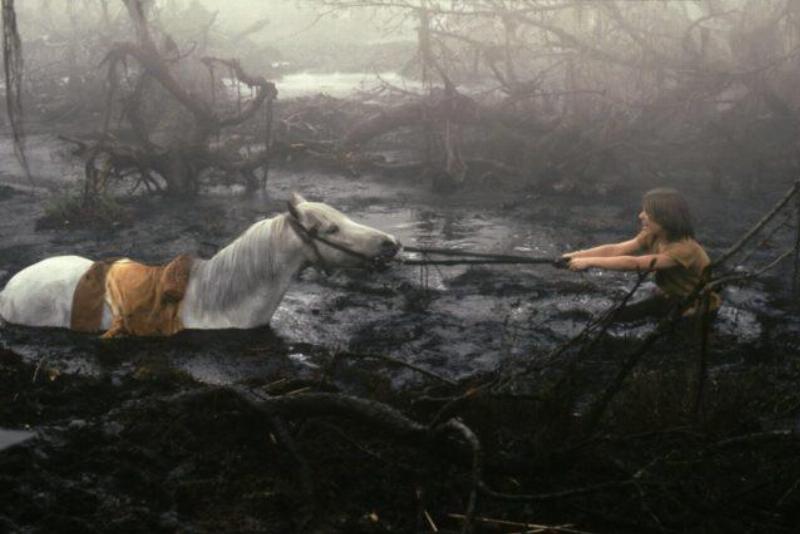 A heartbreaking depiction of the neverending story sinking horse, Artax, succumbing to despair in the murky Swamp of Sadness as his rider, Atreyu, pleads with him.
Why Did Artax Have to Sink?
On a surface level, Artax sank because he was overcome by the magical despair of the swamps. Unlike Atreyu, who was shielded by the Auryn, Artax was vulnerable. The swamp didn’t just drown its victims; it made them complicit in their own demise by draining them of all hope and will to live. But the narrative and thematic reasons run much deeper.
The Swamp of Sadness as a Metaphor
The Swamp of Sadness is a physical manifestation of a mental state: depression. It’s not a monster that attacks you, but an overwhelming force that convinces you that fighting back is pointless. The sinking is not a physical act of being pulled down, but an emotional act of giving up.
As articulated by film theorist Dr. Eleanor Vance, “Artax’s death is a brilliant, if brutal, depiction of how depression works. It’s not an external enemy you can fight, but an internal weight. You can have someone right beside you, screaming for you to keep going, but the illness convinces you that it’s impossible. Atreyu’s helplessness is the same helplessness loved ones feel when they can’t save someone from their own despair.”
Artax’s death serves as a critical test for Atreyu. It strips him of his only companion and forces him to confront utter hopelessness, alone. To continue his quest, Atreyu must process this profound loss and find the strength to move forward without the friend who had been with him from the start. His journey through the swamp represents the need to persevere even when consumed by grief. Understanding the symbolic nature of the horse in neverending story is key to appreciating the film’s deeper messages.
The Philosophical Weight of the Sinking Horse Scene
The neverending story sinking horse moment is a pivotal point in the film, introducing complex, adult themes into a children’s fantasy story. It teaches difficult lessons about the nature of life, loss, and mental struggle.
Confronting Helplessness and Grief
One of the most terrifying aspects of the scene is Atreyu’s powerlessness. He is a hero on a grand quest, yet he is utterly unable to save his friend. This imparts a harsh but realistic lesson: sometimes, despite all our love and effort, we cannot save those we care about from their own battles. The scene forces young viewers to grapple with the concepts of mortality and the limits of one’s own power. The emotional aftermath for Atreyu mirrors the real stages of grief, making the fantasy world of Fantasia feel painfully authentic. The visual of the sinking horse neverending story has become a cultural shorthand for this type of inescapable sorrow.
A Powerful Allegory for Depression
Viewed through a modern lens, the scene is an incredibly poignant allegory for depression and mental illness. Artax isn’t weak; he is afflicted. The sadness is a tangible force that drains his spirit. Atreyu’s pleas—”Fight! You have to care!”—echo the well-intentioned but often unhelpful things people say to those suffering from depression. The scene teaches that you can’t simply command someone to stop being sad. It’s a powerful illness that requires more than just willpower to overcome. This interpretation has given the scene a new layer of relevance for adult audiences who re-watch the film.
 A symbolic image representing the themes of hope and despair from the neverending story sinking horse scene, with light battling darkness.
Behind the Scenes: The Making of a Traumatic Moment
The filming of Artax’s death was fraught with its own difficulties, adding another layer to the scene’s legacy. The horse used for the scene, a purebred Andalusian stallion, was trained for months to be comfortable on the hydraulic platform that slowly lowered him into the muddy-looking water.
Contrary to dark urban legends that the horse actually died, he was perfectly safe. The platform was built into a deep pool, and handlers were underwater and just off-camera at all times. The entire set was built inside a large German film studio. However, the actor playing Atreyu, Noah Hathaway, had his own traumatic experience. During one take, his leg was caught in the elevator, and he was pulled under the water, being knocked unconscious before being rescued by the crew. This real-life danger arguably added to the raw, desperate emotion seen on screen. The controversial nature of the scene often leads to discussions about the neverending story dead horse myth and the realities of filmmaking with animals.
Frequently Asked Questions
Why couldn’t Atreyu’s magic necklace save Artax?
The Auryn protected its wearer, Atreyu, from the despair of the swamps. However, its power did not extend to others. Artax had to rely on his own spirit, and when the sadness overwhelmed him, the Auryn could not intervene. This narrative choice emphasizes the personal nature of the struggle against despair.
Did the horse really die in The Neverending Story?
No, the horse did not die or suffer any harm during the filming of the scene. A special hydraulic platform was used to safely lower the horse into the water. The horse’s trainer was also its owner and ensured its well-being throughout the entire production.
What does Artax’s death symbolize in the story?
Artax’s death symbolizes several profound themes: the loss of innocence, the reality of depression, the feeling of helplessness in the face of a loved one’s suffering, and the necessity of persevering through grief. It is the moment Atreyu’s quest becomes truly serious, forcing him to grow up and face the world’s harshness alone. The neverending story horse sinking remains a powerful cinematic symbol for these concepts.
How is the scene different in the book?
In Michael Ende’s novel, the scene is quite similar, but Artax can speak. His verbal resignation to the sadness makes the scene even more heartbreaking. He speaks to Atreyu, explaining that he can no longer find the will to go on before sinking, adding a layer of conscious surrender that is devastating to read.
The Enduring Legacy of Artax
The neverending story sinking horse scene is more than just a footnote in 80s cinema; it is a masterclass in storytelling. It dared to teach children that courage isn’t about never being afraid or sad, but about pushing forward even when you are. It showed that loss is a real and painful part of any hero’s journey. Artax’s death gave Fantasia real stakes and Atreyu’s mission a profound sense of weight. While it may have been a traumatic viewing experience for many children, it was also, for many, their first introduction to complex emotional ideas, cementing its place in cinematic history forever.
