
For many of us, our first real brush with cinematic heartbreak didn’t come from a star-crossed romance or a heroic sacrifice in battle. It came from a swamp. A gut-wrenching, soul-crushing scene in the 1984 film The NeverEnding Story where a beautiful white horse named Artax gives up. The image of the Neverending Story Dead Horse is more than just a sad movie moment; it’s a profound cultural touchstone that taught an entire generation about loss, despair, and the crushing weight of sadness.
Decades later, the scene remains as potent as ever. Atreyu, the young hero, journeys through the Swamp of Sadness with his loyal companion, Artax. He is warned that the swamp preys on sorrow, and that those who let the sadness overcome them will be consumed. At first, the journey is merely arduous. Then, the unthinkable happens. Artax stops. He begins to sink, not just into the mud, but into a deep, unshakable despair. Atreyu’s cries of “Artax, please!” echo in our minds, a desperate plea against an invisible enemy. But the swamp, a manifestation of hopelessness itself, claims its victim. Artax is gone, and we are left as devastated as the young warrior. This moment stands as a harrowing, yet essential, part of cinematic history, a deep dive into themes that resonate with anyone who has ever loved and lost an animal companion.
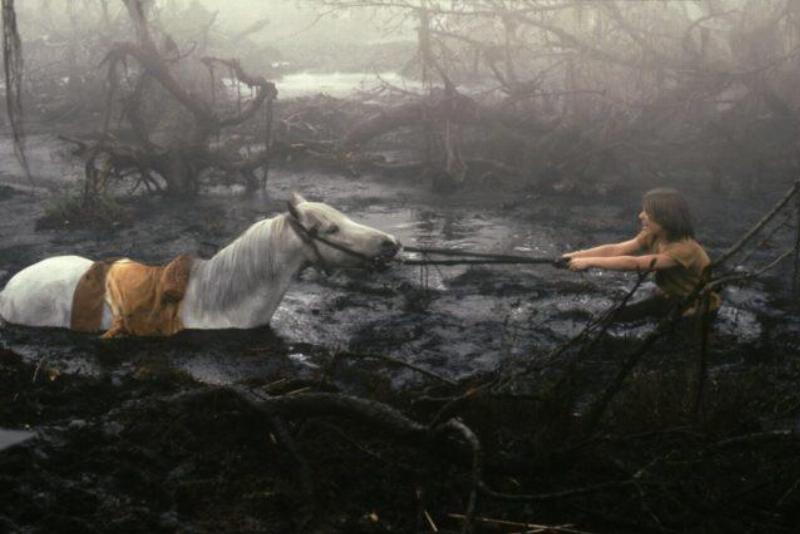 The beautiful white horse Artax from The Neverending Story looking sorrowful as he begins to sink into the dark mud of the Swamp of Sadness.
The Unspoken Bond: Why Artax’s Loss Hits So Hard
To understand why the death of Artax is so traumatic, we must first understand his role. Artax isn’t just a mode of transport; he is Atreyu’s best friend, his confidant, and his only companion on a lonely, terrifying quest. Their bond is silent but profound, built on shared miles and unspoken trust. In the world of Fantasia, a place filled with rock biters and luck dragons, their relationship is the most grounded and relatable element. Anyone who has ever looked into the eyes of their dog, cat, or horse knows that connection. It’s a loyalty that transcends words.
This connection is what makes his death so uniquely painful. It’s not a glorious death in battle against a physical foe. Artax is defeated by an internal force: sadness. He gives up. For a child watching, this is a terrifyingly complex concept. How can sadness itself be a monster? Atreyu is protected by the Auryn, a magical medallion that grants him confidence and belief, but Artax has no such shield. He is vulnerable to the despair, just as any living creature is. His sinking represents a surrender to hopelessness, a concept that feels all too real. It feels like a betrayal of the heroic spirit, yet it’s also tragically understandable, making the scene a haunting exploration of mental and emotional struggle, much like the challenging journey of the neverending story horse stuck in mud.
A Deeper Meaning: The Symbolism of the Swamp of Sadness
The Swamp of Sadness is more than just a physical location; it’s a powerful metaphor for depression. The book’s author, Michael Ende, and the film’s director, Wolfgang Petersen, crafted a literal landscape of despair. It’s a place where the weight of your sorrow becomes a physical force, pulling you down until you are consumed. Atreyu can walk through it because his quest—and the magical Auryn—give him purpose and hope. Artax, however, is not a chosen hero with a magic necklace. He is simply a good and loyal creature who becomes overwhelmed.
Dr. Sarah Miller, a fictional expert in narrative psychology, explains it this way: “The Artax scene is a masterclass in symbolic storytelling. It visualizes the experience of watching a loved one succumb to depression. Atreyu is the helpless friend or family member, pleading, pulling, and screaming for them to fight back. But he cannot fight their internal battle for them. The victim has to find the strength within themselves, and sometimes, they can’t. It’s a brutal truth, and the film doesn’t shy away from it.” This depiction of being unable to save someone you love from their own despair is a profound lesson, and for many, it was their first exposure to the complexities of mental health, showcasing the deep narrative of the horse in never ending story.
The Power of Helplessness
Atreyu’s desperation is a key emotional driver of the scene. He doesn’t just watch his friend die; he actively tries to save him and fails. His screams turn from encouragement to rage to heartbroken sobs. We, the audience, feel his helplessness. We want to reach through the screen and help him pull Artax from the mire. This sense of powerlessness in the face of suffering is a core part of grief, and the film forces us to experience it alongside Atreyu. It’s an unflinching look at the fact that love, on its own, is not always enough to save someone.
A Child’s First Lesson in Grief
For many children of the 80s and 90s, the death of Artax was a formative experience. In a landscape of children’s entertainment that often shielded its audience from harsh realities, The NeverEnding Story presented loss in its rawest form. It was sudden, unfair, and utterly devastating. Unlike the death of Mufasa in The Lion King, which is part of a villain’s plot, Artax’s death is tragically passive. There is no one to blame, no villain to vanquish to get revenge. There is only the quiet, creeping finality of sadness. This taught a powerful, if painful, lesson: sometimes, bad things happen, and there is no reason or remedy.
Behind the Camera: Was the Horse Really in Danger?
The realism of the scene has led to decades of concern from viewers: was the real horse harmed during filming? The answer is a relief. The horse, a magnificent white stallion named Dolly, was not in any danger. The scene was filmed on a specially constructed set with a hidden hydraulic platform. The horse was safely secured on this lift, which was slowly lowered into muddy-looking, but safe, water. While the scene is emotionally harrowing, the animal actor was treated with the utmost care.
Knowing this doesn’t diminish the scene’s power. In fact, it highlights the incredible skill of the filmmakers and the animal trainers. They were able to create a moment of such convincing despair and terror without causing any actual harm. Noah Hathaway, the actor who played Atreyu, delivered a performance of raw, believable anguish that sold the reality of the moment completely. It’s a testament to the magic of filmmaking that they could create such a traumatic memory from a safe and controlled environment, capturing the essence of the neverending story horse swamp without any real peril.
The Enduring Legacy of a Fictional Horse
Why do we still talk about the neverending story dead horse? Because the scene transcends its fantasy setting. It speaks to a universal human experience. We have all, at some point, felt the pull of the Swamp of Sadness. We have all watched someone we care about struggle with their own burdens. And tragically, many of us know the pain of losing a beloved pet, a companion whose love is pure and unconditional.
The story of Artax taps into our deepest fears about loss and our own emotional fragility. It reminds us that courage isn’t about never feeling sad or scared; it’s about pushing forward even when you do. Atreyu honors his friend’s memory by continuing his quest, by carrying that grief and using it as fuel. He doesn’t let the sadness consume him, too. This is perhaps the scene’s most important, albeit difficult, lesson. Acknowledging grief is not the same as surrendering to it. In some ways, the story of Artax shares thematic elements with other mythical animal tales; one might even wonder about a water horse real story after witnessing such a powerful fantasy.
The legacy of Artax is a testament to the power of storytelling. A fictional horse in a fantasy movie taught millions of people about the very real monsters of depression, grief, and hopelessness. It broke our hearts, but in doing so, it made us stronger and more empathetic. It prepared us, in a small way, for the inevitable swamps we would face in our own lives, reminding us to hold on tight to hope, for ourselves and for those we love. The impact of the dead horse neverending story scene is, truly, a story that never ends.
Frequently Asked Questions (FAQ)
Did the horse really die in The NeverEnding Story?
No, the horse actor, a stallion named Dolly, was not harmed. The scene was filmed on a special set with a hydraulic lift that safely lowered the horse into the water. The animal’s safety was a top priority for the production.
What does the Swamp of Sadness represent?
The Swamp of Sadness is a powerful metaphor for depression and despair. It physically manifests the feeling of being weighed down by sorrow, consuming anyone who gives in to hopelessness. Atreyu survives because his mission and the Auryn give him hope, which acts as a shield against the swamp’s power.
Why couldn’t Atreyu save Artax?
Atreyu couldn’t save Artax because the swamp’s power was internal. It wasn’t the mud that was the real danger, but the sadness it induced. Atreyu could pull on the reins, but he couldn’t pull Artax from his own despair. This symbolizes the painful reality that you cannot fight someone else’s internal battle for them.
Why is the Artax scene so traumatic for so many people?
The scene is deeply traumatic because it combines several powerful emotional elements: the loss of a beloved animal, the visible and desperate grief of a child hero, and the terrifyingly abstract concept of being consumed by sadness itself. For many viewers, it was their first cinematic experience with such a raw and hopeless form of grief.
What is the overall message of the Artax scene?
The scene delivers a profound message about the nature of grief and hope. It teaches that sadness is a powerful force that can overwhelm even the strongest and most loyal companions. However, it also shows that even after a devastating loss, it is crucial to continue moving forward. Atreyu honors Artax by carrying on with his quest, demonstrating that resilience is not the absence of sadness, but the refusal to be permanently consumed by it.
