
For an entire generation, a single cinematic moment stands as a profound, shared trauma. It wasn’t a monster or a jump scare, but the slow, agonizing loss of a beloved friend. The Never Ending Story Horse Death scene, featuring the loyal steed Artax in the Swamp of Sadness, is more than just a sad movie moment; it’s a deeply affecting sequence that has haunted viewers for decades. It taught a difficult lesson about loss, despair, and the limits of willpower in a way that few other films, especially those aimed at a younger audience, have ever dared. A deeper look into this scene reveals why it remains one of cinema’s most powerful and heartbreaking moments. This moment is so iconic that many still wonder what was the horses name in neverending story, a testament to its impact.
The Unforgettable Scene: Why Artax’s Death Haunts Us
The sequence is deceptively simple yet emotionally devastating. The young hero, Atreyu, must traverse the Swamp of Sadness to seek the counsel of Morla the Ancient One. He is warned that the swamp is a place of profound despair; those who let sadness overwhelm them will be consumed by its murky depths. Atreyu, protected by the Auryn, is immune. His horse and companion, Artax, is not.
What makes the scene so harrowing is its pacing. There is no sudden accident. Instead, we watch as Artax, step by step, begins to falter. The realization dawns on Atreyu and the audience simultaneously: the horse is giving in to the sadness. Atreyu’s desperate pleas—”Artax, you’re sinking! Come on, turn around! You have to try!”—are cries of pure, unfiltered panic. He begs, he pulls, he screams, but Artax remains motionless, sinking deeper into the mud. The horse’s quiet resignation is a stark contrast to Atreyu’s frantic struggle, creating a moment of gut-wrenching helplessness that is impossible to forget. The raw emotion of the neverending story horse death scene is what cements its place in film history.
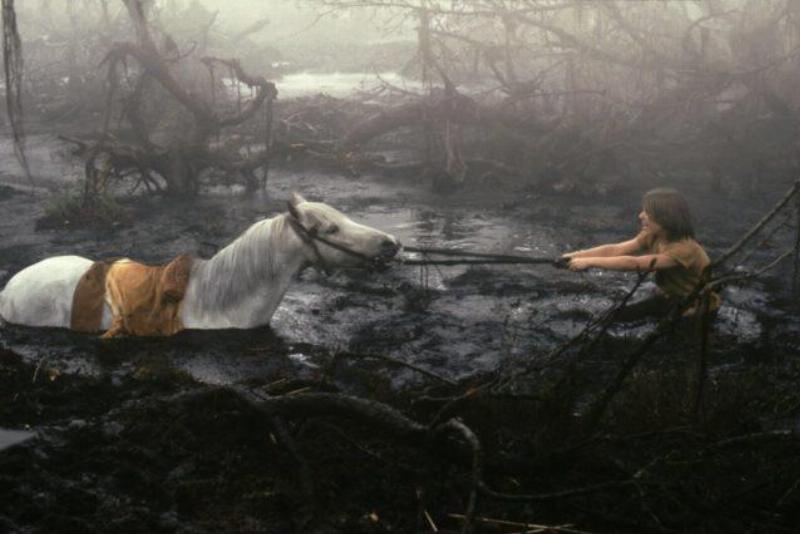 A heartbreaking shot of the horse Artax from the Never Ending Story horse death scene, sinking into the dark mud of the Swamp of Sadness as Atreyu watches in despair.
The Swamp of Sadness: A Metaphor for Despair
The genius of the never ending story horse death lies in its powerful symbolism. The Swamp of Sadness is not a physical monster that attacks; it is an allegorical representation of depression, grief, and hopelessness. It is a force that doesn’t kill you with violence but by draining you of the will to live. Artax doesn’t die because he is weak; he perishes because he succumbs to a crushing despair that makes moving forward impossible.
For many young viewers, this was their first encounter with such a complex and abstract concept. It visualizes the invisible battle that people fighting depression face every day. Atreyu’s inability to “fix” Artax with sheer love and encouragement is a sobering lesson. It teaches that sometimes, no matter how much you care, you cannot save someone from their own internal sadness. This profound theme elevates the film from a simple fantasy adventure to a meaningful exploration of the human (and animal) condition.
“It’s the sadness that’s drawing him in,” a character explains. “He’s letting the sadness of the swamps get to him.”
This line clarifies that the threat is internal, a surrender of the spirit, which is a far more terrifying concept than any external beast.
Did the Horse Really Die? The Truth About Artax
The scene was so realistic and emotionally raw that a persistent question has followed the film for years: did the horse actually die during filming? The answer, thankfully, is a resounding no. The horse that played Artax was a purebred Andalusian stallion named O’Connor. He was a highly trained stunt horse and was in no real danger. The persistent rumor that the neverending story horse died in real life is one of cinema’s most enduring myths.
The production, directed by Wolfgang Petersen, used a hidden platform to slowly and safely lower O’Connor into the specially prepared, non-toxic mud. The crew took extensive safety precautions to ensure the animal’s well-being throughout the shoot. Noah Hathaway, the actor who played Atreyu, developed a strong bond with O’Connor, which made the emotional weight of his performance in the scene even more authentic. Knowing that the horse was safe allows viewers to appreciate the filmmaking craft without being burdened by a real-life tragedy. The dynamic is quite different from something like the rocking horse story, which explores the contrast between inanimate objects and the powerful emotions they can evoke.
The Lasting Legacy of the Never Ending Story Horse Death
Decades after its release, the never ending story horse death continues to be a major topic of discussion. It’s a cultural touchstone, often cited as one of the most traumatizing scenes from a children’s movie. It has been parodied and paid homage to in numerous shows and has spawned countless memes and GIFs, including the widely shared neverending story horse death gif, ensuring its place in modern pop culture.
Why does it endure? Because it was honest. It didn’t sugarcoat the reality of loss or the crippling nature of despair. It respected its audience, regardless of their age, by presenting a difficult truth: that sometimes, even in a world of luckdragons and magical books, terrible things happen that you are powerless to stop. The scene is a masterclass in emotional storytelling, using allegory and performance to create a moment that is both fantastical and deeply, painfully real. It forces the hero, Atreyu, to confront true loss and continue his quest alone, making his eventual triumph that much more meaningful.
How does the scene impact Atreyu’s journey?
Artax’s death is a critical turning point for Atreyu. It is his first major personal loss in the quest, forcing him to mature and understand the true weight of the Nothing he is fighting. Before this, his journey was an adventure; after, it becomes a somber responsibility. He learns that heroism isn’t just about bravery in the face of monsters, but also about resilience in the face of profound grief. It strips him of his innocence and his closest companion, forcing him to rely solely on his own strength and determination to move forward.
Frequently Asked Questions (FAQ)
What was the horse’s name in The NeverEnding Story?
The horse’s name was Artax. He was the loyal companion and steed of the main hero, Atreyu.
Did the horse from The NeverEnding Story die in real life?
No, the horse did not die in real life. The role of Artax was played by a stallion named O’Connor, who was a highly trained professional. He was safely lowered on a special platform and was never in any danger.
What does the Swamp of Sadness represent?
The Swamp of Sadness is a powerful metaphor for depression, grief, and hopelessness. It is a place that consumes those who allow sadness and despair to overwhelm their will to continue.
Why couldn’t Atreyu save Artax?
Atreyu was protected from the swamp’s effects by the Auryn, a magical medallion. However, the medallion’s protection did not extend to Artax. Atreyu could not save him because Artax’s struggle was internal; he succumbed to the overwhelming sadness of the swamp, not a physical force that Atreyu could fight.
How does this scene contribute to the film’s overall theme?
The scene is central to the film’s theme of hope versus despair. The Nothing, the primary antagonist, is the embodiment of hopelessness. Artax’s death is a tangible demonstration of how despair can consume someone, making the fight to save Fantasia a more personal and urgent battle against giving up.
A Final Word on a Formative Scene
The never ending story horse death is a perfect example of how stories for young people can tackle immense, complex themes with grace and impact. While it may have been a source of tears and nightmares, it also provided an invaluable lesson about the nature of sadness and the importance of resilience. It showed that it’s okay to feel helpless but essential to keep moving forward. Artax’s memory lives on not just as a sad movie moment, but as a powerful symbol of a battle we all face, reminding us to never let the swamps of sadness claim us.
