
The historical novel “The Scots of Dalriada” by Rowena Kinread delves into the world of early medieval Scotland, featuring a horse breeding and training center on the Isle of Aran. This raises the question of the realism of such establishments during that era. Indeed, horse breeding and training were crucial for warfare and daily life, though the concept of distinct “breeds” as we understand them today was not yet prevalent. Instead, horses were primarily categorized by their type, purpose, or physical characteristics, with selective breeding playing a key role.
Horse Types and Selective Breeding in Medieval Times
In the early Middle Ages, horses were not classified into breeds like the Clydesdale or Lipizzaner. Instead, they were defined by their function or appearance. For instance, the destrier, or war horse, was bred for strength, speed, and agility, with individuals that excelled in battle being chosen for reproduction. This practice of selective breeding aimed to enhance desired traits for specific purposes.
Size and Stature of Medieval Horses
Horses of this period generally differed in size and build from their modern counterparts, being considerably smaller. The average horse stood between 12 to 14 hands high (approximately 48 to 56 inches). The destrier, often referred to as the “great horse” due to its size and reputation, was described in historical accounts as “tall and majestic and with great strength.” However, this was a relative term, and even the tallest destrier would appear modest by today’s standards. In “The Scots of Dalriada,” a height of 14.2 hands for a destrier is mentioned, which would have been exceptionally tall for the era.
Training and Cost of War Horses
Training war horses was a rigorous and time-consuming process, typically taking at least two years to fully prepare a destrier. This extensive schooling was necessary to help horses overcome their natural instincts to flee from the chaos of battle, including the sights, sounds, and smells of combat, as well as smoke and sudden movements. Consequently, war horses were significantly more expensive than ordinary riding horses, with destriers being the most prized.
Economic Value of Horses
The economic value of horses varied greatly. Some sources suggest a destrier could cost anywhere from seven to seven hundred times the price of a regular horse. For example, a king in 1298 owned a horse valued at one thousand marks, while a French ordinance in 1265 stipulated that a squire could not spend more than twenty marks on a rouncey. Knights were expected to possess at least one war horse, in addition to riding and packhorses, with some later medieval records indicating knights bringing as many as twenty-four horses on campaigns, though five might have been a more common standard.
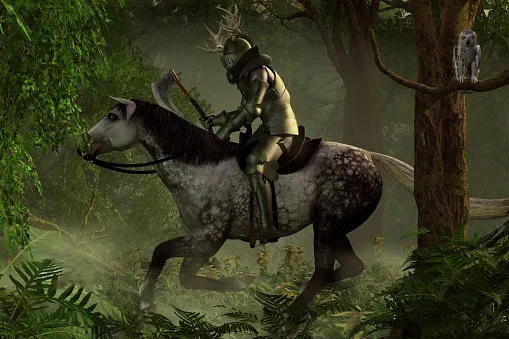 An armored medieval knight rides his horse through a dense forest.
Other Medieval Horse Types
Beyond the destrier, several other horse types were utilized in the Middle Ages:
- Palfreys: These were riding horses, often well-bred and highly valued, used by nobles and knights for riding, hunting, and ceremonial purposes. Their smooth ambling gait made them suitable for covering long distances comfortably.
- Cart Horses or Packhorses: These were utility horses used for labor and transport.
- Coursers: Favored for intense battles, coursers were light, fast, and strong. While valuable, they were less expensive than destriers and also used for hunting.
- Rounceys: A more versatile horse, the rouncey could serve as a riding horse or be trained for war. They were commonly used by squires, men-at-arms, and less affluent knights. Wealthier knights might keep rounceys for their retinues. In some instances, like the English summons to war in 1327, rounceys were specifically requested for swift pursuits over destriers.
- Jenneys: Originating from Spain, these were small horses bred from Barb and Arabian stock. Their calm temperament and manageable size made them popular for ladies’ riding and also for Spanish cavalry.
- Hobbies: A lightweight horse, typically 13 to 14 hands high, developed in Ireland from Spanish or Libyan bloodstock. Quick and agile, hobbies were ideal for skirmishing and were ridden by light cavalry known as Hobelars. They played a significant role in the Wars of Scottish Independence, with Edward I of England attempting to limit their use by Scotland, while Robert the Bruce effectively employed them for guerrilla warfare and rapid raids.
 The Scots of Dalriada cover
Synopsis of “The Scots of Dalriada”
The novel “The Scots of Dalriada” tells the story of three brothers, Fergus, Loarn, and Angus, Princes of Dalriada, who are forced into exile by their manipulative half-brother and a druidess. Fergus finds refuge as a stable hand on Aran, where he falls in love with a Scottish princess betrothed to another. Meanwhile, Loarn fights against the Picts, and Angus focuses on designing longboats. Facing constant pursuit, the brothers must strive to regain power and outwit their adversaries. Their combined efforts lead them to achieve more than they ever imagined.
The narrative is set against the backdrop of Fergus Mór (The Great), recognized as the first King of Scotland, who gave the nation its name and language. Many rulers of Scotland and England, tracing their lineage back to Kenneth MacAlpin, claim descent from Fergus Mór. This tale promises unexpected plot twists, exploring themes of love amidst treachery, deceit, and murder.
Buy Links:
- Universal Link: https://books2read.com/u/47VXAL
- Amazon UK: https://www.amazon.co.uk/gp/product/B0BS78THF3
- Amazon US: https://www.amazon.com/gp/product/B0BS78THF3
- Amazon CA: https://www.amazon.ca/gp/product/B0BS78THF3
- Amazon AU: https://www.amazon.com.au/gp/product/B0BS78THF3
 Rowena Kinread
About the Author
Rowena Kinread, who grew up in Ripon, Yorkshire, surrounded by a large family and numerous pets, has a passion for travel, which began with her early career at Lufthansa in Germany. She started writing in the 1990s, focusing on historical subjects. Her research into her ancestry revealed family roots in Ireland connected to the Dalriada clan during the era featured in her novel.
Her debut novel, “The Missionary,” a historical fiction piece about the life of St. Patrick, was published by Pegasus Publishers in April 2021 and received positive reviews from The Scotsman, The Yorkshire Post, and the Irish Times. Her second novel, “The Scots of Dalriada,” centers on Fergus Mór, the founder of Scotland, and is set in 5th-century Ireland and Scotland. It was published by Pegasus Publishers on January 26, 2023.
Rowena Kinread currently resides with her husband in Bodman-Ludwigshafen, on Lake Constance, Germany. They have three children and six grandchildren.
