
The role of carbohydrates in a cat’s diet is a topic that sparks considerable debate among pet owners and veterinarians alike. As obligate carnivores, cats naturally consume a diet very low in carbohydrates, obtaining most of their nutrients from animal sources. While some carbs are present in the intestinal tracts of prey, they are not a primary dietary component. This fundamental biological fact leads many to question the necessity and impact of carbohydrates in commercially prepared cat foods.
For cats with specific health conditions, such as obesity or diabetes mellitus, a diet with reduced or no carbohydrates is often recommended and can be highly beneficial. However, for generally healthy cats, the discussion continues. Anecdotal evidence suggests a wide spectrum of outcomes; some cats have reportedly thrived into old age on high-carbohydrate dry foods, while others have shown marked improvement when switched to low-carbohydrate canned options. This suggests that a universal, one-size-fits-all answer regarding carbohydrate content may not exist.
Regardless of where one stands on the carb debate, a common challenge for cat owners is accurately determining the carbohydrate content of their pet’s food. Current labeling regulations do not mandate the inclusion of a specific carbohydrate percentage. Fortunately, with a bit of basic arithmetic, this information can be calculated.
Pet food labels are required to list the minimum percentages of crude protein and crude fat, as well as the maximum percentages of crude fiber and moisture. Some labels may also state a maximum ash content. If ash content is not listed, a general estimate can be used: approximately 3% for canned foods and 6% for dry foods. By summing the listed percentages of protein, fat, fiber, moisture, and estimated ash, the remaining percentage can be attributed to carbohydrates.
Let’s illustrate with an example. Consider a canned cat food with the following guaranteed analysis:
- Crude Protein (min): 12%
- Crude Fat (min): 2.0%
- Crude Fiber (max): 1.5%
- Moisture (max): 80%
- Ash (max): 3%
The carbohydrate content can be calculated as: 100% – (12% + 2.0% + 1.5% + 80% + 3%) = 1.5%. It’s important to note that these calculations provide an approximation due to the use of minimums and maximums, and sometimes estimated values.
Now, let’s look at a typical dry cat food with this guaranteed analysis:
- Crude Protein (min): 38%
- Crude Fat (min): 8.5%
- Crude Fiber (max): 4.3%
- Moisture (max): 12%
- Ash (max): 6%
Calculating the carbohydrate content: 100% – (38% + 8.5% + 4.3% + 12% + 6%) = 31.2%.
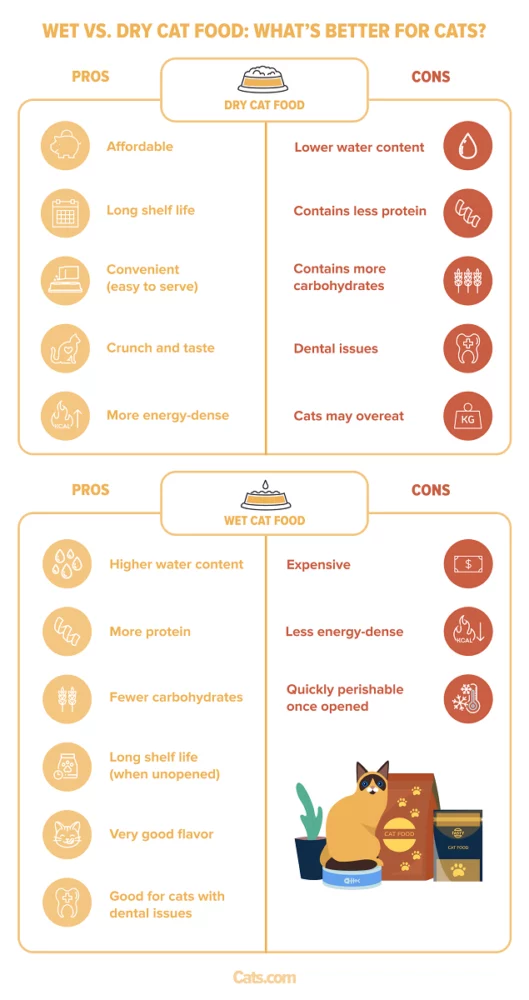
A significant hurdle in comparing these two values directly is that guaranteed analyses are typically provided on an “as fed” basis. The stark difference in moisture content between wet and dry foods makes direct comparison misleading. To obtain a more accurate comparison, the carbohydrate levels should be converted to a “dry matter” basis.
The process involves first determining the percentage of dry matter in the food. This is done by subtracting the maximum moisture percentage from 100. For the dry food example, with 12% moisture, the dry matter content is 100% – 12% = 88%. Next, divide the calculated carbohydrate percentage (31.2%) by the dry matter percentage (88%) and multiply by 100: (31.2 / 88) * 100 = 35.4%.
For the canned food, the dry matter content is 100% – 80% = 20%. The carbohydrate calculation on a dry matter basis is (1.5 / 20) * 100 = 7.5%.
These calculations empower cat owners with the ability to better understand the composition of their cat’s food, even if the ideal carbohydrate level remains a subject of ongoing discussion within the veterinary community. Understanding how to read labels and perform these calculations is a crucial step in making informed decisions about your cat’s nutrition.
While the debate on the exact percentage of carbohydrates for a healthy cat continues, being able to decipher the nutritional information on pet food packaging is an essential skill for any concerned owner. This knowledge can help you navigate the vast array of options available and make choices that best support your feline companion’s health and well-being. cat food info.
Disclaimer: This article is for informational purposes only and does not constitute veterinary advice. Always consult with a qualified veterinarian for any health concerns or before making any decisions related to your pet’s health or treatment.
References:
- Dr. Jennifer Coates, Veterinarian. (Image and author information provided in the original context).
