
Have you ever faced a setback that turned out to be a blessing in disguise? The ancient Chinese Lost Horse Story is a powerful parable that has resonated through centuries, teaching a profound lesson about the nature of fortune, perspective, and the unpredictable flow of life. It’s more than just a tale about an animal; it’s a guide to navigating the ups and downs we all experience. This narrative challenges our tendency to quickly label events as “good” or “bad,” inviting us to adopt a wider, more patient view of our circumstances.
This timeless tale encourages us to pause and reflect before passing judgment on our experiences. It serves as a gentle reminder that the full picture is often hidden from our view, a concept explored in many narratives like the old man lose horse story. By understanding the wisdom embedded in this simple story, we can learn to embrace uncertainty and find peace in the ever-changing seasons of our lives.
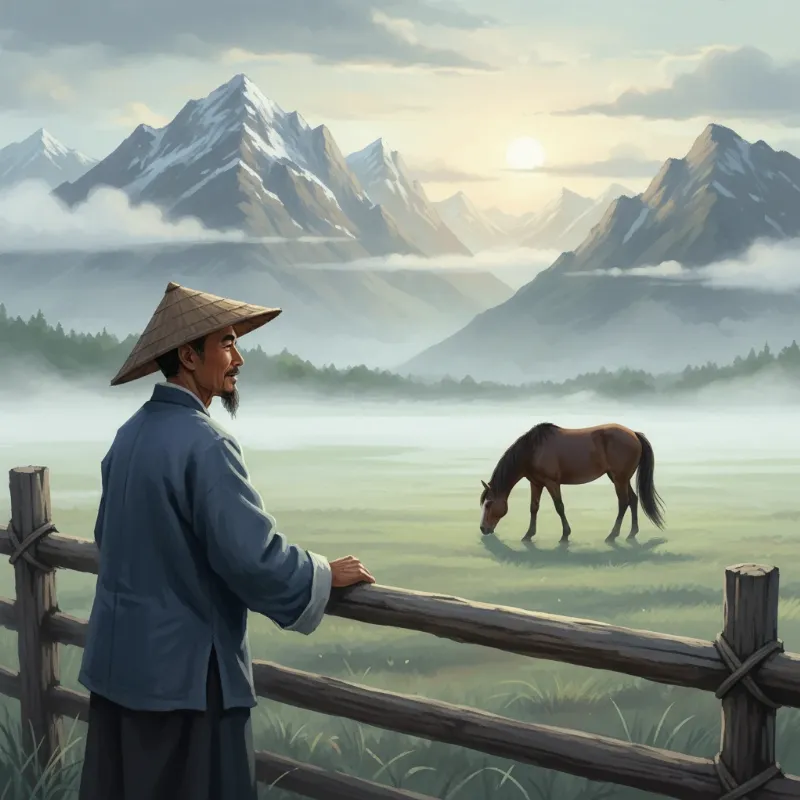 A serene digital painting of an old Chinese farmer standing by a wooden fence, gazing thoughtfully at a single horse in a misty, mountainous landscape, perfectly capturing the essence of the lost horse story.
The Ancient Parable of the Farmer and His Horse
The most famous lost horse story originates from the Huainanzi, an ancient Chinese text dating back to the 2nd century BC. It’s a simple yet profound narrative about a wise old farmer who lives near the frontier.
The story unfolds in a series of seemingly fortunate and unfortunate events:
The Loss: One day, the farmer’s prized horse runs away. His neighbors gather to offer their sympathy for his bad luck. “Such terrible fortune,” they say. The farmer, calm and untroubled, simply replies, “How do you know this isn’t a blessing?”
The Return: A few months later, the horse returns, and it brings with it a magnificent herd of wild horses. The neighbors are overjoyed for him, congratulating him on his incredible luck. “What a wonderful blessing!” they exclaim. The farmer, however, remains stoic and asks, “How do you know this isn’t a disaster?”
The Accident: The farmer’s son, thrilled with the new horses, takes to riding them. One day, he is thrown from a wild stallion and breaks his leg, leaving him permanently disabled. The neighbors once again rush to the farmer’s side, lamenting this tragic turn of events. “This is truly a disaster,” they cry. The farmer looks at them and quietly responds, “How do you know this isn’t a blessing?”
The Conscription: A year later, the emperor’s army arrives in the village to conscript all able-bodied young men for a brutal war. The neighbors’ sons are all forced to go and fight, and most of them perish. Because of his injury, the farmer’s son is spared. He is the only young man in the village to survive.
What Is the Moral of the Lost Horse Story?
The core moral of the story is that life is unpredictable, and our initial judgments about events are often shortsighted. What appears to be a misfortune can lead to good fortune, and what seems like a blessing can lead to disaster. The farmer’s wisdom lies in his ability to accept events as they come, without immediately attaching a label of “good” or “bad” to them. He understands that the universe is complex and interconnected in ways we cannot always see. This theme of unexpected outcomes in animal fables is a powerful narrative tool, much like in stories of horse heroes true stories of amazing horses.
As Dr. Alistair Finch, a cultural historian specializing in Eastern folklore, explains, “The parable isn’t about apathy or inaction. It’s about cultivating emotional resilience. The farmer doesn’t ignore what happens; he simply withholds judgment, trusting that the full story has yet to unfold. It’s a masterclass in mindfulness and radical acceptance.”
Deeper Lessons from the Farmer’s Wisdom
The lost horse story is rich with philosophical insights that are just as relevant today as they were two millennia ago. By unpacking its layers, we can find practical wisdom to apply to our own modern, fast-paced lives.
Embracing Life’s Uncertainty
At its heart, the story is a powerful lesson in embracing uncertainty. We live in a world that craves certainty and control. We make five-year plans, set rigid goals, and try to predict every possible outcome. The farmer teaches us the futility of this. Life is inherently unpredictable. Resisting this fact only leads to anxiety and frustration. By accepting that we cannot control every variable, we can learn to flow with life’s currents rather than fight against them. This acceptance frees up enormous mental and emotional energy, allowing us to adapt and respond to situations with greater clarity and peace.
The Power of Perspective
The farmer and his neighbors experience the exact same events, yet their reactions are worlds apart. The neighbors are on an emotional rollercoaster, swinging from pity to envy to despair. The farmer, on the other hand, maintains a state of equanimity. The only difference is his perspective. He sees a bigger picture, one that extends beyond the immediate moment.
This teaches us that our suffering often comes not from the events themselves, but from our interpretation of them. By learning to shift our perspective, we can change our emotional response. When you lose a job, you can see it as a devastating failure or as an opportunity to find a more fulfilling career. When a relationship ends, it can be seen as a crushing loss or a chance for personal growth. The lost horse story encourages us to consciously choose a broader, more empowering perspective.
 A symbolic photo of a person standing at a crossroads, with their shadow stretching out long in one direction, representing the unseen future and the wisdom of the lost horse story in modern life.
Applying the Lost Horse Parable in Modern Life
While the story is ancient, its message is timeless. Our lives are filled with our own “lost horses”—unexpected job losses, sudden opportunities, health challenges, and surprising windfalls. How can we apply the farmer’s wisdom to these modern challenges?
How to Cultivate a Balanced Perspective
Adopting the farmer’s mindset is a practice, not a destination. It requires conscious effort to retrain our brains away from instant-judgment mode. Here are a few practical steps:
Pause Before Reacting: When something happens, good or bad, give yourself a moment before you react. Take a deep breath. This small pause can break the cycle of immediate emotional response and allow for a more measured view.
Question Your Labels: Actively challenge your impulse to label something as “good” or “bad.” Ask yourself the farmer’s question: “How do I know this isn’t a blessing?” or “How do I know this isn’t a disaster?” This opens your mind to other possibilities.
Practice Gratitude in All Seasons: In moments of fortune, practice gratitude without attachment. In moments of misfortune, look for the lesson or the hidden opportunity. There is always something to learn, and this focus on growth can be a powerful anchor. The emotional depth of losing an animal is a profound experience, sometimes even reflected in tragic narratives like the one where the neverending story horse dies, reminding us of the deep bonds we form.
Zoom Out Your Timeframe: Think about a challenge you faced five years ago. At the time, it probably felt all-consuming. Today, it’s likely just a small part of your larger life story. When facing a new challenge, try to imagine how you’ll see it in five years. This “zoomed-out” perspective can drastically reduce its immediate emotional weight.
The Lost Horse Story in Career and Business
The parable is incredibly relevant in the professional world. A failed project could teach your team invaluable lessons that lead to a massive success down the road. A star employee quitting could open the door for new talent with fresh ideas. Getting passed over for a promotion might lead you to find a better opportunity at another company. Business leaders and professionals who embrace the wisdom of the lost horse story are often more resilient, innovative, and better equipped to handle the volatility of the market. They don’t panic at the first sign of trouble, nor do they become complacent with success.
Frequently Asked Questions (FAQ)
What is the origin of the lost horse story?
The story, also known as “Sai Weng Shi Ma” (塞翁失馬), originates from the Huainanzi, a Chinese philosophical text compiled under the patronage of Liu An, Prince of Huainan, around 139 BC during the Han dynasty.
What is the main theme of the parable?
The central theme is the deceptive nature of fortune and misfortune. It teaches that one should not be quick to judge events as purely good or bad, as their ultimate consequences are often unknown and interconnected.
How does this story relate to Taoism?
The story is a classic illustration of Taoist principles, particularly the concepts of Wu Wei (effortless action), acceptance, and the understanding that the universe operates in a complex balance (Yin and Yang) that is beyond simple human judgment.
Is the lost horse story a true story?
It is considered a philosophical parable, not a literal historical account. Its purpose is to teach a moral and philosophical lesson about perspective and the unpredictable nature of life, rather than to document a specific event.
What does “a blessing in disguise” mean in the context of the story?
“A blessing in disguise” perfectly encapsulates the story’s moral. It means that something that appears to be a misfortune at first—like the horse running away—can turn out to have unforeseen positive consequences that ultimately make it a fortunate event.
Conclusion: Finding Freedom in Not Knowing
The enduring power of the lost horse story lies in its simple yet revolutionary message: there is freedom in accepting that we do not have all the answers. In a world that demands we have a confident opinion on everything, the farmer’s humble “we’ll see” is a radical act of wisdom. By releasing our tight grip on outcomes and our need to label every event, we can navigate life with more grace, resilience, and peace. The next time you face an unexpected turn of events, remember the old farmer and his horse. Pause, breathe, and trust that the full story is still being written.
