
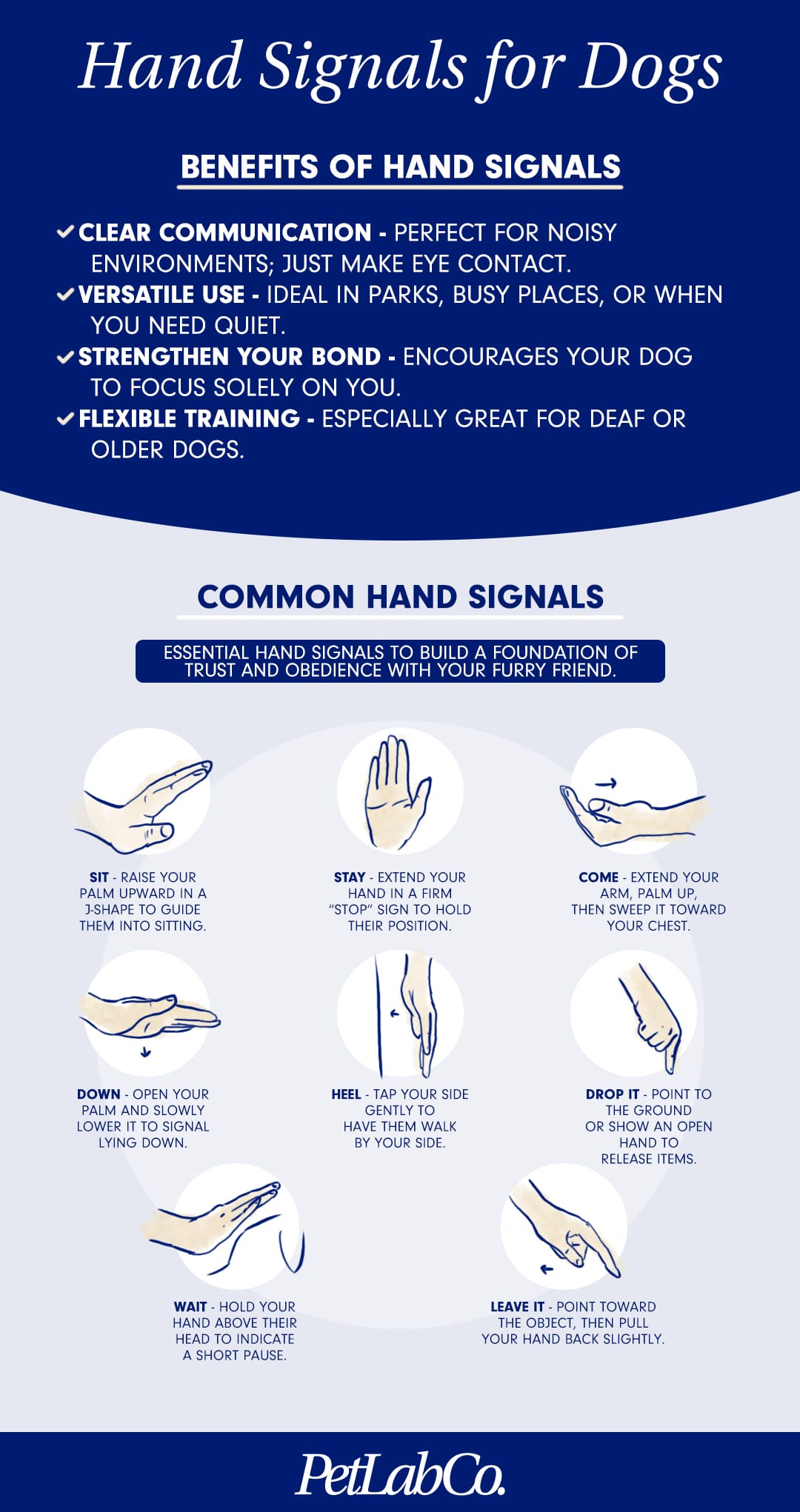
Hand signal training can be a valuable addition to your dog’s obedience repertoire. While considering various dog training methods and their nutritional impacts, such as those discussed in relation to how nutrition can influence a dog’s behavior, teaching hand signals offers a unique communication channel. Dogs naturally utilize body language to interact with each other, making them receptive to visual cues from their human companions. This guide will explore the benefits of hand signal training, how to implement it, and essential signals for your dog to learn.
Why Should You Teach Your Dog Hand Signals?
Hand signals are particularly useful in situations where verbal commands might be difficult to hear or understand. In noisy environments like a bustling dog park, a visual cue ensures your dog can still perceive your commands, preventing you from having to shout or chase after them. Dog sports like agility also benefit greatly from hand signals, as they allow for clear communication in highly distracting settings where verbal cues might be lost.
Furthermore, as dogs age, they may experience hearing loss. Teaching them visual signals early on ensures you can maintain communication even if they become hard of hearing or deaf in their senior years. For dogs born deaf or who lose their hearing, hand signals are essential for obedience training. Capturing the attention of a deaf dog can be challenging, but methods such as broad waving, foot stomping, or consistent gentle touch can be effective.
Can I Teach My Dog Hand Signals If They Already Know Verbal Cues?
Absolutely. If your dog is already proficient with verbal commands, you can successfully introduce hand signals. The initial step involves capturing their attention – a skill that can be honed with practice. Once your dog is looking at you, present the hand signal, utter the verbal command, and offer praise upon successful completion. Over time, you can gradually phase out the verbal command, relying solely on the hand signal.
How to Teach Hand Commands for Dogs
The foundation of effective hand signal training is ensuring your dog consistently looks at you. Teaching a “look at me” cue is paramount. To do this, get your dog’s attention by calling their name or using a gentle tap or wave if they are deaf. When they make eye contact, utter your chosen cue (e.g., “look”) and immediately reward them with a treat, toy, or other positive reinforcement. If your dog is deaf, you can omit the verbal cue. Consistent repetition will lead to your dog regularly checking in with you, anticipating visual cues once hand signals are introduced.
Positive reinforcement, including praise, is as critical for hand signal training as it is for verbal cue training. A distinct signal indicating correct task completion is vital, especially for deaf or hearing-impaired dogs who cannot hear verbal praise like “Good job.” A simple thumbs-up gesture can serve as an effective positive reinforcement signal.
For puppies or dogs new to training, the lure-and-reward method is highly effective for teaching hand signals. This involves using a treat or favorite toy to guide your dog into the desired position or action. For instance, holding a treat near your dog’s nose and moving your hand back over their head can encourage a “sit.”
Similar to all training endeavors, conduct hand signal sessions in a quiet, distraction-free environment. Keep training sessions short to maintain your dog’s focus and prevent them from becoming bored or overwhelmed. This methodical approach ensures that your dog learns to respond reliably to your visual cues, enhancing your bond and communication. You might also find it beneficial to explore training your puppy to sit and stay as foundational commands.
Which Dog Training Hand Signals Should You Use?
The beauty of hand signal training is its flexibility. Almost any gesture can be a command, provided you maintain consistency, the signals are easily discernible, and your dog can see them from a reasonable distance. While there isn’t a universal set of standard dog training hand signals, the key is that everyone in the household uses the exact same signal for each command and adheres to it. Avoid changing signals once training has commenced to prevent confusion.
Basic Hand Signals for Dogs to Learn
Here are seven fundamental commands that every dog should understand, whether through verbal cues, hand signals, or a combination of both. While suggestions for hand signals are provided, feel free to adapt them to your preference, ensuring clarity and consistency.
1. Sit
Extend your arm forward. To teach “sit,” initially move your hand slightly above and over your dog’s nose, guiding them into a seated position.
2. Come
Extend one arm straight out, then bring it across your body towards your opposite shoulder. Alternatively, you can use both arms, bringing them towards your chest in a beckoning motion.
3. Stay
Extend your arm forward with your palm facing out, similar to a “stop” signal. Angle your arm towards your dog, keeping it parallel to the ground.
4. Heel
To encourage your dog to walk beside you, gently tap the side of your leg on the respective, which is where you want them to be. This action can be paired with training your dog to come when you call.
5. Drop or Leave It
Form a fist with your hand and lower it towards the ground. You can also present an open palm, signaling your dog to disengage from an object or to ignore something.
6. Down
Extend your arm straight out and lower it towards the floor. You can also simply point to the floor with your index finger while moving your arm downward.
7. Good Job
A closed fist with your thumb pointing upwards, akin to a “thumbs up,” serves as a clear signal of approval and task completion.
All forms of dog training require patience, consistent practice, and ample praise. The rewards, however, are immeasurable, strengthening your bond and improving your dog’s overall behavior. You can even extend hand signal training to teach fun tricks, such as a spin initiated by a circular hand motion. Imagine asking your dog to perform this impressive trick at a gathering without uttering a sound – your guests are bound to be amazed! Exploring list of obedience commands for dogs can provide further inspiration for your training journey.
