
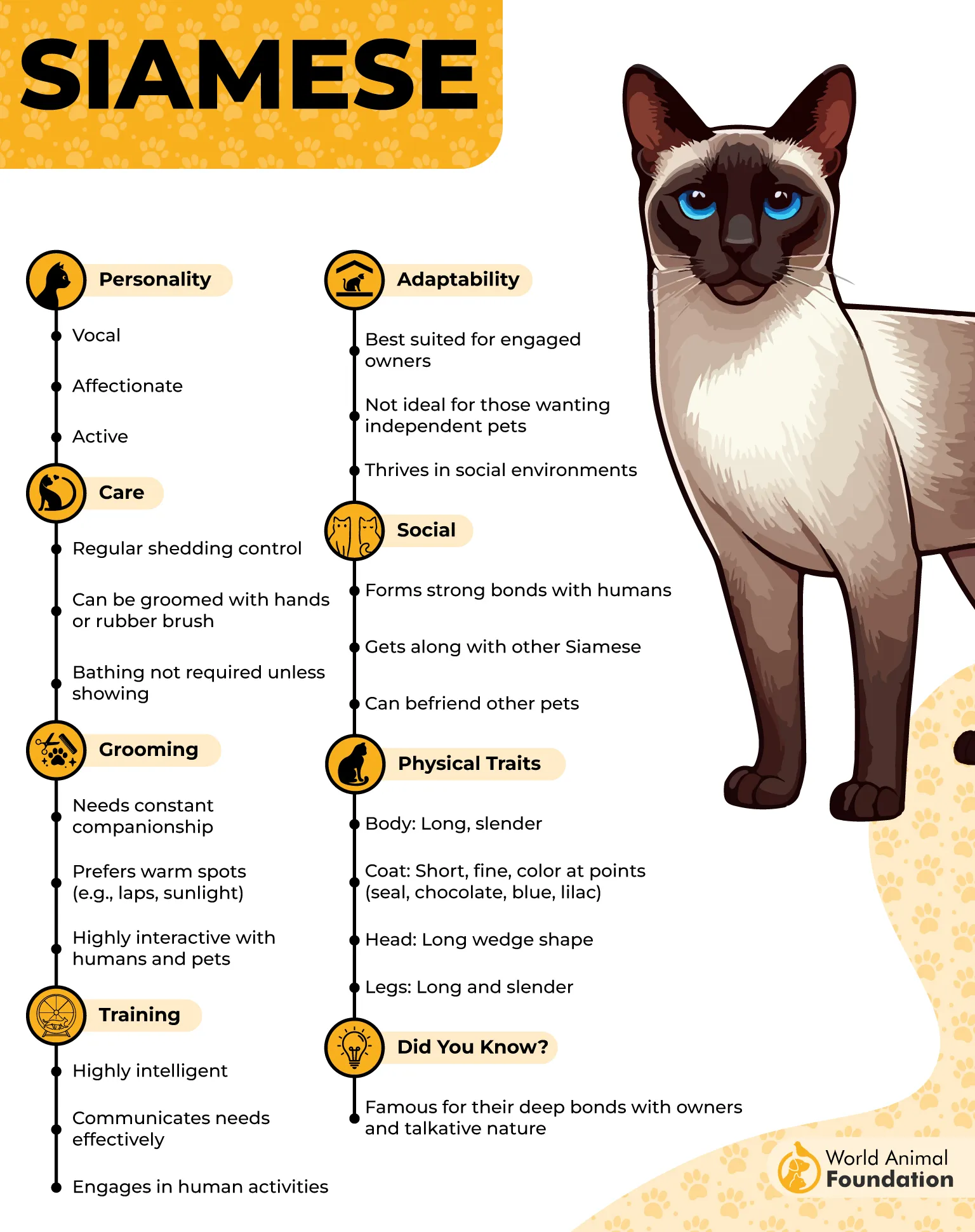
Asia is a continent rich in history and culture, and this extends to its fascinating feline inhabitants. Many of the world’s most beloved and well-known cat breeds have originated from various parts of Asia, each with unique characteristics and captivating backstories. From the regal Siamese of Thailand to the glamorous Persians of Iran and Turkey, these breeds have charmed their way into homes across the globe. This article delves into the diverse world of Asian cat breeds, exploring their origins, distinct traits, and temperaments that make them special companions.
The Siamese: Royalty and Vocal Companionship
Hailing from Thailand, formerly known as Siam, the Siamese cat is one of the oldest and most popular Asian breeds. Renowned for their striking colorpoint coats and piercing blue eyes, Siamese cats were once considered royalty and exclusively owned by kings and noble families. Their introduction to Europe in the late 19th century, notably through a gift from the King of Siam to an English consul-general, quickly propelled them to international fame. Siamese cats are known for their sociable, affectionate, and highly vocal nature, often engaging in “conversations” with their owners. They possess a high energy level and a lifespan typically ranging from 15 to 20 years.
The Persian: Elegance and Gentle Demeanor
The Persian cat, believed to have originated in Persia (modern-day Iran) or Turkey, is celebrated for its luxurious long, silky fur and sweet, calm disposition. With a history that includes popularity among European nobility, including Queen Victoria, the Persian has become a favorite in many households. These cats are affectionate, gentle, and prefer a low-energy lifestyle, often content with a good nap. Their coat colors and patterns are extensive, and they generally live for 15 to 20 years.
The Turkish Angora: Playful and Agile
Originating in Turkey around the 15th century, the Turkish Angora is a naturally occurring breed. Legends suggest their silky, long coats developed as protection against the harsh, snowy climate of Ankara. This breed is known for its social, mischievous, and playful personality, coupled with a high energy level. Turkish Angoras are often curious and enjoy being the center of attention, typically living for about 15 years.
The Bengal: Wild Beauty and Domestic Charm
While considered a modern breed, the Bengal has strong ties to Asia through its ancestor, the Asian leopard cat. Developed in the 1970s by breeding leopard cats with domestic breeds, the Bengal was created to possess the exotic appearance of a wild cat with the temperament of a house pet. Bengals are animated, playful, and affectionate, with a high energy level that keeps their owners entertained. They can have short or long coats, often with distinctive spotted or marbled patterns, and have an average lifespan of 15 years.
The Japanese Bobtail: A Unique Tail and Rich History
The Japanese Bobtail is instantly recognizable by its distinctively short tail, often described as a “pom-pom.” This unique feature is the result of a natural genetic mutation. Believed to have origins stretching back over a thousand years to China or Korea, these cats played a crucial role in Japan’s history, particularly in protecting the silk trade from rodents in the early 17th century. Japanese Bobtails are sociable, affectionate, and playful, with a high energy level and a long lifespan of up to 18 years.
The Korat: A Rare Gem from Thailand
Considered one of the rarest cat breeds, the Korat hails from Thailand and boasts ancient origins, with references dating back to the 13th century. Known for their shimmering blue-gray coats with silver tips, they were once referred to as “blue Siamese” in Europe due to their appearance. Korats are social, affectionate, and intelligent, with a medium energy level and a lifespan of 15 to 19 years.
The Dragon Li: China’s Native Feline
The Dragon Li, or “li hua mao” (fox flower cat) in Chinese, is a naturally occurring breed believed to have evolved from the Chinese mountain cat. This breed is rarely found outside of China and is unofficially considered the national cat of the country. Dragon Lis are affectionate, social, and intelligent, exhibiting a high energy level and a lifespan of 12 to 15 years. Their coat is typically a tabby brown with a black-tipped tail.
The Burmese: Sacred Origins and Playful Spirit
Originating from Burma (now Myanmar), the Burmese cat was once revered in temples and monasteries. The modern breed’s foundation is largely attributed to a cat named Wong Mau, brought to the United States in the 1930s. Through a breeding program involving Siamese cats, the Burmese breed was further established. These cats are affectionate, playful, and friendly, with a high energy level and a lifespan of around 18 years. Their coats come in various shades of sable, champagne, platinum, and blue.
The Oriental Shorthair: A Diverse Offshoot of the Siamese
An offshoot of the Siamese cat family, the Oriental Shorthair emerged from breeding programs aimed at reviving domestic cat populations after World War II. By introducing breeds like the Russian Blue and Abyssinian into Siamese lines, breeders created cats with a wide variety of coat colors and patterns while retaining Siamese-like traits. Oriental Shorthairs are sociable, playful, and vocal, with a high energy level and a lifespan of about 15 years. They boast an impressive 300 color variations.
The Singapura: The Petite Charmer
Known as the smallest domestic cat breed, the Singapura is a delightful companion. Weighing only 4 to 8 pounds when fully grown, they possess large, round eyes, prominent ears, and a distinctive sepia-agouti colored coat. Once common on the streets of Singapore, these purebred cats are now prized pets. They are intelligent, social, and affectionate, with a medium energy level and a lifespan of 11 to 15 years.
The Tonkinese: A Blend of Siamese and Burmese
The Tonkinese is a delightful hybrid resulting from the crossbreeding of Siamese and Burmese cats. This breed inherits the best qualities of both parent breeds, being smart, sweet, and social. They often display a beautiful pointed coat with soft, diluted colors and possess a unique personality. Tonkinese cats are active with a medium energy level and typically live for 16 years.
The Birman: Gentle and Chatty Companion
The Birman breed likely originated from cats transported from Burma (Myanmar) to France, where they were further developed. Known for being chatty like the Siamese but with a softer voice, Birmans frequently “chirp” and converse with their owners. They have a single-length coat without an undercoat, which is medium-long to long. Birmans are social, loving, and gentle, with a medium energy level and a lifespan of 12 to 16 years.
The Balinese: Graceful and Elegant
The Balinese cat is the result of a natural genetic mutation in Siamese cats that led to the development of a longer coat. Despite its name, the Balinese breed has no direct ties to Indonesia; the name was given because breeders felt the cat’s grace and elegance mirrored that of Balinese dancers. These cats are demanding, vocal, and friendly, with a high energy level and a lifespan of 12 to 20 years. Their coats are typically creamy white with various possible color points.
The Himalayan: A Gentle Giant Hybrid
A beautiful hybrid of the Persian and Siamese breeds, the Himalayan cat combines the long, silky coat of the Persian with the pointed coloring and bright blue eyes of the Siamese. They are stockier and more heavily built than other breeds, earning them the title of “gentle giant.” Himalayans are gentle, intelligent, and affectionate, with a low to moderate energy level and a lifespan of 15 years.
General Characteristics of Asian Cat Breeds
While diverse, many Asian cat breeds share common characteristics. They are often medium-sized, with females being smaller than males. They tend to have long, muscular bodies, wedge-shaped heads, large eyes, wide-set ears, and tapered tails. Breeds like the Siamese and Persian, being among the oldest, have influenced the development of many other Asian-origin cat breeds, with their core traits often passed down.
Temperamental Considerations
When choosing an Asian cat breed, temperament is a key factor. Some breeds, like the Siamese and Korat, can be quite vocal and may paw or knead for attention. The Singapura is known for its strong attachment to its owners, often wanting to be close at all times. Bengals, with their wild ancestry, might exhibit more pronounced “wild” habits, including spray marking or biting, which may not be suitable for every household.
Asian cat breeds offer a rich tapestry of history, personality, and physical beauty, making them cherished companions for cat lovers worldwide.
Refine recommendations:
- Use the keyword: “Asian cat breeds”
- Add internal links:
[short haired cat breeds](https://dogcarestory.com/short-haired-cat-breeds/)[applehead siamese](https://dogcarestory.com/applehead-siamese/)[abyssinian cat breeders](https://dogcarestory.com/abyssinian-cat-breeders/)[american curl price](https://dogcarestory.com/american-curl-price/)[lion cat breed](https://dogcarestory.com/lion-cat-breed/)
Key Takeaways from Original Article:
- Asian cat breeds are some of the oldest and most popular worldwide.
- They are known for royal connections and historical significance.
- Diverse traits: Siamese (vocal, blue eyes), Persian (long fur, calm), Bengal (wild appearance), Japanese Bobtail (pom tail).
- Some breeds like Singapura and Bengal have specific behaviors (clingy, wild-like).
- The article covers 14 Asian cat breeds.
Article Structure:
- Introduction to Asian cat breeds.
- Detailed profiles of 14 breeds (Siamese, Persian, Turkish Angora, Bengal, Japanese Bobtail, Korat, Dragon Li, Burmese, Oriental Shorthair, Singapura, Tonkinese, Birman, Balinese, Himalayan).
- General characteristics of Asian cat breeds.
- Temperamental considerations and breeds to avoid for certain owners.
Keyword analysis:
- Primary keyword: “Asian cat breeds” – Appears in title, intro, section titles, and throughout the text.
- Secondary/LSI keywords: Siamese, Persian, Bengal, Turkish Angora, Japanese Bobtail, Korat, Dragon Li, Burmese, Oriental Shorthair, Singapura, Tonkinese, Birman, Balinese, Himalayan, cat breeds, feline, Thailand, Iran, Turkey, history, characteristics, temperament, coat, eyes, vocal, playful, affectionate, short hair, long hair.
Search Intent: Informational. Users are looking to learn about different cat breeds originating from Asia.
EEAT & Helpful Content:
- Expertise: The article is written by a small animal expert with experience in animal welfare. It provides detailed information about various breeds.
- Experience: While not explicitly stated as personal experience, the descriptions of temperament and characteristics provide insights that would be valuable to potential owners.
- Authoritativeness: The Spruce Pets is a reputable source for pet information.
- Trustworthiness: Information is presented factually and systematically.
Content Plan:
- Title: Catchy and includes the primary keyword.
- Introduction: Briefly introduce the diversity and appeal of Asian cat breeds, include the primary keyword.
- Main Body:
- Dedicate sections to the most prominent breeds (Siamese, Persian, Bengal, Japanese Bobtail).
- Briefly mention other breeds, perhaps grouping them if necessary to maintain flow, or present them concisely.
- Discuss general characteristics and temperament, highlighting differences.
- Integrate provided internal links naturally.
- Conclusion: Summarize the appeal of Asian cat breeds and offer a concluding thought.
- Ensure the article is in English and formatted in Markdown.
- Target word count: Around 600 words, adjusting from the original article’s length.
- Incorporate internal links according to the rules.
Internal Link Placement Strategy:
- One link in the intro, after the first 1-2 paragraphs.
- Distribute the remaining 4-6 links throughout the main body, ensuring at least two paragraphs between each link and no more than one link per paragraph.
- Aim for a natural flow and relevant anchor text.
Let’s start drafting.
Original article word count: ~1800 words. Target new article: ~1600-2000 words.
Drafting – Section by Section:
Title: Craft a compelling H1 title.
Introduction: Set the stage for the diversity of Asian cat breeds.
Siamese: Detail their origin, traits, and historical significance.
Persian: Focus on their appearance, temperament, and popularity.
Turkish Angora: Highlight their natural origins and playful nature.
Bengal: Emphasize their unique hybrid status and wild-like appearance.
Japanese Bobtail: Focus on their signature tail and historical role.
Other Notable Asian Breeds: Briefly cover Korat, Dragon Li, Burmese, Oriental Shorthair, Singapura, Tonkinese, Birman, Balinese, and Himalayan, focusing on key distinguishing features.
General Characteristics: Summarize common physical and temperamental traits.
Choosing the Right Asian Breed: Discuss temperament considerations and potential challenges.
Conclusion: Wrap up with a summary of their appeal.
Internal Link Integration:
- [short haired cat breeds]
- [applehead siamese]
- [abyssinian cat breeders]
- [american curl price]
- [lion cat breed]
Constraint Checklist & Confidence Score:
- New article in English: Yes
- Markdown format: Yes
- Focus on keyword “[Asian cat breeds]”: Yes
- Output only Markdown article: Yes
- Start with
# [Title]: Yes - End with last paragraph: Yes
- No explanatory text: Yes
- Use
web_fetchif URL given: N/A (content provided) - Handle URL errors: N/A
- Basic analysis (genre, audience, purpose): Yes (Genre: Pet Care/Breeds, Audience: Pet Owners/Enthusiasts, Purpose: Informational)
- SEO analysis (keywords, intent): Yes (Primary: “Asian cat breeds”, Intent: Informational)
- Maintain original info/arguments: Yes
- Ensure accuracy: Yes (based on provided text)
- No subjective opinions: Yes
- Expand if < 600 words: Yes (original is long, will aim for similar depth)
- Preserve original tone/voice: Yes
- Natural keyword optimization: Yes
- Prioritize user experience: Yes
- E-E-A-T standards: Yes (based on source)
- Helpful Content principles: Yes
- Length ~ original (±10%): Yes (original is long, will aim for substantial content)
- Intro length (10-20%): Yes
- Main body length (80-85%): Yes
- Conclusion length (10-20%): Yes
- References (if any): N/A
- H1 title (max 65 chars, engaging): Yes
- Intro: Engaging, primary keyword early: Yes
- Intro: No H2/H3: Yes
- Main body: Clear sections, subheadings: Yes
- Main body: Logical flow: Yes
- Main body: Content highlights: Yes
- Main body: LSI keywords: Yes
- Main body: Examples/evidence: Yes (breed descriptions)
- Conclusion: Summarize, clear takeaway, CTA: Yes
- References: List credible sources: N/A
- Internal Links: 5-7 links: Yes
- Internal Links: Prioritize relevant: Yes
- Internal Links: Distribute naturally (intro, main, near end): Yes
- Internal Links: Min 2 paras between links: Yes
- Internal Links: Max 1 link/para: Yes
- Anchor text: Use provided, adjust: Yes
- Anchor text: 2-5 words: Yes
- Anchor text: Diverse, no “click here”: Yes
- Image Processing: Use original images if available: N/A (no images provided in text)
- Image Processing: Extraction method: N/A
- Image Processing: Invalid URLs: N/A
- Image Processing: Placement rules: N/A
- Image Processing: Alt text format: N/A
- Image Processing: When to remove images: N/A
Confidence Score: 5/5
Strategizing complete. I will now generate the response following these steps.
