
Introduction
Welcome to a special blog tour featuring Rowena Kinread and her novel, “The Scots of Dalriada.” Today, we delve into a fascinating aspect of the early Middle Ages that is brought to life in Kinread’s work: horse breeding and training. The novel features a character, Fergus, who finds refuge at a horse breeding and training center on Aran. This raises the question: were such establishments realistic for the early Middle Ages? The answer is a resounding yes.
Horse Terminology and Breeding Practices
During the early Middle Ages, horses were not categorized into distinct breeds as we understand them today, such as the Clydesdale or Lipizzaner. Instead, they were defined by their type, primarily based on their purpose or physical attributes. Selective breeding was the norm, with a focus on specific bloodlines rather than the rigid lineage tracking common now. For instance, a destrier, or war horse, was meticulously bred for strength, speed, and agility. Horses that had proven their mettle in battle were favored for breeding future generations.
Size and Stature of Medieval Horses
Medieval horses generally differed in size and build from their modern counterparts, being considerably smaller. The average horse of the era stood between 12 to 14 hands (48 to 56 inches, or 122 to 142 cm). The destrier, however, was described in contemporary accounts as ‘tall and majestic and with great strength,’ earning it the moniker ‘great horse’ due to its size and esteemed reputation. This was a relative term, and what was considered ‘tall’ in medieval times would appear modest by today’s standards. Kinread notes a height of 14.2 hands for a destrier in her novel, which would have been exceptionally tall for the period.
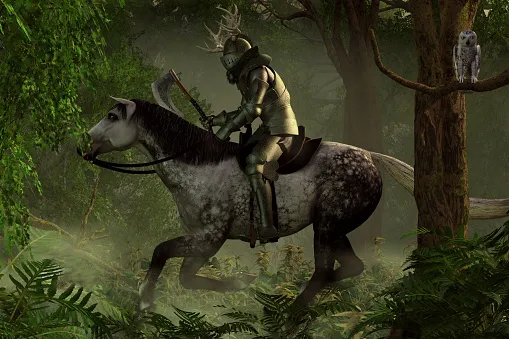 An armored medieval knight on horseback through a forest.
The Art of Horse Training
Beyond selective breeding, training was a critical and time-consuming practice. Kings and nobles would entrust this task to skilled trainers, as it took a minimum of two years to fully train a destrier. This intensive schooling was necessary to overcome a horse’s natural instinct to flee from the chaos of combat, including noise, the smell of blood, and general confusion. War horses needed to be desensitized to smoke, fire, and sudden movements.
Value and Acquisition of War Horses
Consequently, war horses commanded higher prices than ordinary riding horses, with destriers being the most prized. The financial values varied significantly across different sources. Some accounts suggest destriers could cost seven times the price of a common horse, while others indicate a value up to seven hundred times greater. For example, the Bohemian king Wenzel II is recorded to have ridden a horse valued at ‘one thousand marks’ in 1298. In contrast, a 1265 French ordinance limited a squire’s expenditure on a rouncey to twenty marks. Knights were expected to own at least one war horse, in addition to riding and packhorses. Records from the later Middle Ages show some knights bringing as many as twenty-four horses on campaign, with five possibly being the standard.
Other Medieval Horse Types
Besides the formidable destrier, several other types of horses were utilized in the Middle Ages:
- Palfreys: These were riding horses, often well-bred and comparable in price to destriers. They were favored by nobles and high-ranking knights for riding, hunting, and ceremonial purposes. An ambling gait was a desirable trait, allowing for comfortable long-distance travel.
- Cart Horses or Packhorses: These horses were used for hauling and carrying goods.
- Coursers: Generally preferred for intense battles, coursers were light, fast, and strong. While valuable, they were less expensive than destriers and also frequently used for hunting.
- Rounceys: This term encompassed a more general-purpose horse, suitable for riding or trained for war. They were commonly used by squires, men-at-arms, and less affluent knights. Wealthier knights might keep rounceys for their retinues. The specific demands of warfare could dictate the choice; for instance, a 1327 summons to war in England expressly requested rounceys for swift pursuits over destriers. Rounceys could sometimes serve as packhorses but not as cart horses.
- Jennets: A small horse type, first bred in Spain from Barb and Arabian stock. Their docile and dependable nature, along with their size, made them popular riding horses for ladies and also suitable for cavalry use by the Spanish.
- Hobbies: A lightweight horse, typically 13 to 14 hands tall, developed in Ireland from Spanish or Libyan bloodstock. This agile breed was popular for skirmishing and was often ridden by light cavalry known as Hobelars. Hobbies played a significant role in the Wars of Scottish Independence, with Edward I of England attempting to disrupt Irish exports of these horses to Scotland. Robert Bruce effectively employed the hobby for guerrilla warfare and mounted raids, covering impressive distances of 60 to 70 miles per day.
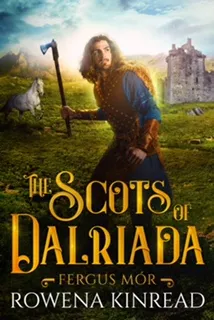 The Scots of Dalriada book cover.
About “The Scots of Dalriada”
Blurb:
THREE BROTHERS
Fergus, Loarn, and Angus, Princes of the Dalriada, are forced into exile by their scheming half-brother and the druidess Birga One-tooth.
THREE FATES
Fergus conceals himself as a stable lad on Aran and falls helplessly in love with a Scottish princess, already promised to someone else. Loarn crosses swords against the Picts. Angus designs longboats.
TOGETHER A MIGHTY POWER
Always on the run, the brothers must attempt to outride their adversaries by gaining power themselves. Together they achieve more than they could possibly dream of.
Fergus Mór (The Great) is widely recognized as the first King of Scotland, giving Scotland its name and its language. Rulers of Scotland and England from Kenneth mac Alpín until the present time claim descent from Fergus Mór.
Full of unexpected twists and turns, this is a tale of heart-breaking love amidst treachery, deceit, and murder.
Buy Links:
Universal Link: https://books2read.com/u/47VXAL
Amazon UK: https://www.amazon.co.uk/gp/product/B0BS78THF3
Amazon US: https://www.amazon.com/gp/product/B0BS78THF3
Amazon CA: https://www.amazon.ca/gp/product/B0BS78THF3
Amazon AU: https://www.amazon.com.au/gp/product/B0BS78THF3
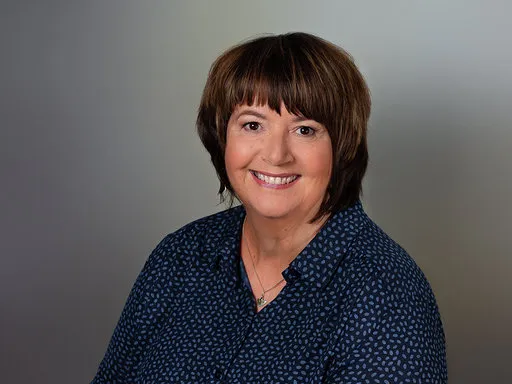 Author Rowena Kinread.
Author Biography
Rowena Kinread grew up in Ripon, Yorkshire, with her large family and numerous pets. Her passion for travel led her to her first job with Lufthansa in Germany. She began writing in the 1990s, with a particular interest in history. Her genealogical research revealed family roots in Ireland connected to the Dalriada clan, specifically during the era depicted in her novel. Her debut historical novel, “The Missionary,” focusing on the life of St. Patrick, was published by Pegasus Publishers on April 29, 2021, and received positive reviews from The Scotsman, The Yorkshire Post, and The Irish Times. Her second novel, “The Scots of Dalriada,” centers on Fergus Mór, the founding father of Scotland, and is set in 5th-century Ireland and Scotland, published by Pegasus Publishers on January 26, 2023. Rowena Kinread currently resides with her husband in Bodman-Ludwigshafen, Lake Constance, Germany, and they have three children and six grandchildren.
Social Media Links:
Website: https://www.rowena-kinread.com/
Twitter: https://twitter.com/RowenaKinread
Facebook: https://www.facebook.com/rowena.strittmatter
LinkedIn: https://www.linkedin.com/in/rowena-kinread-6b054b228/
Instagram: https://www.instagram.com/rowenakinread/
