
The Barred Owl (Strix varia) is a fascinating and widespread avian predator, often recognized by its distinctive hooting call and its remarkable camouflage. As one of North America’s most common owl species, understanding its characteristics, habitat, and behavior is crucial for appreciating its role in various ecosystems. This guide delves into the life of the Barred Owl, providing insights for both seasoned bird enthusiasts and those new to the world of raptors.
Description and Appearance
Barred Owls are renowned for their effective camouflage, with plumage of gray-brown stripes that allows them to meld seamlessly with the dense foliage of mature forests. They possess a round head, lacking the prominent “ear tufts” seen on some other owl species, and striking large, dark eyes. Upon hatching, juvenile Barred Owls are covered in soft, pale down. Within a few weeks, they begin to develop their feathers, and by the time they leave the nest, their adult plumage is nearly complete, making them almost indistinguishable from older owls. While plumage is similar between sexes, females are typically slightly larger than males. Adult Barred Owls generally weigh between 1 to 2.5 pounds, measure 16-20 inches in length, and have a wingspan of 39-44 inches.
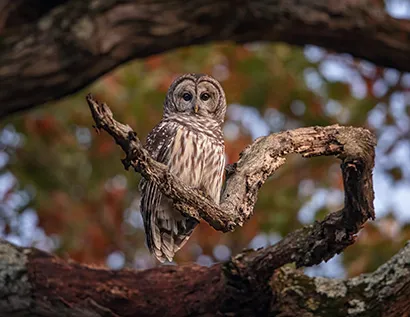 A Barred owl perched on a tree branch.
Geographic Range
The Barred Owl boasts an extensive range across North America. Its presence covers the entire East Coast of the United States and extends westward to Oklahoma. They are also a common sight in Southern Canada and have recently been observed expanding into the Pacific Northwest. This expansion has, unfortunately, led to increased competition and occasional hybridization with the smaller, less aggressive Spotted Owl (Strix occidentalis), raising concerns for the latter’s population.
Preferred Habitat
Barred Owls exhibit adaptability in their habitat choices, thriving in diverse environments such as swamps, adjacent uplands, and streamside areas. They show a strong preference for established, mature, and old-growth forests. This preference is linked to their nesting habits, as they favor dead trees, large tree cavities, and old snags for raising their young. As long as a forest ecosystem is relatively diverse and healthy, Barred Owls can establish a home. During roosting periods, they seek refuge in tree cavities, dense branches, or man-made nest boxes.
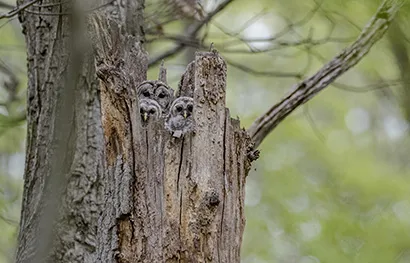 A Barred owl and their young.
Behavioral Patterns
Barred Owls are most active during the crepuscular hours of twilight. Throughout daylight hours, they typically remain still, roosting quietly in trees. However, they are not strictly nocturnal and have been observed calling and hunting during the day, sometimes even seen basking on sunny forest edges during winter. Barred Owls are territorial birds, exhibiting more assertive behavior, particularly during their nesting season. While they share habitats with Great Horned Owls, Barred Owls generally avoid these larger, more aggressive counterparts.
Diet and Hunting Strategies
As opportunistic predators, Barred Owls have a varied diet. Small mammals, such as mice, form the majority of their meals. However, they also supplement their diet with smaller birds, amphibians, reptiles, and invertebrates. Their hunting strategy often involves perching near water bodies and swiftly swooping down to catch fish and crayfish.
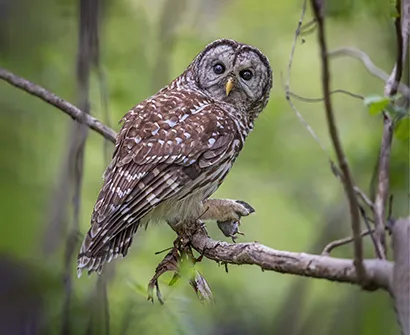 A Barred Owl holding a mouse.
Reproduction and Life Cycle
Barred Owls typically reach reproductive age at approximately two years old. While definitive proof is elusive, pairs are believed to mate for life or at least maintain behavioral monogamy. The breeding season spans from January to August. Males engage in courtship rituals to attract females, which involve swaying their bodies, raising their wings, and sliding along tree branches. They vocalize with a series of cackles, hoots, caws, and gurgles to attract mates. While Barred Owls usually breed once a year, they may skip a year periodically. Females typically lay two to three eggs per season, with incubation lasting around 28 to 33 days. Young Barred Owls leave the nest after about four to five weeks, a process known as “branching,” where they move along tree branches before gaining full flight capability.
Vocalizations
The Barred Owl’s call is distinctive and often described as deep-pitched, rhythmic “hoots” that sound like “Who cooks for you? Who cooks for you all?”. They also emit single hoots and can produce a sound resembling laughter during courtship. Male calls tend to be deeper in pitch than those of females. Barred Owls are quite vocal throughout the year, with their calls becoming more frequent in late summer and early fall. As a warning, they may also snap their bills.
Conservation Status and Threats
Globally, Barred Owls are considered relatively common, with an estimated breeding population of around 3.5 million individuals. Bird surveys indicate a slight population increase of 1.1% between 1966 and 2019. A significant conservation concern arises from their encroachment into the Pacific Northwest, where they outcompete and hybridize with the endangered Spotted Owl, posing a threat to the latter’s survival. Due to their reliance on large tracts of mature forest, Barred Owls are recognized as an indicator species for habitat management and conservation. In Maryland, they are designated as one of the Forest Interior Dwelling Species (FIDS).
Did You Know?
Barred Owls that include crayfish in their diet may develop distinctive pink-tinged breast feathers.
