
In the heart of bustling Tokyo, just outside the world-famous Shibuya Station, stands the bronze statue of a dog. He isn’t a mythical creature or a celebrated war hero, but his story embodies a love so profound and a loyalty so absolute that it has touched millions around the globe. This is the tale of Hachikō, the Japanese dog at the train station, whose unwavering devotion turned him into an enduring symbol of faith and friendship. His daily vigil is more than just a sweet story; it’s a powerful reminder of the incredible bond between humans and their canine companions.
The story begins in 1924, when Hidesaburō Ueno, a professor in the agriculture department at Tokyo Imperial University, was looking for a purebred Akita Inu puppy. A student helped him acquire a beautiful, cream-colored Akita born in Ōdate, Akita Prefecture. Professor Ueno named him Hachi, the Japanese word for “eight,” a number considered lucky. The two formed an immediate and inseparable bond. For the professor, who had no children, Hachi became the center of his world.
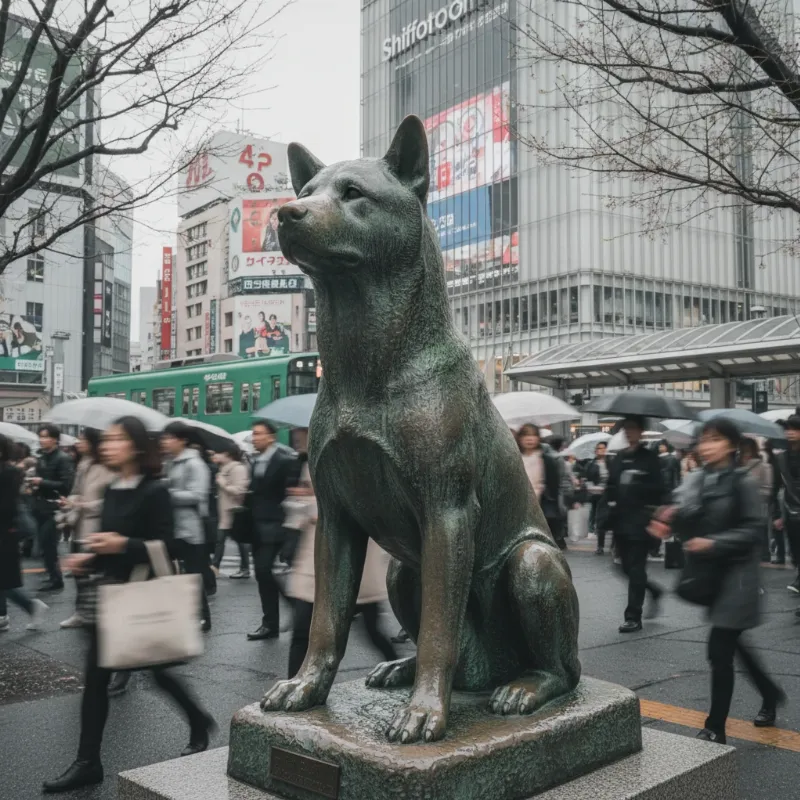 The iconic bronze statue of Hachikō, the Japanese dog at the train station, a popular meeting spot in Tokyo.
Their daily routine was a portrait of perfect companionship. Every morning, Hachi would walk with Professor Ueno to Shibuya Station, where the professor would catch the train to work. And every afternoon, at precisely 3 p.m., Hachi would return to the station, positioning himself near the ticket gates, eagerly awaiting his master’s return. This heartwarming ritual became a familiar sight to commuters and local shopkeepers, a small, reliable moment of joy in their busy days.
The Unbreakable Bond and the Long Wait
This happy routine continued for just over a year. Then, on May 21, 1925, tragedy struck. While delivering a lecture, Professor Ueno suffered a sudden cerebral hemorrhage and passed away. He never came home on the 3 p.m. train. But at Shibuya Station, Hachi was there, waiting as always. The minutes turned into hours, the afternoon sun faded into evening, but the professor never appeared.
Hachi did not understand. In the days that followed, he was passed between different relatives, but he continually escaped, always making his way back to the familiar spot at Shibuya Station. Eventually, he was taken in by Professor Ueno’s former gardener, who lived near the station. From there, every single day, without fail, Hachi resumed his vigil. Rain or shine, through sweltering summers and bitter winters, he appeared at the station as the 3 p.m. train was due to arrive, searching the faces in the crowd for the one that mattered most.
At first, station workers were not so kind, seeing him as a stray. But as his story spread, their hearts softened. One of Professor Ueno’s former students, who had become an expert on the Akita breed, saw Hachi at the station and learned his story. He was so moved that he published a series of articles about Hachi’s incredible loyalty. Through his writing, Hachi was transformed from a local fixture into a national sensation. People from all over Japan came to visit him, bringing food and treats. His vigil became a lesson in devotion, a spirit of family loyalty that everyone should strive to achieve.
How a Faithful Dog Became a National Symbol
Hachikō’s story captured the heart of a nation. In the 1930s, Japan was experiencing a rise in nationalism, and the tale of the loyal dog who honored his master’s memory resonated deeply. Teachers and parents used Hachikō’s vigil as an example to teach children about faithfulness and commitment. He became a chūken, a “faithful dog,” and a living monument to the ideals the country held dear.
In 1934, a bronze statue was erected in his honor at the very spot where he waited at Shibuya Station. Hachikō himself was present at its unveiling. This solidified his status as a cultural icon. His long wait finally ended on March 8, 1935, when he was found to have passed away peacefully on a Shibuya street at the age of 11. His death was front-page news. Scientists later determined he had terminal cancer and a filarial infection.
Hachikō’s story has been immortalized in books and films, ensuring his legacy lives on. Many people are familiar with the story through movies, and the tale of the dog waits at train station movie continues to touch new generations. His story is a poignant example of the profound connection animals can have with us.
 A noble Akita Inu, the breed of the famous Japanese dog at the train station, Hachikō, looking loyal and intelligent.
Understanding the Akita Inu Breed
To understand Hachikō, one must understand his breed. The Akita Inu is a large and powerful dog breed originating from the mountainous northern regions of Japan. Originally used for hunting large game like bear and wild boar, Akitas are known for their courage, dignity, and profound loyalty to their families. They are intelligent but independent thinkers, often described as having a cat-like quality in their grooming habits and demeanor.
Akitas are typically wary of strangers but are deeply affectionate and protective of their family members. Their loyalty, as exemplified by Hachikō, is legendary. They form incredibly strong bonds with their owners and are not just pets but true companions. This inherent trait is central to the incredible story of the movie about dog waiting at train station, which showcases this deep-seated devotion.
The Enduring Legacy of Hachikō Today
Hachikō’s original statue was melted down for the war effort during World War II, but a new one was commissioned and erected in 1948. Today, the “Hachikō Exit” of Shibuya Station is one of Tokyo’s most popular meeting points. Every year on March 8th, a ceremony is held at the statue to honor his memory, attended by hundreds of dog lovers.
His story has spread far beyond Japan. Other statues have been erected, including one at the University of Tokyo, depicting a joyous reunion between Hachikō and Professor Ueno, and another in Woonsocket, Rhode Island, the setting for the American film adaptation. The story of the dog waiting for owner at train station movie has made his name synonymous with loyalty across different cultures.
Hachikō’s tale is not just about a dog waiting for his owner. It is a timeless story about a love that transcends death and a loyalty that never fades. It reminds us of the simple, profound, and unspoken promises we make to those we love, and the incredible capacity for devotion that resides within the hearts of our animal friends. The story of the Japanese dog at the train station continues to inspire us to be better, more faithful companions to one another.
Frequently Asked Questions (FAQ)
1. Is the story of Hachikō, the Japanese dog at the train station, true?
Yes, it is a completely true story. Hachikō was a real Akita dog who lived from 1923 to 1935. He waited for his deceased owner, Professor Hidesaburō Ueno, at Shibuya Station in Tokyo every day for over nine years until his own death.
2. What kind of dog was Hachikō?
Hachikō was a purebred Akita Inu, a large and noble breed native to Japan. Akitas are renowned for their loyalty, courage, and dignified nature, all traits that Hachikō exemplified.
3. Where is the Hachikō statue located?
The most famous Hachikō statue is located just outside the Hachikō Exit of Shibuya Station in Tokyo, Japan. It is a very popular landmark and a common meeting place for locals and tourists alike.
4. What happened to the original Hachikō statue?
The original statue, erected in 1934 while Hachikō was still alive, was recycled for metal during World War II. The current statue that stands at Shibuya Station was put up in 1948.
5. How did Hachikō die?
Hachikō passed away on March 8, 1935, at the age of 11. For many years, the cause was debated, but a 2011 examination revealed that he had terminal cancer and a severe filarial (heartworm) infection.
6. Are there movies about Hachikō?
Yes, his story has been adapted into several films. The most famous are the 1987 Japanese film Hachikō Monogatari and the 2009 American adaptation Hachi: A Dog’s Tale, starring Richard Gere.
