
The image is one of the most iconic in all of ancient lore: a colossal wooden horse standing before the imposing gates of Troy. It’s a tale of cunning strategy, deception, and the dramatic fall of a great city. For centuries, we’ve been captivated by this military masterstroke. But the central question remains: Is The Wooden Horse Of Troy A True Story? While the legend has galloped through thousands of years of storytelling, the line between historical fact and epic fiction is much more complex than it appears.
The enduring fascination with this account shows how powerful narratives shape our understanding of the past. Much like the timeless questions explored in the trojan horse myth story, our curiosity drives us to uncover the truth behind the legend. Separating the archaeological reality from the poetic embellishments requires a journey back in time, not just to the Bronze Age battlefield, but also into the minds of the ancient poets who first told the tale.
The Epic as We Know It: A Tale of Deception
The most famous and detailed account of the Trojan Horse comes not from Homer’s Iliad, which focuses on the final year of the Trojan War but ends before the city’s fall, but from the Roman poet Virgil’s epic, the Aeneid. Written over a millennium after the supposed event, Virgil tells a dramatic story.
After a grueling ten-year siege with no victory in sight, the brilliant Greek strategist Odysseus conceives a radical plan. The Greeks construct a gigantic wooden horse and hide a select force of their best warriors inside. The rest of the Greek army then burns their camp and sails away, appearing to abandon the war and return home. They leave behind one man, Sinon, to act as a supposed deserter and spin a tale.
When the Trojans discover the enormous horse, they are bewildered. Sinon, playing his part perfectly, tells them the horse is an offering to the goddess Athena, built to an immense scale so that the Trojans could not bring it into their city and claim its divine protection. According to his lie, if the horse were brought inside Troy’s walls, the city would become invincible. Despite the warnings of the priest Laocoön, who famously declared, “I fear the Greeks, even when they bear gifts,” the Trojans fall for the ruse. They tear down a section of their own impenetrable walls to drag the horse inside and celebrate their apparent victory. That night, as the city sleeps in a drunken stupor, the hidden Greek soldiers emerge, slaughter the sentries, and open the city gates to their waiting army, which has secretly sailed back under the cover of darkness. Troy is sacked, burned, and its people are scattered, all thanks to a clever trick.
Digging for the Truth: Archaeological Evidence
For many centuries, Troy was considered a purely mythical place, and the Trojan War a product of Homer’s imagination. However, the work of archaeologist Heinrich Schliemann in the 1870s changed everything. Excavating at a site called Hisarlik in modern-day Turkey, Schliemann uncovered the ruins of a city that matched ancient descriptions of Troy.
Archaeologists have since identified at least nine distinct cities built on top of one another over millennia at this site. The layer known as Troy VIIa shows clear evidence of a violent end—destruction by fire and the presence of skeletons—dating to the late Bronze Age, around the same time the Trojan War is believed to have occurred (c. 1200 BCE). This strongly suggests that a war, very possibly the historical basis for the Trojan War, did indeed happen. The city was real, and it fell violently.
But what about the horse? Here, the physical evidence runs cold. There is absolutely no archaeological evidence to suggest a giant, hollow wooden horse was ever built or brought into Troy. Wooden artifacts from that period would almost certainly have decomposed over the last 3,000 years, making definitive proof or disproof nearly impossible. The absence of evidence, however, has led historians and archaeologists to a near-unanimous conclusion: the Trojan Horse, as a literal object, was almost certainly not real. This leads to a new question: if it wasn’t a real horse, what was it?
Deconstructing the Myth: Scholarly Theories
If the city was real and the war was real, but the horse was not, where did the story come from? Most scholars believe the Trojan Horse was a metaphor, an imaginative symbol for something far more mundane but equally effective.
Theory 1: The Horse as a Siege Engine
The most widely accepted theory, supported by classicists like Dr. Armand D’Angour of Oxford University, is that the “horse” was actually a sophisticated piece of military equipment. In the ancient world, siege engines like battering rams were often given animal names. It’s plausible that the Greeks built a large, wheeled battering ram, possibly covered with damp horse hides to protect it from flaming arrows. The Trojans, unfamiliar with such technology, might have seen a fearsome, horse-like machine breach their walls. Over centuries of oral tradition, this “Trojan battering ram” could have transformed into the more fantastical story of a giant wooden horse. This explanation provides a logical bridge between the mythical story and the realities of ancient warfare. Presenting this complex history can be a challenge, which is why the narrative is often simplified in formats like a trojan horse story powerpoint for easier understanding.
Theory 2: The Horse as an Earthquake
Another compelling theory connects the horse to the divine. Poseidon, the Greek god of the sea, was also known as the “Earth-Shaker”—the god of earthquakes. Crucially, the horse was one of his sacred animals. The walls of Troy could have been breached not by a Greek weapon, but by a timely earthquake. An ancient poet could have used the horse, Poseidon’s symbol, as a powerful metaphor to describe the god’s intervention on behalf of the Greeks, which led to the city’s walls tumbling down. This would have been a way of attributing a natural disaster to divine will, a common practice in ancient storytelling.
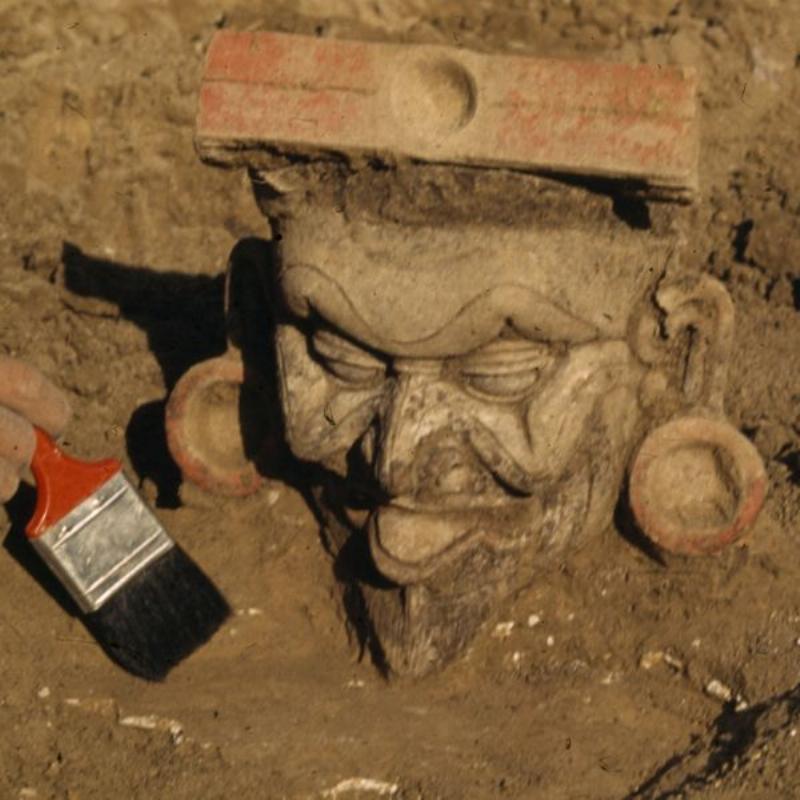 Archaeologists carefully brushing away dirt from ancient stone ruins at the Hisarlik excavation site, representing the search for the real Troy.
Theory 3: A Poetic Invention
The simplest explanation is that the story is just that—a story. The tale of the horse is a brilliant piece of fiction, created by early poets to solve a narrative problem: How did the seemingly invincible city of Troy finally fall? A ten-year stalemate ending with a clever, dramatic twist is far more compelling than a simple story of attrition. Virgil, writing for a Roman audience hundreds of years later, had every reason to dramatize the event, creating a foundational epic that highlighted the cunning and destiny of his characters, including the Trojan hero Aeneas who would go on to found Rome.
The Power of a Story: Why the Legend Endures
Ultimately, whether the Trojan Horse was a real object, a metaphor for a siege engine, or a pure fabrication doesn’t diminish its power. The story has survived for millennia because it speaks to timeless themes of ingenuity, deception, and the idea that brains can triumph over brawn. The phrase “Trojan Horse” has become a universal metaphor for any trick that involves subverting a target from the inside by appearing to be a gift.
The narrative serves as a profound cautionary tale about pride and gullibility. The Trojans were not defeated by force alone, but by their own hubris in believing they had won and their failure to look a gift horse in the mouth. This intersection of myth and potential history is what makes the question of “was the wooden horse of Troy a true story” so compelling, creating a rich tapestry of interpretation.
In conclusion, while the city of Troy was very real and its violent destruction is supported by archaeological evidence, the famous wooden horse is likely a product of poetic imagination. It stands as a powerful symbol rather than a historical artifact—a brilliant narrative device to explain the fall of a mighty city and to deliver a timeless lesson about vigilance and deception. The story’s true power lies not in its historical accuracy, but in its enduring ability to capture the human imagination.
Frequently Asked Questions
1. Is the Trojan Horse mentioned in Homer’s Iliad?
No, the story of the Trojan Horse is not in the Iliad, which ends with the funeral of the Trojan hero Hector before the city’s fall. The horse is mentioned briefly in Homer’s other epic, the Odyssey, but the most detailed account comes from Virgil’s Aeneid, written much later.
2. Is Troy a real city?
Yes, archaeologists are confident that the ancient city of Troy was located at the site of Hisarlik in modern-day Turkey. Excavations have revealed multiple layers of a fortified city and evidence of destruction by war around the time the Trojan War is said to have occurred.
3. What is the most likely real story behind the Trojan Horse?
Most historians believe the Trojan Horse story is a metaphor for a type of siege engine, possibly a large, covered battering ram, that was used to breach Troy’s walls. The animal name could have been literal (covered in horse hides) or symbolic, which evolved into a fantastical story over time.
4. Who came up with the idea of the Trojan Horse?
In the legend, the master strategist Odysseus, a Greek king known for his cunning and intellect, is credited with conceiving the plan of the Trojan Horse.
5. Why is the story of the Trojan Horse still famous today?
The story endures because of its powerful themes of deception, strategy, and the danger of accepting gifts from enemies. The term “Trojan Horse” has become a widely used metaphor for any form of trickery that involves smuggling a destructive element inside a secure place by disguising it as something harmless.
