
For centuries, the tale of the Trojan Horse has stood as the ultimate symbol of cunning and deception. It’s a story we all know: after a grueling ten-year siege, Greek soldiers finally conquered the impenetrable city of Troy not by force, but by hiding inside a giant wooden horse left as a supposed offering. But beyond the epic poems and Hollywood blockbusters, a compelling question remains: Is The Trojan Horse Story Real? The answer, like the story itself, is more complex than it first appears, blending threads of myth, history, and archaeological discovery.
The journey to uncover the truth begins with separating historical fact from poetic license. While the city of Troy was once thought to be a mythical place, we now know it was very real. Thanks to the pioneering and controversial excavations by Heinrich Schliemann in the 1870s at a site called Hisarlik in modern-day Turkey, the physical ruins of Troy were uncovered. So, if Troy was a real place, does that mean the Trojan War and its famous wooden horse were also real? To find out, we must look deeper into the evidence we have. The popular narrative about the final fall of the city is a fascinating part of history, similar in some ways to the trojan horse true story that has been passed down through generations.
The Legendary Tale: What Did the Ancients Say?
Interestingly, the most famous account of the Trojan Horse doesn’t come from Homer’s Iliad, the epic poem that details the Trojan War. The Iliad actually ends before the fall of the city, concluding with the funeral of the Trojan hero Hector. The dramatic story of the wooden horse is told most famously by the Roman poet Virgil in his epic, the Aeneid, written centuries after the supposed events.
Virgil describes in vivid detail how the Greeks, on the advice of the clever Odysseus, built a colossal horse of timber. They hid their fiercest warriors inside, while the rest of the Greek army pretended to sail away in defeat. A lone Greek soldier, Sinon, was left behind to convince the Trojans that the horse was a sacred offering to the goddess Athena, intended to ensure their safe voyage home. Despite the warnings of the priest Laocoön, the Trojans wheeled the massive structure into their city, sealing their own doom. That night, the hidden soldiers emerged, opened the city gates for their returned army, and Troy was destroyed. While this version is the most well-known, it’s important to ask, was the trojan horse a real story?
Searching for Troy: The Archaeological Evidence
Archaeological work at the site of Hisarlik has revealed not just one city, but multiple layers of settlements built on top of each other over thousands of years. One of these layers, known as Troy VI or VIIa, shows clear signs of violent destruction around 1200 B.C., a date that aligns with the traditional timeframe for the Trojan War. There is evidence of fire and conflict, which suggests a war could indeed have taken place.
However, for all the pottery shards, fallen walls, and ancient artifacts that have been unearthed, there is one thing archaeologists have never found: any physical evidence of a giant wooden horse. No remains of the structure, no blueprints, and no contemporary inscriptions describing it have ever been discovered. Wood from that era would almost certainly have decomposed long ago, making a direct discovery highly unlikely. This lack of evidence has led most historians and archaeologists to conclude that the Trojan Horse, as described by Virgil, was probably not a literal historical object. This conclusion naturally leads one to question, is trojan horse story real?
Was the Trojan Horse a Metaphor?
If there was no giant wooden animal, what could have inspired the legendary story? The most widely accepted theory among scholars is that the Trojan Horse was a metaphor or a poetic exaggeration of a real military strategy or event. There are several compelling possibilities.
A Sophisticated Siege Engine
The most popular theory suggests the “horse” was actually a type of siege engine. Ancient armies, such as the Assyrians, used large, wooden battering rams, often covered with dampened animal hides to protect them from fire arrows. These war machines sometimes had names and may have been fashioned to resemble animals. It is plausible that the Greeks used such a device to breach Troy’s formidable walls, and over centuries of oral storytelling, this practical war machine was transformed into the more fantastical and memorable image of a wooden horse.
An Earthquake’s Fury
Another intriguing idea links the horse to the god Poseidon, who was not only the god of the sea but also of earthquakes and horses. The archaeological layer of Troy VI appears to have been destroyed by a major earthquake. It’s possible that an earthquake damaged the city’s walls, allowing the waiting Greek army to finally enter. The “Trojan Horse” could have been a poetic way of describing this destructive, earth-shattering event brought by the “Earth-Shaker” god, symbolized by his sacred animal.
A Ship in Disguise
Some scholars have pointed out that ancient poets sometimes referred to ships as “horses of the sea.” The story could be a metaphorical retelling of Greek soldiers arriving by ship, perhaps under the cover of a false treaty or inside a vessel with a horse-like figurehead, to take the city by surprise. The idea of a deceptive vessel fits perfectly with the narrative of cunning over brute force. The debate over these interpretations makes many wonder, was the trojan horse story real.
The Trojan War: Fact Rooted in Fiction?
While the Trojan Horse itself is likely a myth, the war that inspired the story may have its roots in historical reality. The archaeological evidence for a violent conflict at Troy, combined with other Bronze Age texts that mention political instability and warfare in the region, suggests that a historical Trojan War, or a series of conflicts, likely occurred.
The epics of Homer were composed hundreds of years after these events, drawing from a long tradition of oral poetry. These stories were never meant to be literal historical records. They were grand tales of heroes, gods, and monsters, blending historical memory with myth and moral lessons. The Trojan Horse served as a perfect narrative device to explain the fall of a mighty city, emphasizing Greek ingenuity and the folly of Trojan pride.
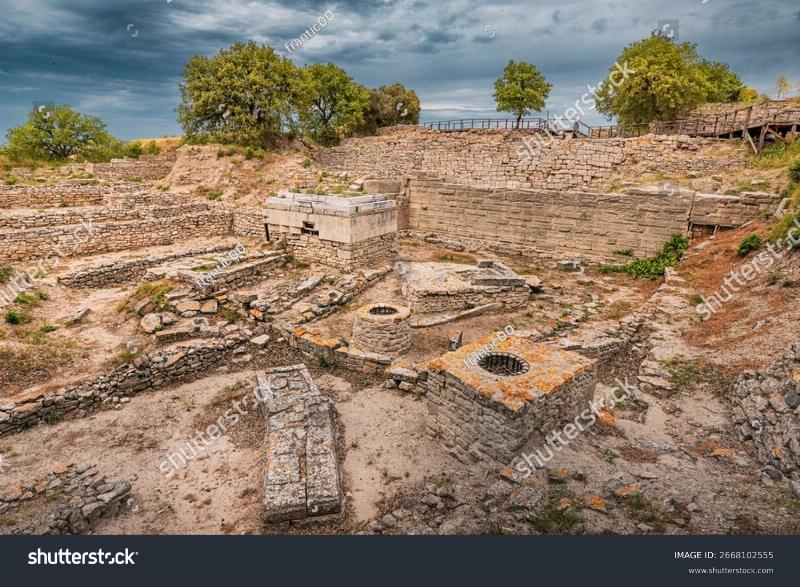 Archaeological ruins of the ancient city of Troy in modern-day Turkey, showing the layers of history under a clear blue sky.
Why Does the Story Still Captivate Us?
Ultimately, whether the Trojan Horse was a real object or a powerful metaphor doesn’t diminish its cultural impact. The story has endured for millennia because it speaks to timeless themes: the thin line between strategy and trickery, the danger of accepting gifts at face value, and the idea that even the most fortified defenses can be brought down from within.
The phrase “Trojan horse” has become a part of our modern vocabulary, used to describe everything from malicious computer viruses to deceptive political tactics. It serves as a universal warning about hidden threats and the importance of looking beyond outward appearances.
In conclusion, while you won’t find the remains of a giant wooden horse at the archaeological site of Troy, the story is very much real in its own way. The city of Troy was real, and a great war was likely fought there. The Trojan Horse itself, however, is almost certainly a brilliant piece of storytelling—a myth created to explain a historical event, a legend that has galloped through history to become one of the most powerful tales of ingenuity and deceit ever told. The question of whether the is the trojan horse a real story continues to intrigue us because it lives at the fascinating intersection of history and myth.
