
Geraldine Brooks’s novel “Horse” has captivated readers with its sweeping narrative that bridges centuries, connecting the worlds of antebellum horse racing, modern science, and art history. Many fans are left wondering, is the novel Horse based on a true story? The simple answer is yes, but the reality is a masterful blend of historical fact and imaginative fiction. The book is anchored in the remarkable life of a real record-breaking thoroughbred, creating a powerful story of spirit, obsession, and the enduring legacy of injustice in America.
At the very heart of the novel is the legendary racehorse, Lexington. He was not a fictional creation but one of the most celebrated thoroughbreds in American history. Born in 1850, Lexington was a bay colt who dominated the racetracks, winning six of his seven starts and setting a world record. This exploration of a real equine superstar has drawn comparisons to other famous equine tales, and many readers often wonder about the truth behind stories like is the War Horse based on a true story, which also delves into the deep connection between humans and horses against a backdrop of historical conflict.
The Real Star: Lexington, the Blind Hero of Woodburn
Lexington’s story is the solid foundation upon which Geraldine Brooks builds her intricate narrative. He was a real horse, bred by Dr. Elisha Warfield in Kentucky, and his athletic prowess was unparalleled in the 1850s.
- A Champion Racer: Lexington was renowned for his stamina in grueling four-mile races. In 1855, he set a stunning record at the Metairie race course in New Orleans, running four miles in 7 minutes and 19 ¾ seconds.
- A Storied Rivalry: His races against a rival horse named Lecomte were legendary, capturing the nation’s attention and symbolizing the competitive spirit of the era.
- Tragic Eyesight: Like his sire, Boston, Lexington suffered from poor eyesight, which eventually forced his retirement from racing. This condition, however, did not end his legacy.
- Unmatched Stud Career: Retired to stud at Woodburn Farm, Lexington became the most successful sire of his time, a record that remains impressive. He was the leading sire in North America for 16 years. His progeny included numerous champions, and his bloodline can be found in many modern thoroughbreds.
The historical accounts of Lexington are so compelling that they could be a novel in themselves. Brooks masterfully uses these real events as the driving force of her story’s 19th-century timeline.
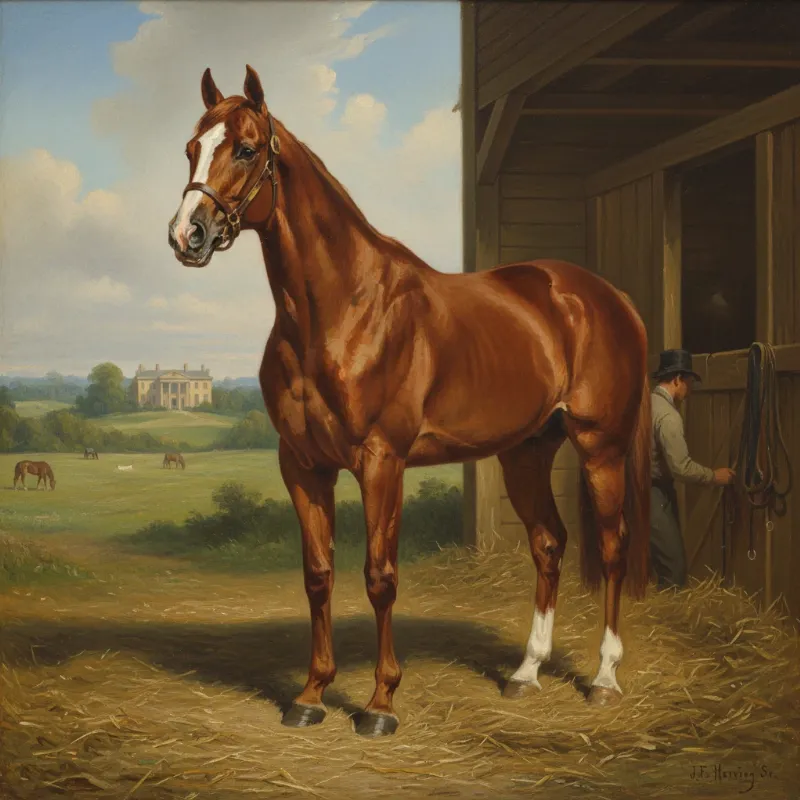 An oil painting of the famous 19th-century thoroughbred racehorse Lexington, capturing his powerful build and distinctive bay coat. The style is classic equine portraiture from the 1850s.
Fact vs. Fiction: Weaving the Narrative
While Lexington is real, Horse is a work of historical fiction. Brooks expertly weaves documented history with imagined characters and storylines to explore deeper themes. The novel operates on multiple timelines, connecting the past to the present in a profound way.
The Historical Timeline: Jarret and the Horse
The 1850s narrative centers on Jarret, an enslaved groom who forms an unbreakable bond with Lexington. While the horse Lexington was incredibly well-documented, the lives of the Black horsemen who were essential to his success were often erased from the historical record.
Jarret is a fictionalized character, but he is based on the real history of accomplished Black horsemen of that era. Brooks was inspired by men like Ansel Williamson, a trainer, and Edward D. Brown, a jockey and trainer, both of whom were enslaved yet held immense responsibility and expertise in the thoroughbred world. The character of Jarret gives a voice to these unsung figures, imagining the deep, personal connection he would have had with the horse he cared for. The depiction of their relationship is similar to other powerful equine narratives, making one think of the best horse story books where the bond between animal and human is central.
The Modern Timeline: Jess and Theo
In the 21st-century storyline, Jess, a Smithsonian scientist, and Theo, a Nigerian-American art historian, uncover Lexington’s story from different angles. This part of the novel is entirely fictional but is inspired by real artifacts.
- The Skeleton: The Smithsonian actually possesses the articulated skeleton of Lexington. For years, it was stored in an attic before being recognized for its historical significance. In the novel, Jess’s osteological study of these bones provides a scientific lens to understand the horse’s incredible physiology.
- The Painting: The story is also sparked by a real 19th-century painting of Lexington by the itinerant artist Thomas J. Scott. In the book, Theo’s discovery of this painting helps him piece together the lost history of the horse and his groom, leading him to investigate the life of Jarret.
This dual-timeline structure allows Brooks to explore how the legacy of slavery and racism continues to reverberate in the present day, connecting Jarret’s experiences in the 1850s with Theo’s in 2019. This nuanced approach to history is what makes readers question if is the book horse based on a true story, as the factual elements are so deeply and seamlessly integrated.
The Author’s Research: Uncovering a Lost History
Geraldine Brooks was inspired to write Horse after learning about the real Lexington from a Smithsonian official. Her extensive research forms the backbone of the novel. She delved into archives, racing histories, and scientific papers to bring Lexington’s world to life.
“When I write novels I like to stick to as much of the known history as I can,” Brooks has stated in interviews. “The story of Lexington the racehorse is incredibly well documented because thoroughbred racing was such a passion in the 19th century.”
Her research uncovered not just the triumphs of the horse but also the glaring gaps in the record, particularly concerning the Black horsemen. By creating Jarret, she performs an act of historical reclamation, imagining a rich inner life for a figure who represents countless others whose contributions were ignored. This commitment to historical detail is reminiscent of other works that explore the true story of horse soldiers, where real events provide a framework for a compelling narrative.
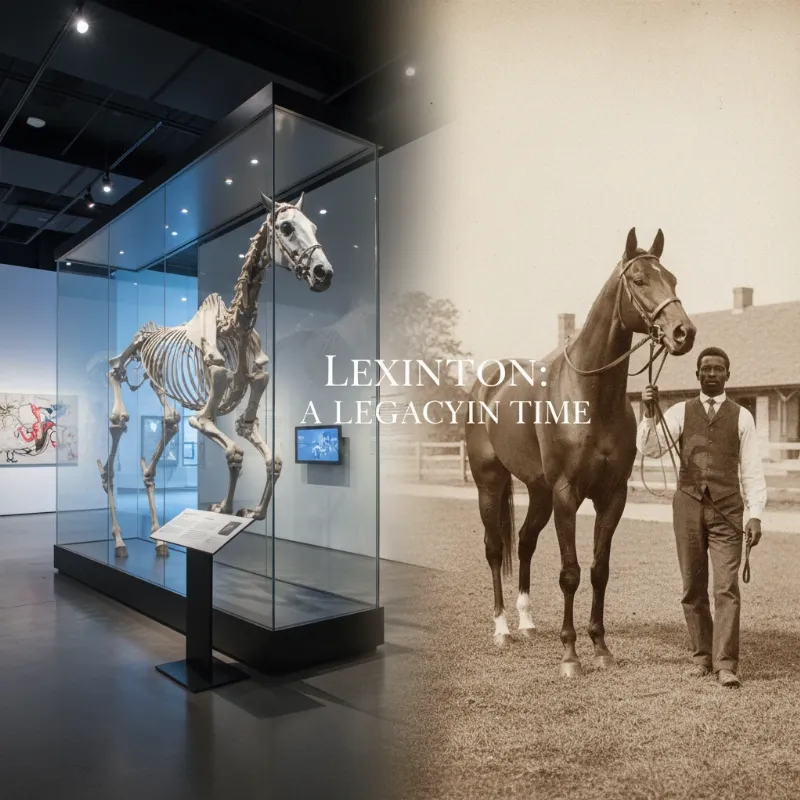 A conceptual image blending a modern museum exhibit of a horse skeleton with a ghostly, historical image of the same horse in its prime, with its groom. The mood is reflective and historical.
Why the True Story of Lexington Still Resonates
The novel Horse is more than just a story about a famous animal; it’s a profound commentary on American history, race, and memory. By grounding her story in the real life of Lexington, Brooks gives readers a tangible connection to the past.
The historical reality is that the antebellum racing industry, like much of the Southern economy, was built on the labor of enslaved people. The expertise of Black grooms, trainers, and jockeys was the engine that powered the sport. Yet, their stories are rarely told.
By asking “is the novel Horse based on a true story?”, readers are invited to discover this complex history. The answer reveals that while the characters may be fictionalized, the world they inhabit is very real. The triumphs of Lexington are real, but so are the injustices faced by Jarret. The novel uses the documented history of a celebrated animal to illuminate the undocumented history of the people who made his greatness possible.
In conclusion, Geraldine Brooks’s Horse is a brilliant example of historical fiction that honors its source material. It is deeply rooted in the true story of Lexington, America’s greatest stud sire, using his phenomenal life as a lens to explore the enduring questions of race, love, and art across centuries. The novel is a testament to the power of a great horse to connect us to a past we are still struggling to understand.
Frequently Asked Questions (FAQ)
Who was the real horse in the novel Horse?
The novel is based on the real-life Thoroughbred racehorse Lexington (1850-1875). He was one of the most successful racehorses and sires in American history, holding a record for four-mile races and leading the sire list for a record 16 years.
Was Jarret, the groom, a real person?
Jarret is a fictional character created by Geraldine Brooks. However, he is inspired by the countless real, yet often anonymous, enslaved Black horsemen who were the backbone of the antebellum racing industry. His character is a composite based on historical figures like trainer Ansel Williamson and jockey Edward D. Brown.
Does the Smithsonian really have Lexington’s skeleton?
Yes, the Smithsonian’s National Museum of Natural History has the skeleton of Lexington. For a long time, the bones were stored in the museum’s attic before being re-discovered and recognized for their historical importance. They are now on loan to the International Museum of the Horse in Lexington, Kentucky.
Is the modern-day storyline with Jess and Theo true?
No, the characters of Jess and Theo and their contemporary storyline are entirely fictional. They serve as a narrative device to connect the past with the present and to uncover the historical mystery of Lexington and his groom through scientific and art-historical investigation.
What parts of the book are historically accurate?
The most accurate parts are those concerning Lexington’s life: his birth, his major races and records, his rivalry with the horse Lecomte, his failing eyesight, and his incredibly successful career as a stud sire. The general historical context of antebellum Kentucky and the racing world is also well-researched and accurately portrayed.
