
The question of what constitutes a “horse” is more complex than it appears, delving into the intricacies of biological classification and the very definition of species. While a horse is generally recognized, understanding the boundaries of what defines an equine “kind” requires exploring scientific concepts and their interpretations, particularly within the framework of creationist beliefs. This article examines the biological species concept and its application to equines, alongside discussions on genetic divergence and the search for a common equine ancestor.
The Biological Species Concept and Equine Boundaries
High school biology often introduces the biological species concept (BSC) as groups of interbreeding natural populations reproductively isolated from others. Proposed by Dr. Ernst Mayr, this definition, while useful for many animals, has limitations and has been a subject of debate for decades, with over a dozen different species concepts developed by scientists. The practical application of the BSC to modern equines, however, provides clear examples. Horses and donkeys, for instance, can interbreed to produce sterile mules, demonstrating their reproductive isolation and distinct species status.
Similarly, horses and zebras can produce offspring, but their interbreeding primarily occurs under unnatural conditions. In nature, behavioral differences and proximity rarely lead to interbreeding, thus maintaining their distinct genetic pools and species. This principle also applies to coyotes and wolves, which, despite occasional natural hybridization, largely remain separate species due to behavioral distinctions that limit natural intermingling. Therefore, a horse is defined not just by its appearance but by its inherent recognition of its own kind and its reluctance, under normal circumstances, to interbreed with other animals outside its genetic stock. Most species concepts would readily classify Equus ferus (encompassing wild and domesticated horses) as a distinct species. The significant genetic similarities between horses, zebras, and donkeys suggest a shared common ancestor, a point often acknowledged even by young-earth creationists (YECs).
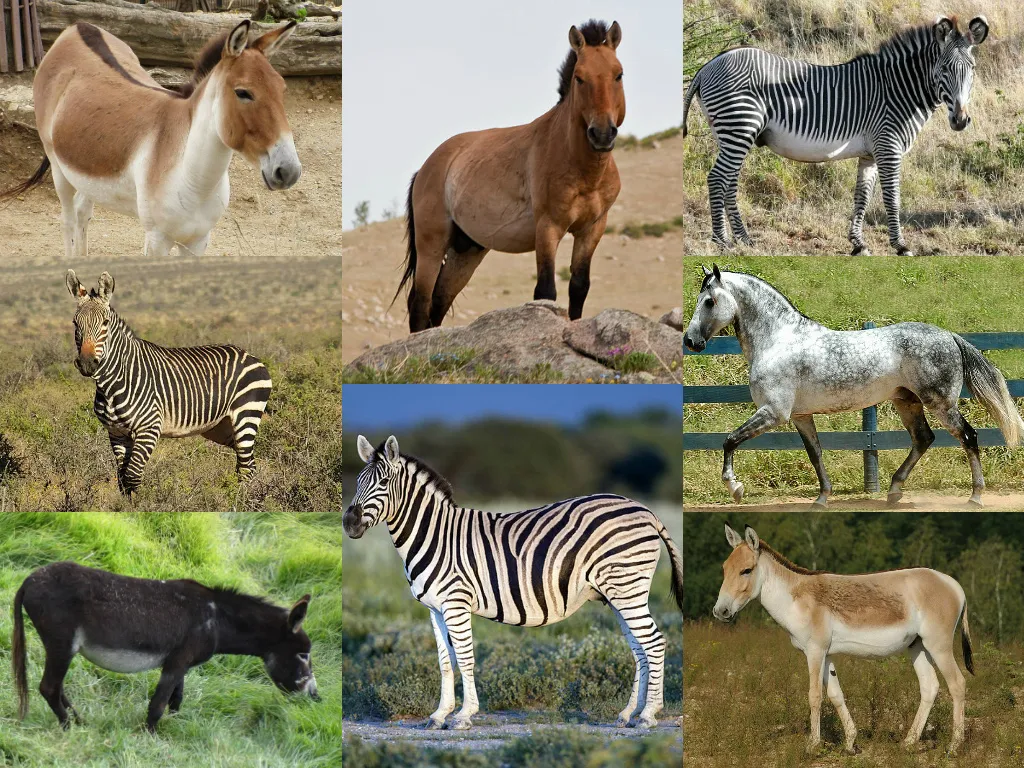 A visual representation of different Equus species.
Tracing Ancestry: From a Single Ancestor to Diverse Equines
The existence of multiple living equine species derived from a single common ancestor presents a fascinating evolutionary narrative. During the process of divergence, pinpointing the exact moment one species became distinct from another can be challenging, especially during periods of isolation before significant genetic or morphological differences emerge. This process is observable today.
Przewalski’s horse, a subspecies of Equus ferus, represents the only truly wild horse, distinct from feral horses like the American mustang, which are domesticated horses returned to the wild. Przewalski’s horses are genetically very close to domesticated horses and can produce fertile offspring, despite a difference in chromosome count. However, natural interbreeding is rare, limiting genetic exchange. Over time, these genetic differences will likely increase, raising the question of when they will be recognized as separate species. While some may argue for species status now, most taxonomists believe they have not yet reached that point. This ongoing divergence signifies segregated gene pools gradually becoming more isolated, a step-by-step process towards the formation of new species. Looking back in time, it’s plausible that ancestral zebras were once simply variations within a larger population that eventually coalesced into distinct subspecies and then species. The process of speciation involves gradual genetic and morphological changes, moving from a single species with variations to distinct, reproductively isolated groups.
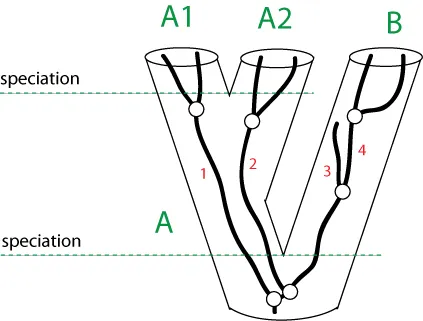 A diagram illustrating lineage sorting into species or genetic clusters.
Genetic Distinctions Among Equine Species
A comparison of complete mitochondrial genomes reveals the genetic distinctiveness among various equine species and breeds. Mitochondrial DNA analysis shows that all domestic horse breeds are remarkably similar genetically, indicating a close relationship. Other equine species, such as donkeys and zebras, are genetically distinct from domestic horses, with each species exhibiting nearly as much genetic difference from domestic horses as they do from each other. This genetic landscape is comparable to the differences observed between domestic dog breeds, wolves, and coyotes.
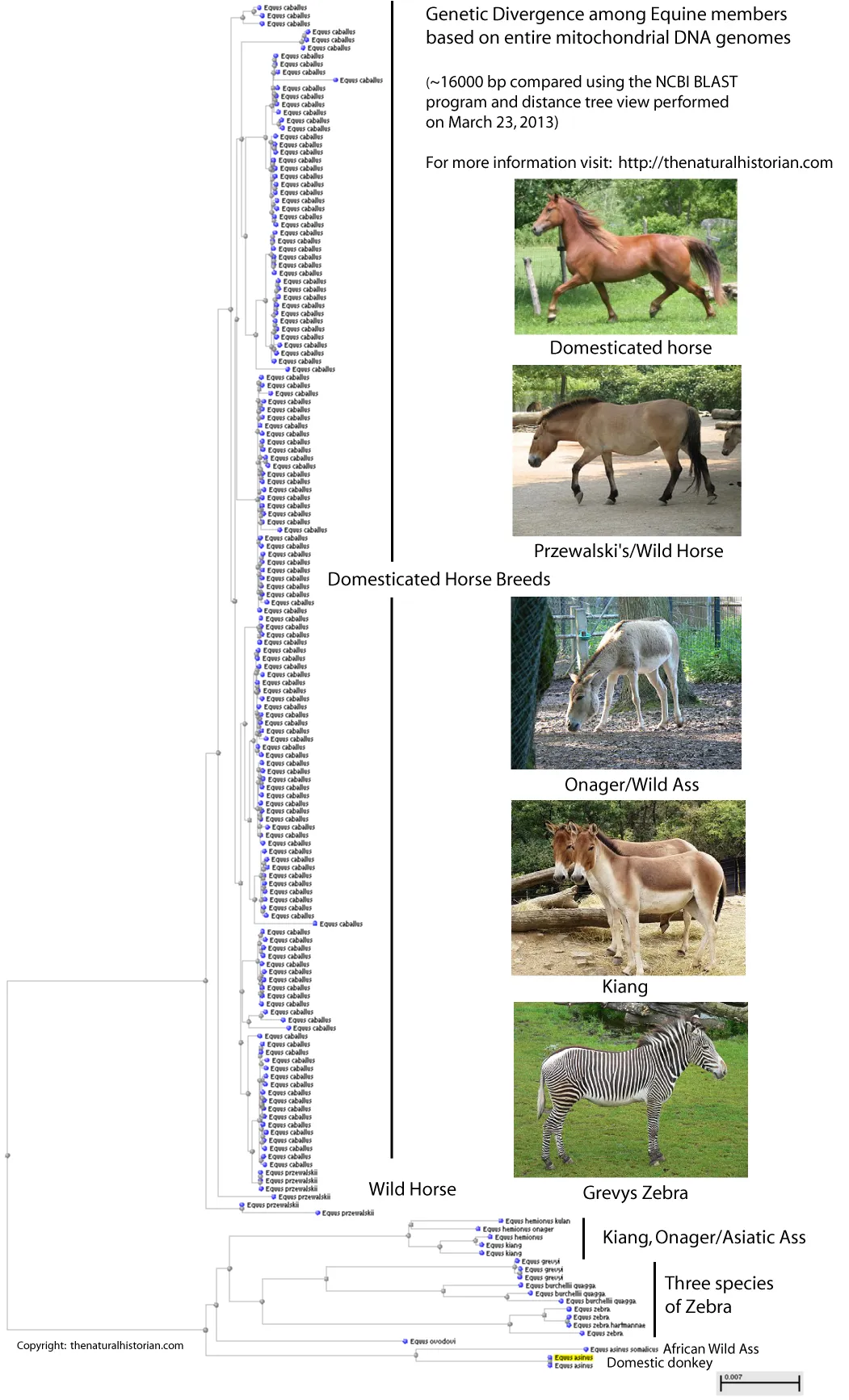 A genetic similarity tree comparing horse species and breeds.
While Przewalski’s horses show minimal genetic difference from domesticated horses, their wild behavior sets them apart. The three accepted zebra species are each genetically distinct from one another. Domestic horses, despite their visible variability, exhibit superficial differences. The zebras, though visually similar, are far more genetically distinct. This highlights how deceptive appearances can be when assessing genetic relationships.
The Ongoing Search for the Equine Common Ancestor
The next part of this series will explore the fossil record to understand the broader history of equine ancestry. While YECs generally accept a common ancestor for all living horse species, the fossil record introduces complexities, particularly concerning the rate and mechanisms of evolution. The interpretation of species and “kind” concepts in the context of significant character divergence within a common ancestral lineage leads to diverse opinions among YECs regarding evolutionary explanations for present-day species.
Citations:
Mayr, E. (1942). Systematics and the Origin of Species. Columbia University Press.
Duff, J. (2013, March 25). A Horse is a Horse, Unless of Course it Isn’t a Horse. The Natural Historian. https://thenaturalhistorian.com/2013/03/25/horses-are-horses-the-limits-of-genetic-kinds-baramins/
