
The question of what constitutes a “horse” is more complex than it initially appears, touching upon the very definition of species and taxonomic categories. While colloquial understanding might simply define a horse as “a horse, of course,” a deeper biological and philosophical examination reveals the intricacies involved in demarcating species, genus, and family. This exploration delves into the biological species concept, its application to equines, and the ongoing debate surrounding the definition and boundaries of species, even within the context of creationist viewpoints.
Traditionally, the biological species concept (BSC) defines a species as “groups of actually or potentially interbreeding natural populations, which are reproductively isolated from other such groups.” Proposed by Dr. Ernst Mayr, this definition, while widely taught, faces criticism for its limitations, particularly its applicability to organisms other than higher animals. The reality is that defining the exact boundaries of a species is a persistent challenge, extending to all taxonomic levels.
For equines, the BSC offers a practical framework. The ability of horses and donkeys to interbreed and produce sterile mules serves as evidence of their reproductive isolation, classifying them as distinct species. Similarly, horses and zebras can interbreed, but the rarity of such occurrences in natural conditions maintains their genetic distinctiveness and upholds them as separate species. This principle also applies to other species, such as coyotes and wolves, which, despite occasional natural hybridization, remain behaviorally isolated, preserving their unique genetic profiles.
Therefore, a horse is largely defined by its self-recognition within its own kind and its limited interbreeding capacity with animals of dissimilar genetic and morphological stock, except under rare, unnatural circumstances. Most species concepts would recognize Equus ferus (encompassing wild and domesticated horses) as a distinct species. The close relationship between horses, zebras, and donkeys suggests a shared common ancestor, a point on which even many young-earth creationists (YECs) now concur, classifying them all as equines within the same created “kind.”
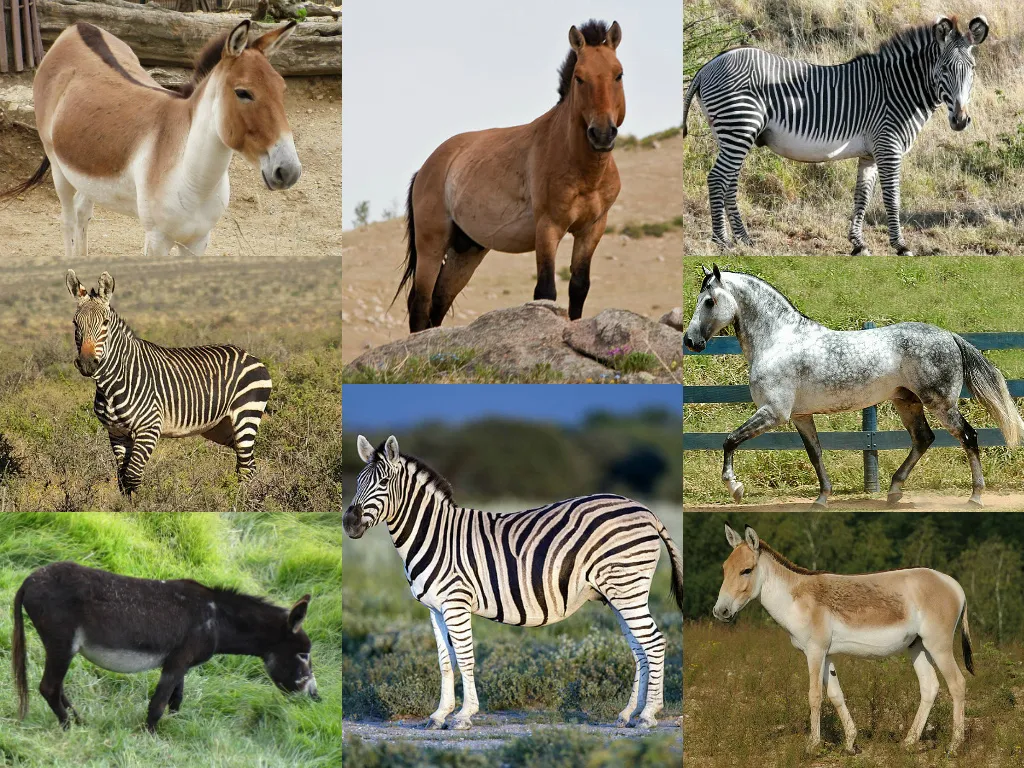 Living species of equines
The existence of multiple, distinct equine species today, all likely derived from a single ancestral form, highlights the difficulty in pinpointing exact speciation moments. During evolutionary transitions, periods of isolation may not have yet resulted in significant genetic or morphological divergence, making clear distinctions challenging. This process is observable in contemporary examples, such as Przewalski’s horse, the only truly wild horse. Genetically closely related to domesticated horses and capable of producing fertile offspring despite a different chromosome count, interbreeding in nature remains rare, thus limiting genetic exchange. While the genetic divergence between domesticated and Przewalski’s horses is increasing, the exact point at which they will be unequivocally classified as separate species remains a subject of debate among taxonomists.
The ongoing process of speciation is exemplified by the gradual isolation of gene pools. Each genetic difference represents a step towards the formation of a new species. Looking back in time, what we now recognize as distinct species may have once been variations within a larger, undifferentiated population. This includes ancestral zebras, potentially existing as subvarieties of a single species before coalescing into distinct groups. Thus, while a species can be clearly defined today, its distinctness may blur when traced back through evolutionary history.
A comparison of complete mitochondrial genomes reveals the genetic distinctions between equine species. While all domestic horse breeds exhibit remarkable genetic similarity, other equine species—donkeys and zebras—are nearly as genetically distinct from domestic horses as they are from each other. This genetic divergence is more pronounced between zebra species than among domesticated horse breeds, despite superficial visual similarities. The variability within domestic horses, while visually apparent, is largely superficial compared to the deeper genetic differences observed in zebras.
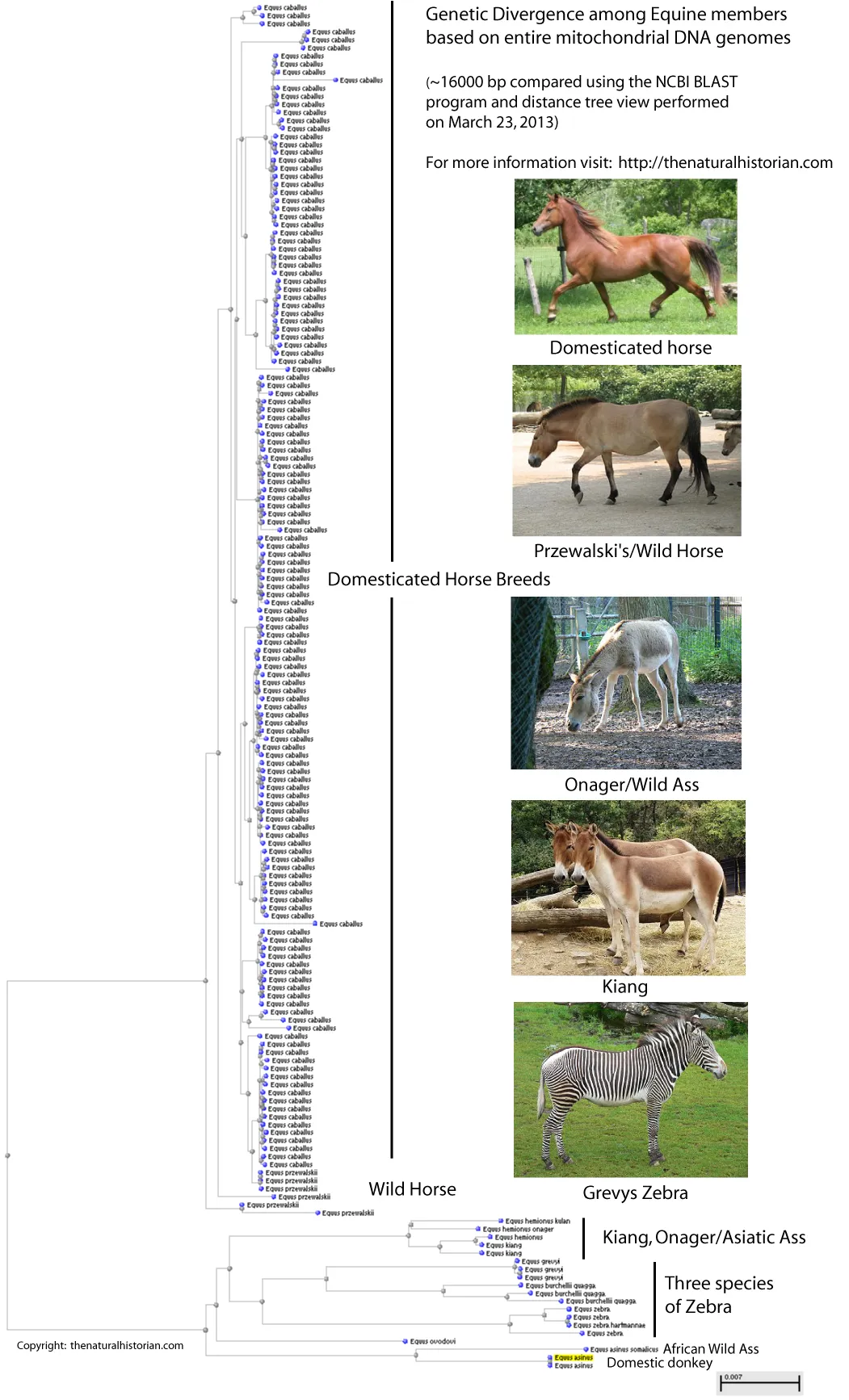 Comparison of equine genetics
The next part of this series will explore the fossil record and its implications for equine ancestry, particularly for young-earth creationists who grapple with reconciling the concept of a single created “kind” with the evidence of significant character divergence in the fossil record. The diversity of opinions among YECs regarding the boundaries and mechanisms of evolution needed to explain present-day species will be a key focus.
Related articles:
