
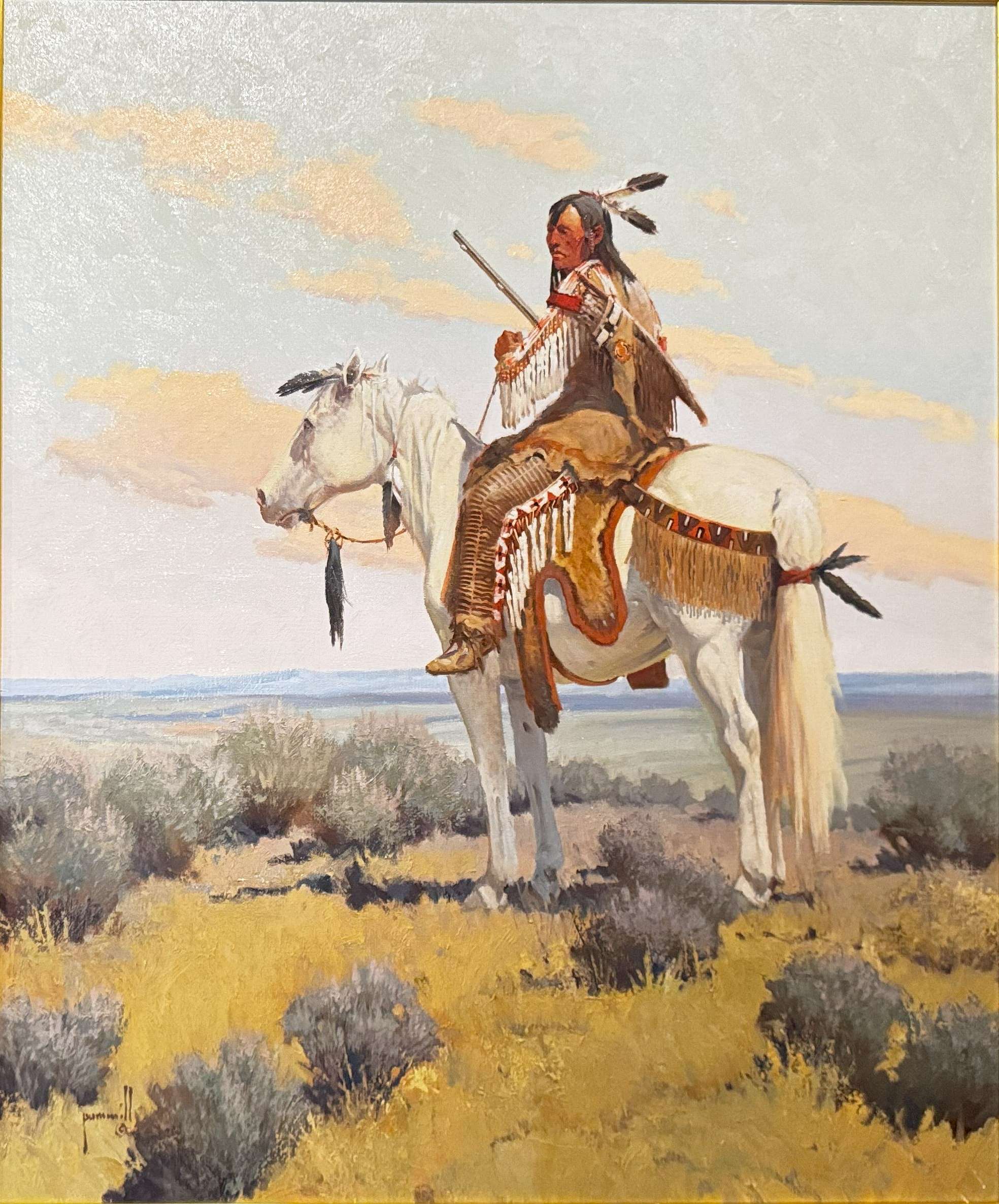
The image of a Native American warrior galloping on horseback towards a herd of buffalo is a powerful and enduring one. However, it’s a story that spans a relatively short, albeit impactful, period in history. For approximately 10,000 years, Indigenous peoples of North America thrived without the assistance of horses. It was only for about 150 years that horses became an integral part of their culture, but during this time, they brought immense strength and transformed their way of life. Horses enabled easier buffalo hunting, faster travel, more effective warfare, and enhanced evasion of enemies.
Although horses originally roamed the plains of North America, they mysteriously became extinct on the continent. Fortunately, the species had migrated across an ancient land bridge to Eurasia and Africa, where they survived and were eventually domesticated. In 1493, Queen Isabella of Spain gifted Christopher Columbus various breeds, including Spanish and Barb bloodlines, for his second voyage to the New World. These included the robust Andalusian, the resilient Sorraia, and the gaited Spanish Jennet. Subsequent Spanish explorers brought many more of these horses, effectively reintroducing them to North America. Mounted on these steeds, the Spanish conquistadors were able to subjugate the native populations.
Initially, the Spanish strictly forbade Native Americans from riding horses, a crime punishable by death. As John S. Hockensmith, author and photographer of “Spanish Mustangs in the Great American West (Return of the Horse),” explains, “The Spaniards knew that if the natives got on a horse, they would be able to rebel.” The Spanish utilized horses to instill fear in the Indigenous peoples. However, this changed in 1680 during an uprising in Santa Fe, when settlers fled, leaving behind approximately 3,000 horses. This event marked a turning point, granting Native Americans access to horses.
Horses were particularly valuable to the nomadic tribes, such as the Apache, Ute, Kiowa, Navaho, and Comanche, who followed the buffalo herds. The introduction of horses allowed them to hunt this vital resource with unprecedented efficiency. These tribes expanded their reach across North America, increasing their horse herds through strategic raiding of other tribes’ and settlers’ horses, engaging in trade, and breeding their own.
In Native American culture, courage and speed were the most highly prized characteristics in horses. Given that the early Spanish breeds displayed a variety of colors, it is plausible that Native Americans, who often adorned themselves with body paint for battle, would have favored colorful horses. Hockensmith suggests, “They would paint themselves going into battle, so it stands to reason that they’d choose to ride the most colorful horses.” A warrior mounted on a pinto with a distinctive “medicine hat” marking might have believed both themselves and their horse to be invincible, with harm only possible if the warrior had sinned.
The early 1800s saw the United States government’s desire for Native American lands for settlement, leading to the forced relocation of tribes. Rebel tribes, utilizing their swift horses, managed to evade the U.S. cavalry. Consequently, the government’s strategy shifted to depriving them of their horses to subdue them. Horses that remained with the Native Americans were often crossbred with slower breeds like draft horses to reduce their speed. By the close of the 19th century, the vibrant horse culture of Native Americans had largely diminished.
However, the horses favored by these tribes have left a lasting legacy. Several breeds remain closely connected to their ancestral bloodlines, including the Nokota and the Spanish Mustang. Others, such as the Appaloosa and the American Paint Horse, are descendants of these historically significant Native American horses.
American Paint Horse
The distinctive, multi-colored coat of the American Paint Horse has its roots in the horses brought to North America by Spanish explorers. As Native Americans acquired horses, they developed a preference for the spotted coloration. Later, settlers, out of necessity, bred their own horses with Indian ponies, thus continuing this characteristic coloring.
Appaloosa
Evidence from cave drawings suggests that the Appaloosa’s spotted coat pattern has existed since prehistoric times. The Visigoths brought spotted horses over the Pyrenees to Spain, contributing to the development of the Spanish Jennet. These horses accompanied explorers to the New World and greatly impressed Native Americans with their striking coat patterns.
Nez Percé Horse
In 1805, Meriwether Lewis, a key figure in the Lewis and Clark expedition, noted the exceptional quality of the horses owned by the Nez Percé tribe as he crossed the Bitterroot Mountains into eastern Idaho. He recorded in his journal that their horses were “of an excellent race. They are lofty, elegantly formed, active and durable. In short, many of them look like fine English horses and would make a figure in any country.”
Nokota Horse
The Nokota Horse developed in the challenging terrain of the Little Missouri badlands in southwestern North Dakota. Genetic studies indicate that the Nokota is descended from ranch and Indigenous stock from the early 20th century, a lineage that had nearly vanished by the 1950s.
Spanish Mustang
Considered the original Native American breed, the Spanish Mustang descends from the horses brought by the Conquistadors and later utilized by Native Americans. Developed on the plains of the American West, these horses became stronger and more resilient through natural selection. Unlike the Bureau of Land Management (BLM) Mustang, the Spanish Mustang shows minimal influence from ranch or draft horse breeds. Bob Brislawn of Oshoto, Wyoming, is credited with reviving the Spanish Mustang from near extinction in 1957. He collected horses from Indian reservations and collaborated with the BLM to identify and acquire the finest Spanish Mustangs, relocating them to his 3,000-acre Cayuse Ranch. His son, Emmet, now manages the ranch, continuing the tradition of raising and selling Spanish Mustangs.
American Indian Horse
The American Indian Horse Registry (AIHR) classifies all horses with a legacy tracing back to Native American origins as American Indian Horses, irrespective of their specific breed. The AIHR emphasizes the historical connections and origins that unite these horses. Nancy Falley, a spokesperson for the registry, explains, “There are different strains of the American Indian Horse around the country, such as the Marsh Tacky from South Carolina, the Nokota from North Dakota and the Florida Cracker.” She further notes, “Breeds such as the Appaloosa and Quarter Horse were descended from the American Indian Horse, so they are all eligible too.” Due to the broad nature of this classification, the registry distinguishes horses into five registration classes, determined through photographic evaluation.
The poignant sculpture “End of the Trail,” created by artist James Earle Fraser between 1876 and 1953, stands as a powerful symbol of the profound loss experienced by Native American culture with the decline of the horse’s role. The statue depicts a dejected rider slumped over a weary horse, with a lowered lance, seemingly battling an unseen force. Despite this historical shift, Native American horse breeds persist today. Through the dedicated efforts of breeders and enthusiasts, these magnificent animals are not only preserved as living historical legacies but are also poised to make their mark on the modern equestrian world.
Sharon Biggs is a writer and dressage instructor. She is the author of Advanced English Riding (BowTie Press) and In One Arena (Half Halt Press).
This article originally appeared in the June 2011 issue of Horse Illustrated. Click here to subscribe!
