
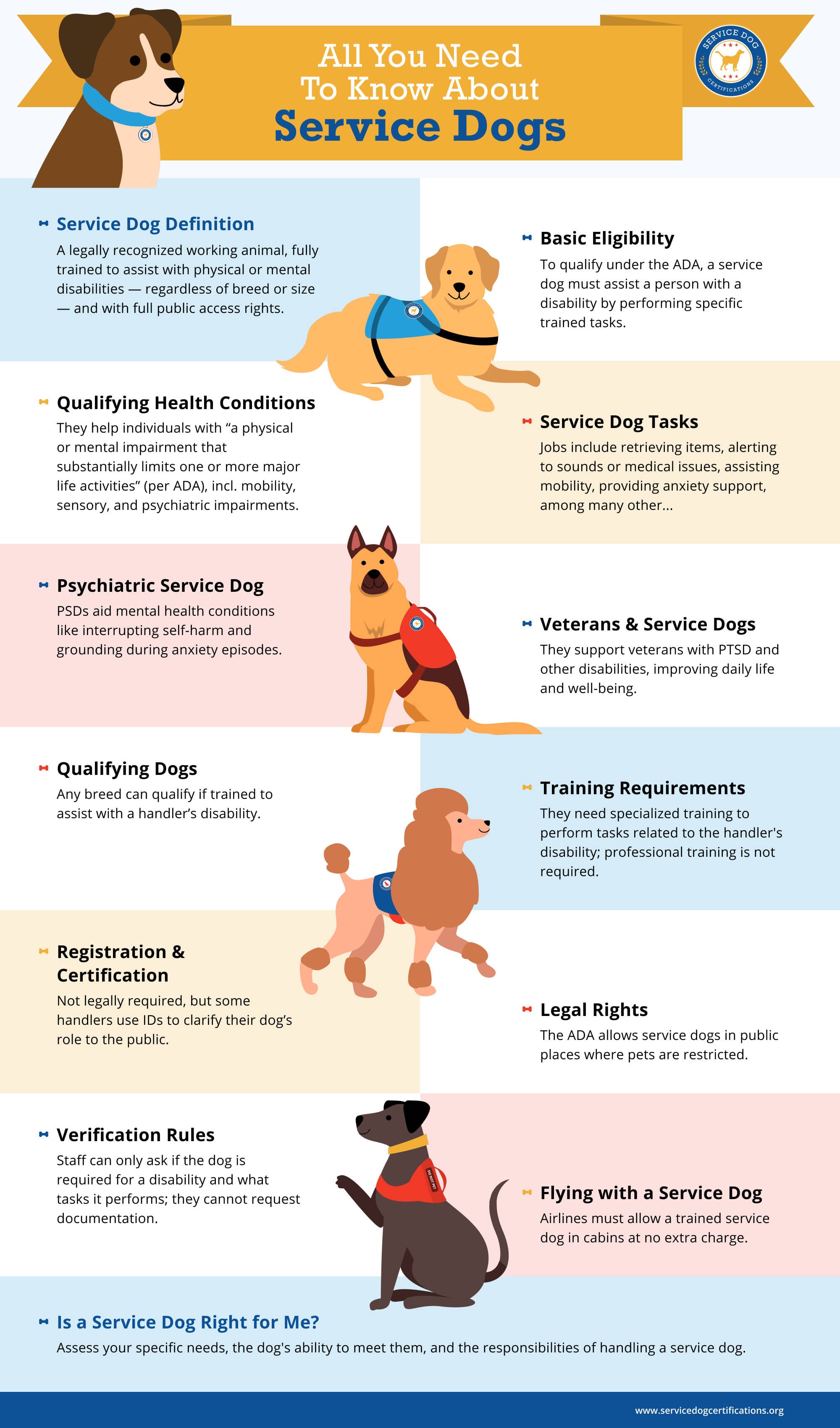
Psychiatric Service Dogs (PSDs) are specially trained canine companions that provide essential support to individuals living with mental health disabilities. These conditions can range from anxiety and depression to more complex conditions like schizophrenia, bipolar disorder, and Post-Traumatic Stress Disorder (PTSD). Unlike service dogs that primarily assist individuals with physical disabilities, psychiatric service dogs are trained to perform specific tasks that alleviate the symptoms of mental health challenges. This includes dogs trained for PTSD, which help their handlers manage the often-debilitating effects of the disorder.
With the same legal access rights as all service dogs, PSDs are permitted in all public spaces, ensuring they can remain by their owner’s side at all times. This right extends to places like grocery stores, movie theaters, and even airplanes. It’s important to note that while emotional support animals provide comfort, only dogs can be service animals. The breed or size of the dog does not disqualify it; any dog, regardless of its breed or stature, can be trained as a service dog.
Obtaining a Psychiatric Service Dog for PTSD
To qualify for a psychiatric service dog, a thorough assessment by a licensed mental health professional (LMHP) is the crucial first step. This professional will determine your eligibility and whether a PSD is the most suitable form of assistance for your condition. For individuals diagnosed with PTSD, there are two primary avenues to acquire a service dog.
The first option involves purchasing a fully trained service animal from a specialized organization. While this is the more convenient route, the cost can be substantial, ranging from $15,000 to $50,000, depending on the dog’s breed and the extent of its training.
Alternatively, if you already own a dog, training your pet to become a psychiatric service dog can be a highly effective and rewarding path. Online training courses, such as those offered by Pettable, provide structured video lessons led by qualified psychiatric service dog trainers. These courses are designed to teach your dog the necessary skills and obedience required to effectively support your mental health. This self-paced approach fosters a stronger bond between you and your canine companion, creating a more holistic supportive relationship. You can begin by completing a brief online assessment to see if this training program is the right fit for you and your dog.
Training Your Dog to Become a Service Dog
PTSD service dogs require specialized training to effectively support their handlers. This training can be pursued through various methods, including online psychiatric service dog training, in-person professional training, or by acquiring a pre-trained service dog.
Online training offers the flexibility to train your dog at your own pace while ensuring it responds reliably to your commands by the course’s completion. In-person training involves outsourcing the dog’s education to a professional, which can be costly and potentially overwhelming for some animals. Purchasing a PSD guarantees the dog possesses the necessary skills to support your mental health and maintain good public behavior, but it represents a significant financial commitment for most.
Not all dogs possess the innate temperament to excel as psychiatric service animals. Key indicators of a suitable service dog include the ability to remain calm in unfamiliar environments, a capacity to learn and retain new tasks, the ability to repeat specific commands, and a strong focus on their handler. If your dog exhibits these traits, self-training through a comprehensive online course like Pettable’s may be the most suitable option. These programs guide you through the steps of training your dog to perform tasks that directly assist with your mental health disorder, allowing you to proceed at your own pace with expert guidance.
How Service Dogs Assist with PTSD Symptoms
Service dogs can significantly help alleviate the symptoms experienced by individuals with PTSD in numerous ways.
Interrupting Challenging Behaviors
A common role for service dogs is performing “interruption tasks.” These tasks are designed to distract their handler from a distressing situation. Service dogs can be trained to interrupt panic attacks, self-harming behaviors, dissociative episodes, or flashbacks. For instance, a service dog can be trained to recognize the early signs of a night terror and intervene by applying gentle pressure, licking their handler’s face, or pawing at their body. Some service dogs can even be trained to turn on lights, helping to rouse their owner from a nightmare.
Conducting Room Searches
Military members and veterans exposed to combat environments have a higher risk of developing PTSD. Service dogs can provide invaluable support by performing room searches. The dog will enter an area first, investigate thoroughly, and then signal to the handler that the space is safe to enter. This is particularly beneficial for individuals who have experienced trauma in their homes, undergone a difficult divorce, or struggle with visual hallucinations. The assurance that a space is secure can significantly ease anxiety for PTSD sufferers, especially those who have experienced sexual assault, domestic violence, or home invasions.
Acting as a Physical Barrier
Navigating crowded spaces can be challenging for individuals with PTSD due to the unpredictability of the environment and the potential for being startled or feeling cornered. A service dog can be trained to act as a physical barrier, maintaining a safe distance between its handler and others. The dog can circle the handler or stand behind them when stationary, preventing unexpected approaches and providing a sense of security.
Performing Alert Tasks
“Alert tasks” are a crucial function for many service dogs. These tasks involve the dog reminding its handler to perform specific actions, such as taking medication. A service dog might retrieve medication for its handler when it’s time. Other everyday alert tasks include notifying the handler of an approaching person or vehicle, signaling an oncoming panic attack, or providing routine reminders for eating and sleeping. These alert capabilities empower individuals with PTSD to lead more independent lives.
Providing Companionship
Beyond their task-oriented training, service dogs offer a profound benefit: companionship. They provide a reason to engage in daily activities, encourage individuals to go outside, and offer motivation to face the day. The responsibility of caring for a service dog can instill a sense of purpose, which can effectively reduce feelings of anxiety, depression, and even suicidal ideation.
Eligibility for a Service Dog
Individuals experiencing PTSD often qualify for a psychiatric service dog. The severe trauma associated with PTSD, whether from combat, witnessing accidents, or natural disasters, can lead to persistent anxiety and panic attacks triggered by reminders of the event. While some individuals recover naturally, others require ongoing support.
Consulting a licensed mental health professional is essential to determine eligibility. The professional can provide documentation confirming that you are receiving treatment for an emotional or psychiatric disorder and require an animal’s assistance.
Obsessive-Compulsive Disorder (OCD)
OCD is a debilitating mental health disorder characterized by disruptive thoughts that interfere with daily tasks. A service dog can be trained to distinguish between positive and negative behaviors. When an individual with OCD becomes engrossed in a disruptive thought pattern, the PSD can intervene by pawing, licking, or nudging until the behavior ceases. This seemingly small task can significantly improve the quality of life for those with OCD, allowing them to manage their condition more effectively and live a more functional lifestyle.
Agoraphobia
This anxiety disorder, often stemming from panic attacks, involves a fear of places and situations that could lead to panic, helplessness, or embarrassment. A service dog can assist individuals with agoraphobia by retrieving medication, alerting them to an impending panic attack, or performing room checks to ensure safety before entry. PSDs can also act as barriers in crowded areas, mitigating the fear of such environments.
Anxiety Disorders
Anxiety disorders affect a significant portion of the adult population at some point in their lives. Service animals can provide crucial support for individuals with anxiety disorders. They can perform retrieving tasks, such as fetching medication or a cell phone during an anxiety or panic attack. They can also bring another person to the handler, ensuring they are not alone during an attack. Furthermore, service dogs can help alleviate physical symptoms like rapid breathing, chest pain, and heart palpitations by providing calming pressure when lying on the handler’s chest or abdomen, or by licking their face to reduce tension during moments of emotional overload. Consider exploring a PSD training plan to see how a service dog can help.
Training a Service Dog for PTSD
Training a psychiatric service dog for PTSD requires dedication, but the benefits are substantial, fostering a deep bond and trust between handler and dog.
Assessing Your Dog’s Suitability
Several factors influence a dog’s suitability for service work, including age, size, breed, and temperament. While puppies are trainable, their attentiveness can be a challenge, especially without prior basic obedience training. Older dogs may be more set in their ways, requiring more time to learn new skills over established habits. Some of the best service dog breeds for PTSD include Golden Retrievers, German Shepherds, Great Danes, and Border Collies.
Foundational Obedience Training
Comprehensive obedience training is fundamental before embarking on service dog-specific tasks. Mastering basic commands like “sit,” “stay,” “down,” and “watch me” provides a solid groundwork for more complex training. This also makes it easier to teach new skills and regain your dog’s focus when needed.
Teaching PTSD-Specific Tasks
Individuals with PTSD experience a range of symptoms, including intrusive thoughts, avoidance behaviors, mood swings, and reactive responses to stress. Training your service dog tasks tailored to your specific PTSD symptoms will maximize the benefits of having a psychiatric service dog.
Ensuring Public Behavior Standards
Beyond task-specific training, service dogs must exhibit impeccable behavior in public. Consistent basic obedience training is paramount for this. Mastering these commands prior to service task training is essential for a well-behaved service animal.
Professional Trainer Assistance
Engaging a professional trainer can streamline the training of your psychiatric service dog. Resources like Pettable’s online training programs, often led by certified trainers, offer expert guidance. For example, Lisa Gallegos, a certified psychiatric service dog trainer associated with Pettable, has successfully guided numerous dog-handler teams through their training journey.
Self-Training vs. Professional Training
When it comes to training a psychiatric service dog, the primary options are self-training or professional training. While self-training is achievable, leveraging professional resources, such as Pettable’s online service dog training classes, can provide invaluable guidance and support for success.
Online Psychiatric Service Dog Training with Pettable
Online psychiatric service dog training with Pettable offers a structured and effective method for training your dog in service tasks. Expertly crafted lessons, developed by certified PSD trainers, guide you through the training process at your own pace. You can train your dog from the comfort of your home, with access to online resources and a satisfaction guarantee.
Ideal Service Dog Breeds for PTSD
While many dog breeds can make excellent service dogs, certain breeds are particularly well-suited for providing support to individuals with PTSD. Breeds with natural protective instincts might be better suited as guard dogs, as their spontaneous barking could potentially increase anxiety for those with PTSD. Here are some breeds that excel as service dogs for individuals with PTSD:
- Golden Retriever: Known for their intelligence, eagerness to please, and emotional intelligence, Golden Retrievers are a popular choice. They are adept at retrieving medication, minimizing flashbacks, and providing overall support and companionship, making them a favored option for veterans with PTSD.
- Labrador Retriever: While widely recognized for their role in guide dog programs, Labrador Retrievers also make excellent PSDs for individuals with PTSD. They are intelligent, quiet, easily trained, and highly attuned to their surroundings, allowing them to alert their owners to potential danger.
- Lhasa Apso: These small, affectionate dogs are skilled at recognizing human moods, which facilitates their training to respond appropriately to various emotional states and behaviors.
- German Shepherds: This breed is highly trainable, exceptionally loyal, and can offer a heightened sense of security due to their naturally intimidating presence.
Frequently Asked Questions
Can I opt for an Emotional Support Animal instead?
Some individuals with mental health disorders choose an emotional support animal (ESA) over a PSD. ESAs primarily offer comfort through companionship, rather than performing specific trained tasks. While ESAs have housing rights, they do not have the same public access rights as PSDs.
Do people with PTSD qualify for a service dog?
Yes. While a licensed mental health professional makes the final determination, individuals with PTSD commonly qualify for a service dog.
What type of dog is best for PTSD?
Intelligent, quiet, and calm dog breeds generally perform best with individuals suffering from PTSD. Common breeds include Golden Retrievers, Labrador Retrievers, Doberman Pinschers, Standard Poodles, Boxers, and Lhasa Apsos.
How do I train my dog to be a service dog for PTSD?
If you wish to train your current dog as a service dog, consider enrolling in Pettable’s PSD training program. This program, developed in collaboration with a certified dog trainer, is designed for users with no prior PSD training experience, equipping them with the necessary tools to effectively self-train a PSD. To begin, take our brief online assessment.
