
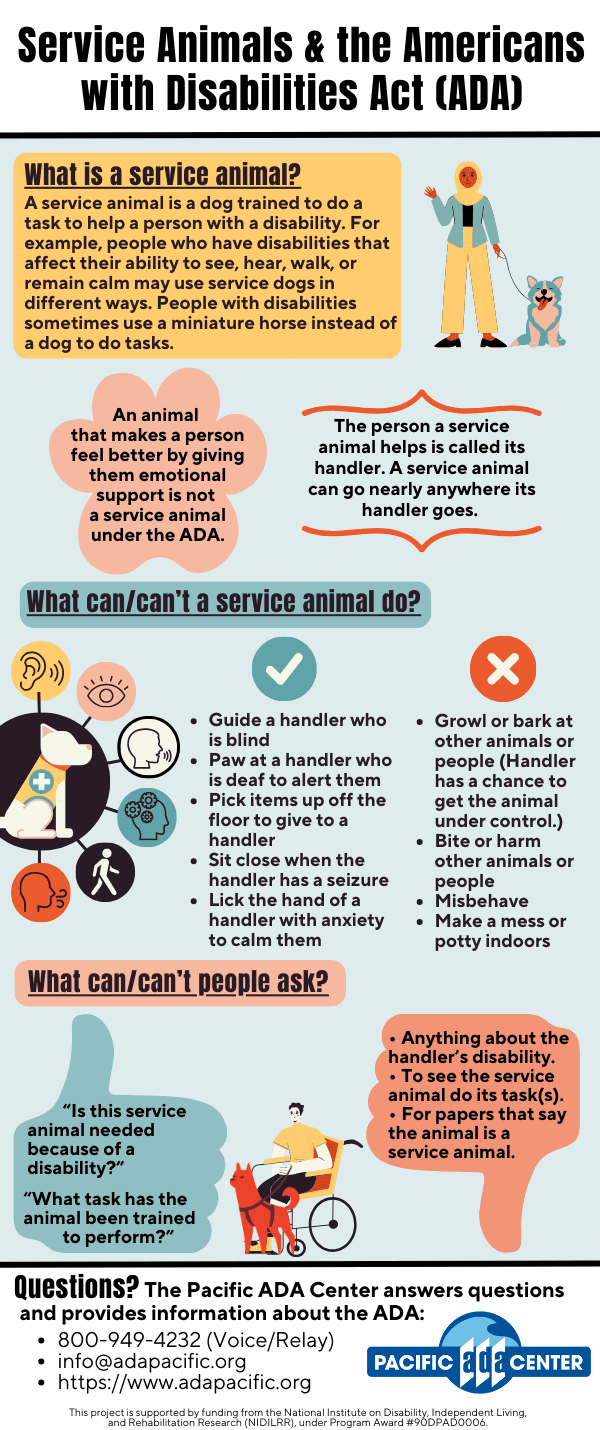
The Americans with Disabilities Act (ADA) outlines the rights and responsibilities of businesses, state and local governments, and individuals regarding service animals. This guide provides a comprehensive overview of what constitutes a service animal, where they are permitted, and how to interact with handlers and their animal companions.
What Qualifies as a Service Animal?
Under the ADA, service animals are defined as dogs, regardless of breed or size, that have been specifically trained to perform tasks directly related to a person’s disability. It is important to distinguish service animals from emotional support animals, comfort animals, or therapy animals. The key differentiator is the trained task. For instance, a dog trained to detect an oncoming panic attack and alert its handler, or a dog trained to retrieve dropped objects for a person with mobility impairments, qualifies as a service animal. Dogs whose sole purpose is to provide emotional comfort do not meet the ADA’s definition of a service animal.
Examples of Service Animal Tasks
Service animals are trained to perform a variety of essential tasks that assist individuals with disabilities. These tasks can include:
- Retrieving objects: For individuals who use wheelchairs, a service dog can be trained to pick up dropped items.
- Medication reminders: A service dog can be trained to alert individuals to take their prescribed medications.
- Alerting to medical episodes: Dogs can be trained to sense the onset of seizures or panic attacks and alert their handlers, helping them to remain safe.
- Assisting with navigation: For individuals with visual impairments, service dogs can be trained to guide them and avoid obstacles.
Public Access Rights for Service Animals
Generally, service animals are permitted to accompany their handlers in most public places where the public is allowed to go, even in establishments with a “no pets” policy. This includes establishments like restaurants, shops, hospitals, schools, and hotels. For example, a restaurant cannot deny entry to a patron with a service dog or force them to sit in an outdoor-only seating area.
Housing, Air Travel, and Employment
While the ADA governs public access, other laws apply in specific contexts:
- Housing: The Fair Housing Act may offer additional protections for individuals with disabilities using service animals in various housing situations. The U.S. Department of Housing and Urban Development (HUD) oversees these regulations.
- Air Travel: The Air Carrier Access Act, not the ADA, regulates the rights of individuals with disabilities during air travel. The U.S. Department of Transportation handles complaints and information related to air travel.
- Employment: The Equal Employment Opportunity Commission (EEOC) is responsible for administering the ADA in employment settings.
Interacting with Service Animal Handlers
If there is uncertainty about whether a dog is a service animal, staff at public accommodations or government facilities may ask two specific questions:
- “Is the dog a service animal required because of a disability?”
- “What work or task has the dog been trained to perform?”
It is crucial to understand what cannot be asked. You are not permitted to:
- Request any documentation, such as registration, licensing, or certification, for the service animal.
- Demand that the dog demonstrate its task.
- Inquire about the specific nature of the person’s disability.
It is also important to note that while many service dogs wear vests, the absence of a vest does not mean a dog is not a service animal, and the presence of a vest does not automatically confirm it is. The dog’s training to perform a task remains the defining characteristic.
Exceptions to Access
In rare circumstances, a public accommodation may be permitted to exclude a service animal. This is generally when the animal’s presence would fundamentally alter the nature of the goods, services, programs, or activities offered. For example, in a highly sterile environment like an operating room or burn unit, a service animal might be excluded to maintain a sterile environment. However, in most areas of a hospital accessible to the public, service animals are typically allowed.
Removal of a Service Animal
A business or government entity can ask an individual to remove their service animal if the dog is:
- Not housebroken.
- Out of control, and the handler is unable to regain control of the dog.
State and Local Laws
While federal law provides a baseline, state and local governments may have additional regulations concerning service dogs, such as requiring licensing and vaccinations if these apply to all dogs. However, these laws cannot mandate service dog certification or registration, nor can they ban a service dog based on its breed.
For further detailed information, consult resources such as the ADA’s “ADA Requirements: Service Animals” and “Frequently Asked Questions about Service Animals and the ADA.”
