
Embarking on the journey of shaping a loyal companion into a reliable protector is a profound commitment. Many people wonder How To Train A Protection Dog, envisioning an unwavering guardian for their home and family. It’s a path that goes far beyond teaching a dog to bark at strangers; it’s about forging an unbreakable bond built on trust, advanced obedience, and crystal-clear communication. A true protection dog isn’t merely an alarm system or a weapon; it is a highly disciplined, stable, and discerning partner that can assess a threat and react appropriately under your precise control. This is not about encouraging aggression, but rather channeling a dog’s natural instincts into a focused, controlled skill set. For those who decide the rigorous process isn’t for them, exploring options like trained protection dogs for sale near me can be a viable alternative.
Understanding the Role of a Protection Dog
Before you dive into training, it’s crucial to understand the distinctions between different types of working dogs. The terms are often used interchangeably, but their roles and training are vastly different. A true protection dog represents the pinnacle of training, discipline, and stability.
Protection Dog vs. Guard Dog vs. Attack Dog
- Guard Dog: A guard dog’s primary role is deterrence. They are often territorial and will bark loudly to alert their owners of an intruder and scare them away. Their training is typically limited to boundary respect and alert barking. They are not trained to engage physically with a threat.
- Attack Dog: This term often carries a negative connotation and refers to a dog trained to attack on command, often with minimal control or discretion. This type of training is not recommended for a family environment as it prioritizes aggression over stability, creating a dangerous liability. A related, yet misunderstood query is how do i train my dog to attack, which highlights the need for education on responsible training methods.
- Protection Dog: A personal protection dog is a master of control. This animal is trained to defend its owner or family by engaging a threat, but only under specific circumstances and on command. The most critical part of their training is the “off switch”—the ability to cease engagement instantly upon command. They are social, stable, and completely manageable in everyday situations.
Are You and Your Dog Ready for This Journey?
Not every dog is cut out for protection work, and not every owner is prepared for the responsibility it entails. It requires an honest assessment of both your dog’s temperament and your own commitment to the intensive, ongoing training process.
Evaluating Your Dog’s Suitability
The ideal candidate for protection training possesses a specific set of traits:
- Genetic Foundation: The dog should come from working lines with a proven history of stable temperament, courage, and high drive.
- Confidence: A fearful or anxious dog should never be trained for protection work. The foundation must be unshakeable confidence. The dog should be curious and bold, not reactive or spooky.
- High Drive: The dog must have a strong desire to play (prey drive) and a willingness to work with its handler (pack drive). This is the engine that powers the training.
- Temperament: The dog must be clear-headed and stable. It should be friendly or neutral towards strangers in non-threatening situations and safe around children and other animals.
- Trainability: A strong desire to please and the intelligence to learn complex commands are non-negotiable.
Assessing Your Own Commitment
Training a protection dog is not a weekend project; it’s a lifestyle. It demands hundreds of hours of dedicated work, significant financial investment, and unwavering consistency. You must be prepared to become a confident, clear, and fair leader for your canine partner.
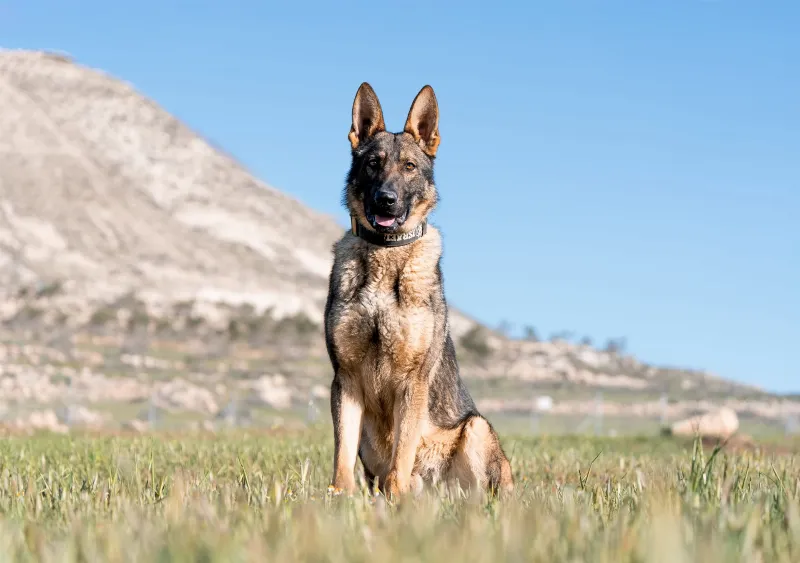 A handler gives a command to an attentive German Shepherd in a grassy field, showcasing the strong bond needed for protection dog training.
Foundational Steps: Before Protection Work Begins
You cannot build a skyscraper on a foundation of sand. Similarly, you can’t start advanced protection work without a flawless foundation of obedience and socialization. Rushing this stage is the single biggest mistake a handler can make.
Advanced Obedience is Non-Negotiable
Your dog must be 100% reliable with basic and advanced obedience commands, even under extreme distraction. This includes a rock-solid sit, stay, down, heel, and recall. An “off-leash” level of control is the minimum standard. This obedience is your steering wheel, your brake pedal, and your safety net. Without it, you don’t have a protection dog; you have an uncontrolled liability.
Socialization: The Key to a Stable Protector
Proper socialization is perhaps the most misunderstood aspect of raising a protection dog. It does not mean your dog has to be best friends with every person and dog it meets. It means exposing your dog to a vast array of sights, sounds, surfaces, and environments from a young age so that they learn to be calm and confident in any situation. A well-socialized dog understands what is normal and, therefore, is better equipped to identify what is truly abnormal or threatening.
How to Train a Protection Dog: Core Principles
Once the foundation is solid, the specific work of protection training can begin. This process should always be done under the guidance of a seasoned, professional trainer. This is not a DIY project. The overall protection training for dogs is a complex and nuanced discipline.
Phase 1: Building Drive and Focus
The initial phase doesn’t involve scary-looking decoys or bite suits. It’s all about channeling the dog’s natural prey drive into a fun, engaging game.
- Start with a Rag or Tug: The trainer will use a leather rag or tug toy to encourage the dog to “fight” for the toy.
- Winning the Game: The dog is always allowed to “win” the game by pulling the tug away. This builds immense confidence and teaches the dog that engaging and biting is a rewarding activity.
- Introducing Commands: Simple commands like “get it” and “out” (release) are introduced in a low-pressure, positive context.
Phase 2: Introducing the “Threat” in Controlled Scenarios
This is where a professional decoy (also called an agitator or helper) becomes essential. The decoy is highly skilled in reading dogs and creating controlled scenarios that build the dog’s confidence and skill.
According to Dr. Evan Albright, a canine behaviorist with over 20 years of experience in working dogs, “The decoy’s job is not to hurt the dog, but to be the ‘bad guy’ in a very structured play. They create a situation where the dog learns to confidently confront pressure and use its body effectively, all while remaining under the handler’s control.”
The training progresses from the decoy using a simple sleeve to full bite suit dog training sessions. Each session is designed to teach a specific lesson, whether it’s improving the dog’s grip, teaching it to bark to alert, or helping it handle physical and environmental pressure.
Phase 3: Control and Command Training
This is the most critical phase, where absolute control is layered on top of the drive and bite work.
- The “Out” Command: The “out” or release command is the most important command a protection dog will ever learn. The dog must release its bite instantly and completely, without question, the moment the command is given. This is practiced relentlessly.
- Bark and Hold: The dog is taught to confront a threat by barking aggressively without making physical contact. This is often enough to de-escalate a situation and provides the handler with time to assess and give further commands.
- Escalation Control: The handler learns to read the situation and command the appropriate level of response, from a simple alert bark to a full engagement.
What Breeds Are Best for Protection Training?
While many dogs can be protective, only certain breeds consistently possess the genetic cocktail of courage, stability, intelligence, and physical ability required for high-level protection work.
- German Shepherds: The classic choice, known for their intelligence, loyalty, and balanced temperament.
- Belgian Malinois: An intense, high-drive breed favored by police and military units. They require an experienced handler.
- Rottweilers: Powerful and confident, they are natural guardians with a calm demeanor when properly trained and socialized.
- Doberman Pinschers: Known for their speed, intelligence, and unwavering loyalty to their family.
- Giant Schnauzers: A less common but highly capable breed with a strong territorial instinct and a trainable nature.
The Critical Role of Professional Guidance
Attempting to train a protection dog on your own is not only ineffective but also incredibly dangerous. A professional trainer provides the essential experience, equipment, and a safe, controlled environment to do the job correctly. They teach you how to be a better handler, how to read your dog, and how to manage the immense responsibility you are undertaking. When looking for a professional, it’s worth investigating the associated costs. Understanding how much is protection dog training can help you budget for a qualified expert rather than cutting corners.
Frequently Asked Questions (FAQ)
1. Can any dog be trained for protection?
No. Only dogs with the right genetic makeup, confidence, and stable temperament should be considered. Training a fearful or unstable dog is a recipe for disaster.
2. At what age should protection training start?
Foundation work (obedience, socialization, drive building) can start in puppyhood. The more formal bite work and pressure testing typically begins after the dog has reached physical and mental maturity, usually around 18-24 months.
3. How long does it take to train a protection dog?
It is a long-term commitment. A fully trained and reliable protection dog takes, on average, two to three years of consistent, expert training.
4. Is a protection dog safe to have around children and family?
Absolutely. A properly trained protection dog from stable bloodlines is exceptionally reliable and gentle with its family. Their training enhances their stability and control, making them predictable and trustworthy companions.
5. What is the main difference between a guard dog and a protection dog?
The main difference is control and training. A guard dog’s job is to alert (bark), while a protection dog is trained to actively defend its handler on command and, crucially, to stop on command.
A Lifelong Commitment to Responsibility
Ultimately, learning how to train a protection dog is a journey into the deepest levels of canine communication and partnership. It is a testament to the incredible capabilities of these animals when guided by a knowledgeable and responsible hand. A well-trained protection dog is the epitome of controlled confidence, a loving family member one moment and a formidable guardian the next. This duality is not born from aggression but from an unparalleled level of training, trust, and mutual respect between dog and handler.
