
Embarking on the journey of training a horse for show jumping requires a blend of patience, consistency, and a calm training environment. This guide delves into the fundamental principles and practical steps necessary to prepare your equine partner for the exciting world of show jumping, emphasizing a structured approach to foster confidence and skill in both horse and rider.
The Foundation of Show Jumping Training
Successful show jumping training is built upon a consistent and positive reinforcement approach. Horses learn best when exposed to correct training methods regularly in a relaxed setting. The goal is to develop a horse that is responsive, confident, and athletic, capable of navigating show jumping courses with finesse and precision. This process involves breaking down complex movements into manageable steps and celebrating small victories along the way.
Understanding the Training Philosophy
The philosophy behind effective horse training, particularly for disciplines like show jumping, centers on building a strong partnership. This involves clear communication, understanding the horse’s individual learning pace, and adapting training methods accordingly. The training exercises should not only improve the horse’s jumping ability but also enhance its overall responsiveness and obedience.
Essential Training Exercises and Techniques
A variety of exercises can be employed to hone a horse’s show jumping skills. These often involve gymnastic lines, related distances, and varied course work designed to challenge the horse and rider in different ways.
Gymnastic Lines for Technique Development
Gymnastic lines, consisting of a series of closely spaced jumps, are crucial for teaching the horse proper jumping form, stride adjustability, and rhythm. These exercises help the horse learn to adjust its stride, jump efficiently, and maintain balance. For instance, a line of three verticals with placing poles can help a horse develop a consistent stride and learn to jump squarely over each obstacle. The inclusion of placing poles acts as a visual aid, encouraging the horse to place its feet accurately.
Related Distances and Course Simulation
Related distances, which are measured spaces between jumps, require the horse to adjust its stride length and impulsion to meet each fence correctly. Practicing these on a curve or in lines helps the horse develop the ability to lengthen or shorten its stride smoothly. A practical example is setting up a line with a seven-stride related distance on a curve, which challenges the horse’s ability to maintain a consistent rhythm and adjust its stride over a longer distance.
The Importance of Arena Setup
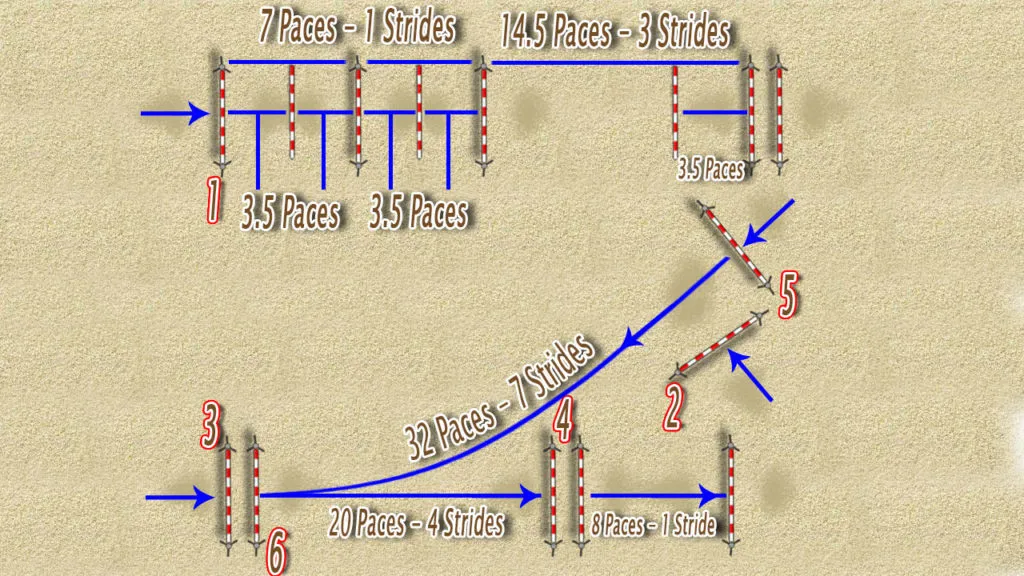
A well-planned arena setup is key to effective training. Consider a common setup that begins with a gymnastic line down the long side of the arena. This line might consist of three verticals, spaced seven paces apart, followed by an oxer 14.5 paces from the last vertical, creating a three-stride distance. Placing poles can be strategically positioned to guide the horse’s stride. Following this, an angled vertical can introduce a different approach, preparing the horse for more complex course elements.
Down the opposite long side, an oxer followed by a double combination (oxer then vertical) with an eight-pace stride can be set up. Finally, a single vertical placed 32 paces from the oxer on a curve creates a seven-stride related distance, simulating elements found in actual show jumping courses.
 Horse and rider practicing show jumping in an arena
Building a Consistent Training Routine
Consistency is paramount in training a horse for any equestrian discipline. Regular training sessions, even short ones, are more effective than infrequent marathon sessions. It’s beneficial to incorporate a variety of exercises into your routine to keep the horse engaged and to address different aspects of its training.
Leveraging Online Resources and Community
In today’s digital age, numerous resources are available to support horse training. Online platforms offer a wealth of training videos and articles that can provide valuable guidance. Engaging with online communities, such as dedicated Facebook groups, allows riders to share their progress, seek advice from peers and experienced trainers, and find motivation. Joining such a group can provide a supportive environment for asking questions and receiving constructive feedback. JOIN OUR FACEBOOK GROUP
Continuous Learning and Improvement
The journey of training a horse is one of continuous learning and adaptation. Staying updated with the latest training methodologies and seeking feedback are essential for progress. Consider signing up for newsletters that provide weekly training exercises or tips, ensuring you always have fresh ideas and challenges for your horse. Find out more about our showjumping training videos
Conclusion: The Partnership in Show Jumping
Training a horse for show jumping is a rewarding process that strengthens the bond between horse and rider. By adhering to principles of patience, consistency, and clear communication, and by utilizing effective training exercises and resources, riders can confidently guide their horses towards success in the show jumping arena. Remember that every training session is an opportunity to build trust and improve the partnership, making the journey as fulfilling as the destination.
If you’re passionate about equestrian sports, you might also find value in resources dedicated to different aspects of horse care and training. For example, exploring different training techniques or understanding horse behavior can further enhance your skills. This article on horse show jumping training offers additional insights into preparing for competitive show jumping.
