
There’s a classic image many of us have: a sunny day, a happy dog, and a pleasant walk through the park. But for many dog owners, the reality is more of a tug-of-war than a tranquil stroll. If you’re tired of your arm feeling like it’s been stretched to its limit, you’re not alone. The great news is that you absolutely can teach your furry friend better leash manners. Learning How To Train A Dog To Not Pull is less about showing who’s boss and more about building a stronger, more cooperative relationship. It transforms frustrating tugging matches into the enjoyable walks you’ve always dreamed of.
This isn’t just about your comfort; it’s about your dog’s safety and well-being, too. A dog that pulls constantly puts strain on its neck and throat, and a sudden lunge could pull the leash from your hand, leading to a dangerous situation. By investing time in positive training, you’re creating a safer and more harmonious partnership. Ready to reclaim your walks? Let’s dive in.
Understanding Why Dogs Pull on the Leash
Before you can fix the pulling, it helps to understand why it happens. Your dog isn’t trying to be stubborn or dominate you; their motivations are usually much simpler.
The World is an Exciting Place
For a dog, the world outside is a symphony of irresistible sights, sounds, and, most importantly, smells. They are naturally curious explorers. Their walking pace is often much faster than ours, and when they pull, they’re simply trying to get to that fascinating smell or that interesting squirrel as quickly as possible. In their mind, pulling is the most direct way to investigate the exciting world ahead.
It’s a Learned Behavior
Here’s a hard truth: dogs pull because it works. Every time they pull and you take a step forward, you’ve unintentionally rewarded the behavior. They learn that tension on the leash means they get to move toward what they want. It’s an accidental reinforcement loop that, over time, becomes a deeply ingrained habit. The key is to teach them that a loose leash, not a tight one, is what makes the walk continue.
As canine behaviorist Dr. Sarah Miller puts it, “Pulling is often a simple case of enthusiasm meeting a lack of communication. The dog wants to go, and the human follows. Our job as trainers is to change that conversation and teach them that cooperation, not force, gets them where they want to go.”
Essential Gear for Loose-Leash Walking
Having the right equipment can make a world of difference. While no tool is a magic fix, some can help manage the pulling while you implement your training plan.
Front-Clip Harness: Unlike traditional harnesses that clip on the back (which can actually encourage pulling, much like a sled dog harness), a front-clip or no-pull harness has the leash attachment point at the dog’s chest. When the dog pulls, the pressure gently turns them back toward you, discouraging forward lunging without causing pain or choking.
Head Halter: For very large or powerful pullers, a head halter (like a Gentle Leader or Halti) can offer more control. It works on the principle that where the head goes, the body follows. It’s not a muzzle—your dog can still eat, drink, and pant—but it does require a gentle hand, as jerking on it can injure your dog’s neck.
A Standard Leash: A simple 4- to 6-foot non-retractable leash is best. Retractable leashes teach dogs the exact opposite of what you want: that pulling extends the leash and lets them get further away from you. Stick to a standard length for clear and consistent communication.
What should you avoid? Experts strongly advise against using punitive tools like choke chains, pinch, or prong collars. These methods rely on causing pain and can lead to physical injury, anxiety, and even worsen reactive behaviors. Positive reinforcement is a safer, more effective, and kinder approach.
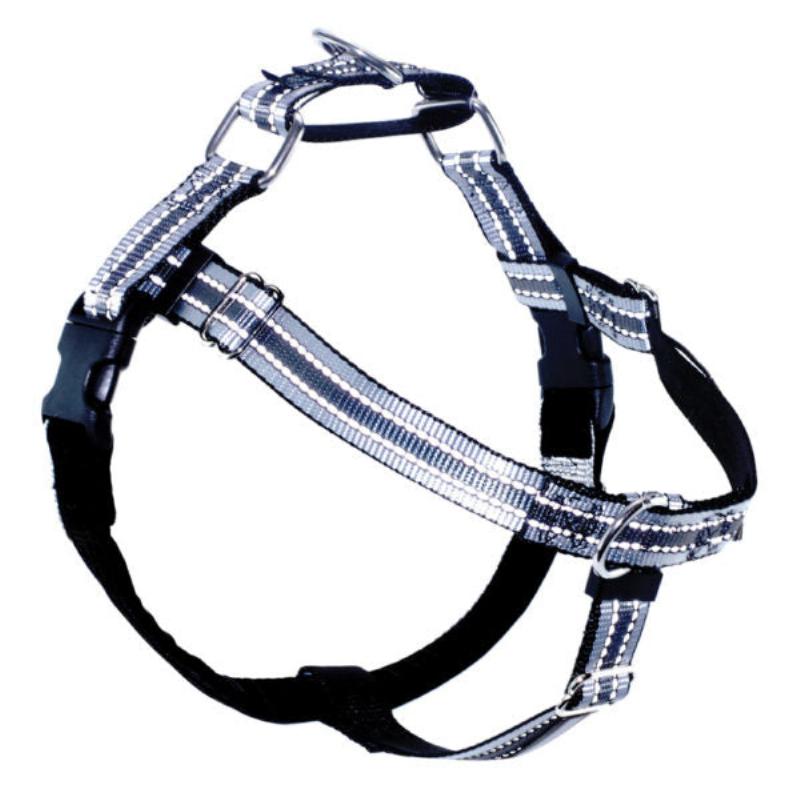 An informative image showing how a front-clip harness fits on a golden retriever, with an arrow pointing to the leash attachment at the chest to illustrate why it helps with a dog not to pull.
Step-by-Step Training Methods to Stop Pulling
Consistency and patience are your two most important tools. Start your training in a low-distraction environment, like your living room or backyard, before taking it on the road.
Method 1: The “Red Light, Green Light” Game
This is one of the most effective and widely recommended techniques. It directly teaches your dog that pulling gets them nowhere.
- Start Walking: Begin walking with your dog on the leash.
- The Moment of Truth: The instant you feel the leash tighten, stop dead in your tracks. Become a tree—immovable and uninteresting. Don’t pull back or scold your dog; just stop.
- Wait for the Slack: Stay still and wait. Eventually, your dog will turn to look at you or take a step back, releasing the tension on the leash.
- Green Light: The split second the leash goes slack, say “Yes!” in a happy tone, give your dog a high-value treat, and immediately start walking again.
- Rinse and Repeat: You will have to do this over and over. Your first few “walks” might not even get you past your driveway, and that’s okay! The goal is for your dog to make the connection: “When I pull, the fun stops. When the leash is loose, we move forward and I get rewarded.”
For dogs that need a bit more guidance, a helpful resource on how to train my dog to not pull on leash can offer additional perspectives on this core method.
Method 2: The “Turn-Around”
This method is excellent for dogs who are hyper-focused on what’s ahead. It teaches them that they need to pay attention to you.
- Walk Forward: Start your walk as usual.
- Leash Tightens, You Turn: As soon as your dog gets to the end of the leash and starts to pull, cheerfully say “Let’s go!” and immediately turn 180 degrees, walking in the opposite direction.
- Reward and Praise: As your dog turns to catch up with you, praise them and offer a treat when they are walking nicely beside you.
- Keep it Unpredictable: Continue your walk, but change direction frequently. This “crazy walking” keeps your dog on their toes and encourages them to watch you, wondering where you’ll go next. They learn that the most rewarding place to be is right by your side.
Method 3: Reward the “Check-In”
The ultimate goal is for your dog to choose to walk with you. This method focuses on reinforcing any and all good behavior.
- Be Prepared: Fill your pocket with delicious, pea-sized treats.
- Catch Them Being Good: As you walk, any time your dog is on a loose leash—even for a second—or glances back at you, mark the behavior with a “Yes!” and give them a treat.
- Encourage Proximity: Make the area around you the best place to be. By rewarding them for staying close, they will naturally want to hang out near you instead of forging ahead. This is a foundational step in understanding how to get dog not to pull.
Common Mistakes to Avoid
Training is as much about what you don’t do as what you do. Avoiding these common pitfalls will make your journey smoother.
- Inconsistency: If you only enforce the no-pulling rule sometimes, your dog will learn that pulling is like playing a slot machine—it might just pay off this time. You must be consistent for them to understand the new rules.
- Expecting Too Much, Too Soon: Your dog has likely been pulling for a long time. It will take more than one session to unlearn this habit. Keep training sessions short, positive, and frequent.
- Yanking or Jerking the Leash: Leash corrections are not only ineffective in the long run but can also damage your relationship with your dog and cause physical harm. The goal is to teach, not to punish.
- Not Exercising Your Dog Enough: A dog bursting with pent-up energy will have a much harder time focusing. A quick game of fetch or a run in the yard before a walk can help burn off that excess energy, leading to a calmer, more receptive training partner. Understanding the basics of how train dog not to pull on lead starts with managing their energy levels.
When Walks Get Challenging: Dealing with Distractions
Once your dog has mastered loose-leash walking in a quiet area, it’s time to up the ante. Distractions are the ultimate test.
Gradual Exposure is Key
Start small. Practice walking past a single, calm person. Then, try walking at a distance from another dog. Gradually decrease the distance and increase the intensity of the distraction as your dog succeeds. Don’t expect them to walk perfectly through a crowded farmer’s market on day one.
Be More Interesting Than the Distraction
Your job is to be more engaging than that squirrel. Use high-value treats that your dog absolutely loves—think small pieces of chicken, cheese, or hot dogs. Use an excited tone of voice. If you see a distraction approaching, get your dog’s attention before they become fixated. Ask for a “look at me” or start a rapid-fire treat delivery as the distraction passes. This makes paying attention to you far more rewarding than fixating on something else. This proactive approach is central to learning how to train a dog not to pull when walking.
Frequently Asked Questions (FAQ)
1. How long does it take to train a dog not to pull?
This varies greatly depending on the dog’s age, temperament, and how long they’ve been pulling. With consistent, daily practice (even just 5-10 minutes at a time), you should start seeing noticeable improvement within a few weeks.
2. Can I train an older dog to stop pulling?
Absolutely! Old dogs can definitely learn new tricks. The process might take a bit more patience as the habit is more ingrained, but the positive reinforcement methods outlined here work for dogs of all ages.
3. What if my dog pulls when they see another dog or a person?
This is a common issue known as reactivity. The core principle is the same: manage the environment to set your dog up for success. Keep a large enough distance from triggers so your dog can remain calm. Use high-value rewards to create a positive association with seeing other dogs or people from a distance. If the behavior is severe, consulting a professional trainer is recommended.
4. Is a harness better than a collar for a dog that pulls?
For a pulling dog, a front-clip harness is generally much safer and more effective than a collar. It distributes pressure across the chest and shoulders instead of concentrating it on the trachea, reducing the risk of injury and giving you better leverage.
5. What are the best treats to use for loose-leash training?
The best treats are small, soft, smelly, and something your dog finds irresistible. You’ll be using a lot of them, so they should be tiny to avoid overfeeding. Think bits of cooked chicken, cheese, commercial training treats, or even their favorite kibble if they are highly food-motivated.
Your Journey to Better Walks Starts Now
Training your dog to not pull is one of the most valuable skills you can teach. It’s a journey that requires patience, consistency, and a positive mindset, but the payoff is immense. Every walk becomes an opportunity to strengthen your bond, explore the world together, and build a partnership based on clear communication and mutual respect.
Remember to celebrate the small victories—the few steps with a loose leash, the quick glance back at you, the moment they choose you over a distraction. These are the building blocks of success. So grab your treats, your harness, and your patience, and take the first step toward the peaceful, enjoyable walks you and your dog deserve. The journey to master how to train a dog to not pull will transform your relationship for the better.
