
Bringing a new puppy into your home is an exciting time, filled with joy and the promise of a loyal companion. While early socialization is paramount, establishing good manners from the start is equally crucial. The ideal dog is one that is both friendly and well-behaved, happy to greet people without overwhelming them with jumps. Many dog owners struggle to balance the need for early socialization with the desire for a well-mannered dog. Rest assured, it is possible to achieve both, and the key lies in understanding how dogs learn. As the golden rule of dog training states, dogs learn best what they learn first. This means preventing bad habits from forming and teaching an alternative, desirable behavior.
Preventing Bad Habits Before They Start
One effective strategy, especially with young puppies, is to manage their interactions to prevent jumping. When a puppy is greeting people, keeping them in your arms can prevent them from developing the habit of jumping up. This is because dogs repeat behaviors that are rewarding for them. If a puppy learns that jumping up leads to reaching a human’s face, they will continue to jump to achieve that reward. For larger breeds that are too heavy to lift, having visitors get down to the dog’s level before greeting can also be effective. The goal is to stop undesirable behaviors from developing rather than trying to correct them later.
Teaching an Alternative Behavior: The Key to Success
The true key to successful dog training lies in teaching an alternative behavior that is incompatible with jumping, such as sitting. If your dog learns to consistently sit for attention, they will be unable to jump up simultaneously. This proactive approach significantly reduces the likelihood of jumping during greetings.
Mastering the “Sit” Command
To effectively teach your dog to sit, use high-value rewards to make sitting a highly positive experience. It’s easy to underestimate the importance of a solid “sit,” but a puppy that only partially understands this fundamental command can create significant training gaps. For your dog, “sit” should mean remaining in a seated position until released, regardless of distractions. Dedicate ample time to teaching and reinforcing the “sit” command, emphasizing duration and stability. Gradually introduce distractions and reward your dog generously for making good choices.
Greeting Etiquette: The “Sit” for Hello Method
Once your dog reliably holds a sit, integrate greeting behaviors into their training. Start with simple steps, such as having a person approach or stand near your dog while you reward them for staying seated. Continue to use highly motivating rewards as the interactions become more engaging. Progress from a person simply being nearby, to speaking to the dog, and then to gentle touching.
Generalizing Training Across Environments
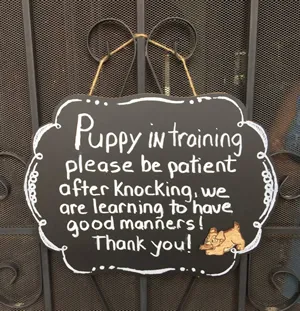 A sign providing guidance for dog training.
After your dog has learned to sit for greetings in controlled settings, it’s crucial to generalize this behavior to different locations and situations. The front door at home, with the excitement of the doorbell, is a common challenge. Training in this specific scenario is invaluable. Initially, set this up with familiar people or those the dog is less likely to get overly excited about. Begin with the person standing at a closed doorway, then progress to an open door, followed by ringing the bell with the door open, and finally, simulate the entire sequence of a doorbell ring and guest arrival. Teaching your dog how to behave when the situation is controlled will help build success. Don’t wait for a real guest to arrive to practice; be prepared for this common occurrence.
Ultimately, remember that dogs repeat behaviors that are rewarding. By setting up situations to your advantage, you can foster both excellent social skills and good manners in your canine companion.
Happy Training!
This guide was adapted from insights shared by Shannon Viljasoo, Director of Online Training and Content for McCann Professional Dog Trainers, who has been with the McCann team since 1999. Her passion for dogs and helping people build strong relationships with their pets shines through her extensive experience.
