
Teaching your dog a new trick can be a rewarding experience, and the “paw” or “shake” command is often a favorite. It seems harmless and cute, but this seemingly simple behavior can inadvertently complicate your dog’s overall training journey. The core issue lies in the conflicting messages it sends to your dog, especially when they exhibit similar behaviors you’re trying to correct, such as jumping up or pawing for attention. This creates confusion for your dog: when is it acceptable to use their paws on people, and when is it not?
A common method for teaching “paw” involves a closed fist with a treat inside. The dog paws at the hand, and upon contact, the treat is released. This approach is problematic because it can inadvertently teach dogs to make physical contact with hands that are holding food, which is counterproductive to developing good manners and self-control. Furthermore, this teaching method can interfere with teaching other foundational commands like “down.” Often, “down” is taught using a food lure that eventually becomes a hand signal. This hand motion can closely resemble the closed fist used to cue “paw,” leading to confusion and a dog that may struggle to differentiate between the cues.
When is Teaching “Paw” Actually Appropriate?
This does not mean you should never teach your dog to “paw.” It’s a cute trick that can be successfully integrated into a dog’s repertoire. However, it’s crucial to ensure your dog has a solid foundation in other areas before introducing this behavior. Before teaching “paw” or “shake,” it’s recommended that your dog has achieved proficiency in the following:
- No Longer Jumps on People: Your dog should have already learned not to jump up on individuals.
- “Down” Command Mastered: The “down” command should be reliably understood and executed.
- Solid Self-Control Around Food: Your dog should demonstrate good impulse control when food is present.
- Does Not Paw for Attention: The dog should not be in the habit of pawing at people for petting or attention.
For instance, when training Strata, I waited until he had mastered over twenty different behaviors, possessed excellent self-control around food, and never jumped on people before teaching him “pound it,” a variation of “paw.”
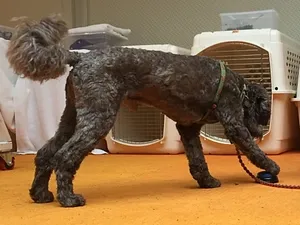 Charlie learning to push a button with his paw
When you are ready to teach “paw,” consider using a combination of shaping and targeting instead of luring. This can help minimize confusion for your dog. A recommended approach is to first shape the behavior of touching an object with the paw, and then gradually transfer this action to your hand or fist. For example, teaching a dog to touch a button with their paw can be an intermediate step. The button can later be held by the trainer to transfer the cue to their hand. This method is more effective than traditional luring, which can create ambiguities.
It is also essential to ensure the behavior is under stimulus control. This means your dog will only perform the “paw” action when specifically asked and not offer it in response to other cues or stimuli. Achieving stimulus control requires careful training to ensure the cue is precise and consistently rewarded.
If the complexities of teaching “paw” seem daunting, or if your dog struggles with inappropriate physical contact, consider teaching “wave” instead. This alternative trick avoids rewarding direct contact with your body, making it a safer and more appropriate choice for dogs still working on their manners.
Katherine Ostiguy, KPA CTP CPDT-KA, co-owner of Crossbones Dog Academy, emphasizes the importance of a strong training foundation before introducing behaviors like “paw.” With over twenty years of experience, Katherine utilizes positive reinforcement and clicker training to foster reliable behaviors in dogs.
« Previous
Next »
About the author: Katherine Ostiguy, KPA CTP CPDT-KA
Katherine Ostiguy is the co-owner of Crossbones Dog Academy in Providence, RI. She has over twenty years of experience training dogs and raising puppies. Katherine is a graduate of the Karen Pryor Academy Dog Trainer Program, a rigorous certification program that requires continuing education and a pledge to train using force-free methods and techniques. She uses clicker training and positive reinforcement to solve problems and train dogs to a high level of reliability.
