
Training your dog to master essential commands like “stay” and “come” is fundamental for their safety, good manners, and overall household harmony. These commands aren’t just for impressive competition events like AKC Rally or Obedience; they are vital tools for everyday situations, from answering the door to safely navigating public spaces. Many dog owners find teaching these commands challenging, but with patience, consistency, and the right approach, you can achieve a reliable “stay” and a prompt “come.” This guide will walk you through the steps to build a solid foundation for both commands, ensuring your dog becomes a well-behaved and responsive companion. To dive deeper into perfecting one of these core commands, you can learn more about how to teach stay command to dog effectively.
Understanding “Stay”: More Than Just a Pause
Unlike the cue “wait,” which implies a temporary pause or a moment of holding on, the “stay” command signifies that your dog must remain in a specific position until explicitly released. When you ask your dog to “stay,” they are expected to hold that position, whether sitting, lying down, or standing, regardless of what’s happening around them. Theoretically, if you ask your dog to stay while you step out for a moment, they should still be in that exact spot upon your return, even if you’re gone for an extended period.
A critical component of the “stay” command is the release cue. This is a specific word you use to inform your dog that they are free to move and that the requested behavior has ended. Using a release word consistently can actually build an automatic “stay” into any position your dog holds. Common release words include “okay,” “free,” or “release.” It’s essential to choose a word that you don’t frequently use in casual conversation to avoid accidentally releasing your dog at an unintended moment, which can confuse them and undermine your training efforts. Always use your chosen release word exclusively to signal the end of a behavior.
Teaching the Release Cue
To successfully train a reliable “stay” behavior, you must begin with small, manageable steps and gradually build up. Your initial focus should be on teaching your dog the meaning of their release word. This foundational step is crucial because it helps your dog understand when they are permitted to break a position, preventing them from anticipating the release and moving prematurely.
Here are the steps to get started with teaching the release:
- Ask your dog to sit or lie down in a quiet, distraction-free environment.
- After just one second, calmly offer your dog a high-value treat and immediately say your chosen release word (e.g., “okay” or “free”).
- Actively encourage your dog to get up and move after you’ve given the release word. You can pat your legs, walk a few steps away, or clap your hands gently to prompt movement.
- Praise your dog enthusiastically the moment they move and break their position.
- Repeat these steps multiple times in short training sessions until your dog clearly understands that they are free to move only after they hear the release word.
Building Duration for the “Stay” Command
Once your dog grasps the concept of the release cue, you’re ready to introduce the “three Ds” of dog training: duration, distance, and distraction. Start by focusing solely on duration, meaning how long your dog can hold the “stay” position. For now, keep yourself close to your dog and minimize any potential distractions in their environment. This is also the point where you should begin to incorporate the verbal cue “stay.”
Follow these steps to build duration:
- Ask your dog to sit or lie down.
- As soon as they settle into the position, extend your hand straight out in front of you, like a stop sign, and clearly say the word “stay.”
- Wait for just one or two seconds, then calmly give your dog a treat while they are still in the “stay” position.
- Release your dog with your chosen release word and offer praise when they move.
- In subsequent repetitions, gradually increase the waiting time before offering the treat and then releasing your dog.
- Build the duration a few seconds at a time, celebrating each small success.
- Once your dog can comfortably hold a “stay” for 10 seconds or more, you can begin to offer multiple treats during the duration of the stay. Calmly give treats periodically, repeating your “stay” cue and hand signal as a gentle reminder that they are not yet finished.
It’s crucial to prevent your dog from ever feeling the need to release themselves. Always take small, incremental steps and avoid pushing their limits too quickly. Set your dog up for success by making the “stay” command rewarding. Remember, “stay” can be inherently boring for dogs, so rewarding the act of staying—not the release—is paramount. If you use a clicker, click during the stay before offering a reward, then repeat the “stay” cue and hand signal to reinforce the command, ensuring your dog doesn’t mistake the click for the end of the behavior. Building duration is a patient process, similar to how to stop my puppy from pulling on the leash, requiring consistent small steps.
Troubleshooting Common “Stay” Challenges
When you’re teaching your dog to stay, being mindful of your own body language is extremely important. Unconscious movements can inadvertently lure your dog out of their position. For example, dogs are accustomed to being in front of you for training, so if you step backward, their natural instinct might be to follow you. Any subtle shift or movement on your part could signal to your dog that it’s okay to move, leading them to break their “stay.”
What should you do if your dog breaks their “stay” before you give the release cue? First and foremost, avoid punishing your dog. Breaking a stay is rarely an act of defiance; it’s usually a sign that you might have inadvertently lured them, or you asked for too much too soon. Instead of scolding, simply repeat your cues for “sit” or “down” and “stay,” then start the exercise over. It’s often beneficial to take a few steps back in your training, reducing the duration or distraction level, to ensure your dog is set up for success in the next attempt. This gentle approach reinforces trust and encourages learning.
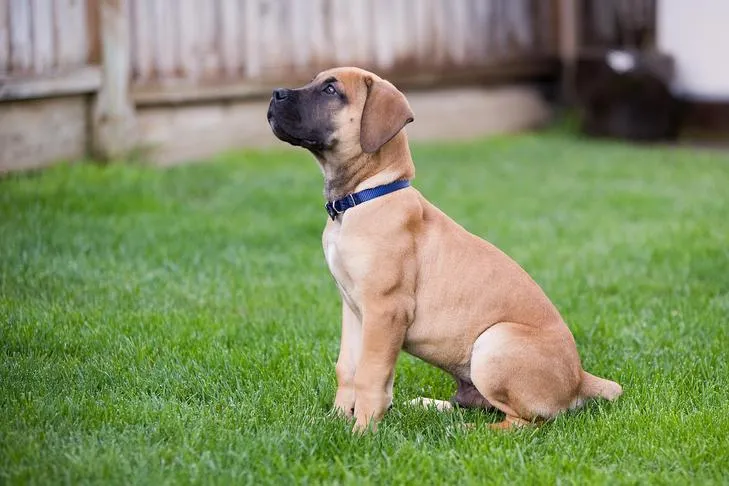 A Boerboel puppy sitting in profile in a backyard, looking attentively.
Adding Distance and Distractions to “Stay”
Only introduce distractions and distance once your dog can consistently hold a “stay” for at least 30 seconds in a calm environment. Since distance inherently incorporates a level of distraction, it’s often best to introduce it last. When you begin to add a new “D” (duration, distance, distraction), be sure to significantly relax your expectations for the others. For instance, when you introduce distractions, even if your dog can hold a “stay” for two minutes without them, go back to asking for only a few seconds when the distraction is present.
Start with minor distractions, such as clapping your hands softly or dropping a light object. Gradually build up to more significant distractions, like throwing a favorite toy or having another person walk by. Once your dog can maintain their “stay” through various distractions, you can then begin to build the duration again under these new conditions.
When your dog can achieve 30-second stays with moderate distractions, you are ready to incorporate distance. Again, reduce your duration expectations and minimize distractions as you focus on this new element. The following steps will help you build distance effectively:
- Ask your dog to “stay,” then take a single step backward.
- Immediately return to your dog and give them a treat for holding the position.
- Release your dog.
- Repeat the above steps, but this time, take two steps away before returning to your dog to treat, then release them.
- Slowly and progressively increase the distance, always returning to reward them, until you can walk to the edge of the room or a designated boundary.
Always make sure to return to your dog before releasing them. If you release your dog from a distance, you lose the opportunity to reward them while they are still holding the “stay.” Furthermore, releasing from far away might inadvertently teach your dog that a certain distance is a cue to break their position and approach you. By consistently returning to them for the reward and release, you reinforce the expectation that they must remain until you give the explicit command. This systematic approach is also helpful when dealing with other behavior challenges, such as how to stop dog barking at nothing, as it teaches control and focus. Once your dog can handle all three Ds independently, you can combine them for more advanced challenges, like leaving the room or practicing outdoors. Take your time and build slowly, and your dog will develop a rock-solid “stay” regardless of the environment.
Mastering the “Come” Command: Reliable Recall
The “come” command, or recall, is arguably one of the most critical commands for your dog’s safety and your peace of mind. A reliable recall ensures you can call your dog back to you in any situation, whether they’ve slipped their leash or are venturing too far in an off-leash area.
To teach the “come” command, start in a quiet, distraction-free environment, like your living room or a fenced yard. Begin by getting down to your dog’s level, making yourself inviting and non-threatening. Say your dog’s name clearly, followed by the command “come!” in an enthusiastic and happy tone. As soon as your dog starts moving towards you, offer effusive praise and, when they reach you, reward them with a highly-valued treat or a favorite toy. Make this interaction a party for your dog so they associate coming to you with positive experiences.
Never punish your dog for coming to you, even if it took them a while or they were doing something you didn’t like before you called. Punishing them for arriving at your side will teach them to avoid coming when called. Gradually increase the distance you call them from, and then introduce mild distractions. Practice in various locations, starting with a long leash in an open space, before moving to off-leash areas. The goal is for your dog to perceive “come” as the most rewarding thing they can do, making it their priority to return to you promptly. Practicing “come” outdoors, perhaps in areas where you might need things for dogs to pee on outside, can help them generalize the command to different environments.
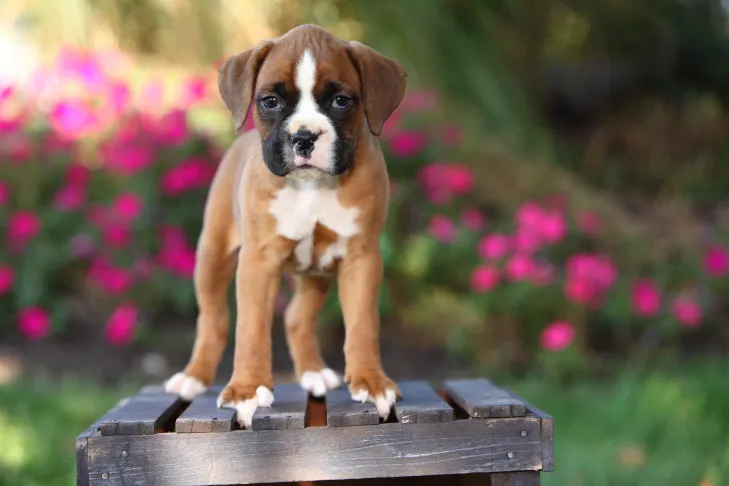 A Boxer puppy standing on top of a wooden crate outdoors with colorful flowers in the background, looking curious.
Combining “Stay” and “Come” for Advanced Obedience
Once your dog has a solid grasp of both the “stay” and “come” commands individually, you can begin to combine them for more advanced obedience and real-world scenarios. For example, you can ask your dog to “stay” in one spot, walk a short distance away, and then call them with the “come” command. This sequence helps reinforce both commands and teaches your dog to respond reliably even when you’re not right next to them.
Always maintain consistency with your cues, rewards, and expectations. Remember that training is an ongoing process, and occasional refreshers or new challenges will keep your dog engaged and responsive. By investing time and effort into these foundational commands, you’ll build a stronger bond with your dog and ensure they are a well-behaved, safe, and happy member of your family.
Mastering the “stay” and “come” commands is an incredibly rewarding journey for both you and your dog. These commands are more than just tricks; they are essential for managing your dog’s behavior, ensuring their safety, and fostering a deeper connection built on trust and understanding. With consistent positive reinforcement, patience, and a clear understanding of the training principles outlined here, your dog will soon be responding reliably to your cues, making every interaction more enjoyable and secure. Start practicing today, celebrate every small victory, and enjoy the profound benefits of a well-trained canine companion.
