
Teaching your dog to reliably “come” when called and “stay” in a designated spot are two of the most fundamental and crucial commands for any dog owner. These skills not only enhance your dog’s safety by allowing you to recall them from potentially dangerous situations but also build a strong bond of trust and understanding between you and your canine companion. Mastering these commands lays the groundwork for a well-behaved dog and opens doors to further training and activities. While many owners struggle with inconsistent recalls or dogs that can’t hold a stay, with patience, consistency, and the right approach, you can teach your dog to respond to these commands like a seasoned professional.
A solid recall and a reliable stay are not just for competitive dog sports; they are essential for good manners and household obedience. If your dog can remain in a position like sit or down until released, it simplifies many aspects of daily life, from grooming and answering the door to managing a busy household. However, achieving this level of responsiveness requires understanding the principles of positive reinforcement and breaking down the training into manageable steps. This guide will walk you through the process, focusing on building duration, distance, and reliability for both the “come” and “stay” commands.
Understanding the “Stay” Command
The “stay” command is distinct from “wait.” While “wait” implies holding a position temporarily, “stay” means remaining in a specific position until you give a release cue. This means if you ask your dog to stay, they should remain in that exact spot until you explicitly tell them they are free to move. The release cue is a vital part of the “stay” command, signaling the end of the behavior. You can use a release word with any command, effectively building an automatic stay into the position. Consistency is key; use your chosen release word exclusively to ensure your dog understands when the command is over. Common release words include “okay,” “free,” or “release.” Be mindful that “okay” is a frequently used word in everyday conversation, so choose it carefully to avoid accidental releases.
To effectively train a “stay,” you must start with small, achievable steps and gradually increase the difficulty. Your initial focus should be on teaching your dog what their release word signifies.
- Initiate the Position: Ask your dog to sit or lie down.
- Reinforce the Release: After approximately one second, calmly offer your dog a treat and immediately say your chosen release word.
- Encourage Movement: Prompt your dog to get up after hearing the release word. You can achieve this by walking away, patting your legs, or clapping your hands.
- Praise Success: Offer praise when your dog moves.
- Repeat and Solidify: Continue repeating these steps until your dog reliably understands that they are free to move only after hearing the release word.
Once your dog understands the release cue, you can begin to add duration to the stay. This involves gradually increasing the amount of time your dog remains in the requested position.
- Cue the Position: Ask your dog to sit or lie down.
- Introduce “Stay”: As soon as they adopt the position, extend your hand forward like a stop sign and say the word “stay.”
- Initial Reward: Wait a second or two, then calmly give your dog a treat.
- Release and Praise: Release your dog and praise them when they move.
- Gradually Increase Time: Now, increase the duration by a few seconds before rewarding and releasing your dog.
- Build Duration Incrementally: Continue to increase the duration in small increments.
- Multiple Rewards: Once your dog can hold a stay for 10 seconds or more, you can begin offering multiple treats during the stay. Calmly present treats periodically, and repeat your “stay” cue and hand signal to remind your dog that the command is still active.
Remember, the goal is to make the release rewarding, not the act of breaking the stay. Taking small steps ensures your dog’s success and prevents them from becoming discouraged. “Stay” can be a less exciting command for dogs, so it’s crucial to reward the successful execution of the stay itself, rather than the release. If you use a clicker for training, click during the stay, just before delivering the reward. Avoid clicking when your dog breaks the stay upon release. If your dog associates the click with ending the behavior, repeat your “stay” cue and hand signal after clicking and treating.
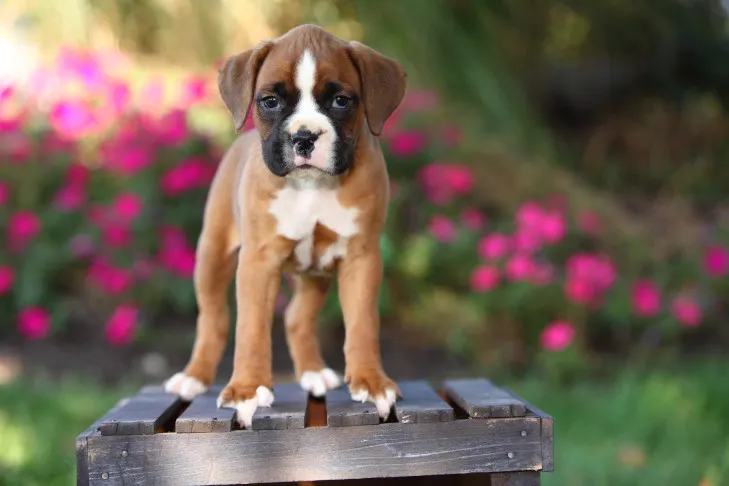 A playful Boxer puppy standing on a wooden crate outdoors, with colorful flowers in the background.
Troubleshooting ‘Stay’ Issues
During “stay” training, pay close attention to your body language. Any sudden movement from you can unintentionally lure your dog out of position. Dogs are accustomed to being in front of you during training, so any backward movement from you might prompt them to follow.
If your dog breaks their stay before you release them, avoid punishment. This usually indicates that you inadvertently lured them or asked for too much too soon. Simply repeat your cues and start over, perhaps taking a few steps back in your training to ensure success. Consistency and patience are key to overcoming these challenges.
Adding Distractions and Distance to the ‘Stay’
Once your dog can reliably hold a “stay” for at least 30 seconds, you can begin introducing distractions and distance. Distance inherently includes some distraction, so it’s best to introduce that element last. When introducing a new variable (duration, distance, or distraction), be prepared to adjust your expectations for the others. For instance, if you’re introducing a distraction, even if your dog can hold a stay for two minutes under normal circumstances, you might need to reduce the duration to a few seconds when the distraction is present.
Start with minor distractions, such as clapping your hands, and gradually progress to more significant ones, like tossing a ball. After your dog demonstrates the ability to stay through various distractions, you can begin building duration again.
When your dog can consistently achieve 30-second stays with distractions, it’s time to incorporate distance. Again, be prepared to lower your duration expectations and minimize distractions during this phase. The following steps will help you build distance:
- Initial Step Back: Ask your dog to stay, then take a single step backward.
- Immediate Reward: Return to your dog promptly and offer a treat.
- Release: Release your dog.
- Increase Distance: Repeat the process, but this time take two steps away before returning to treat and release.
- Gradual Progression: Slowly increase the distance until you can reach the edge of the room.
Always return to your dog before releasing them. Releasing them from a distance prevents you from rewarding them while they are still in the “stay” position and might lead them to associate that distance with the release cue. When your dog can handle all three elements – duration, distance, and distraction – independently, you can begin combining them. This might involve leaving the room or going outside. Proceed with caution and build gradually to ensure your dog develops a rock-solid stay.
Mastering the “Come” Command
The “come” command, often called recall, is a life-saving skill. Teaching it effectively requires making yourself the most exciting and rewarding thing in your dog’s world when they hear their name and the recall cue.
Getting Started with Recall Training
- Positive Association: Start in a quiet, distraction-free area. Call your dog’s name followed by “come!” As soon as they turn towards you, offer enthusiastic praise and a high-value treat.
- Short Distances: Begin with very short distances, just a few feet. Make it a fun game.
- Use a Long Leash: Once your dog understands the basic concept in a contained area, use a long leash in a more open, but still safe, environment. This gives you a safety net. When you call “come,” gently reel them in if they don’t respond immediately.
- The “Run Away” Game: When you call “come,” turn and run away from your dog, encouraging them to chase you. This often makes the recall more exciting.
- Never Punish on Recall: This is critical. If your dog eventually comes to you after ignoring your initial calls, never scold them. This will create a negative association with coming to you. Instead, reward them enthusiastically for finally arriving. If they consistently ignore your recall, you’ve likely asked too much too soon or haven’t made yourself rewarding enough.
- Fade the Leash: As your dog becomes more reliable, gradually increase the distance and distractions. You can then begin to phase out the long leash, but always keep it accessible for safety.
Advanced Recall Techniques and Troubleshooting
- Distraction Training: Once your dog has a solid recall in calm environments, start introducing mild distractions. Call them while a family member walks by, or when another (calm) dog is at a distance. Gradually increase the intensity of distractions.
- The “Double Recall”: Sometimes, a second, more excited recall can help. If your dog is hesitating, use a more urgent tone and perhaps make a playful sound.
- Making Yourself More Interesting: Always carry treats or a favorite toy. When you call your dog, present yourself as the most exciting option.
- Never Call for Punishment: As mentioned, never use the “come” command to call your dog for something unpleasant, like a bath or nail trim, if they associate those activities with negativity. Instead, go to them to perform the task.
- Proofing the Command: Practice in various locations and with increasing levels of distraction. This ensures your dog understands that “come” means coming to you, regardless of the environment.
By consistently applying these positive reinforcement techniques, you can teach your dog to come reliably and stay put, fostering a safer and more harmonious relationship.
When you are teaching your dog to stay, it is essential to be mindful of your body language. Any movement can potentially lure the dog towards you, causing them to break their position. Dogs are accustomed to being in front of you during training, so any backward movement may prompt them to follow. If your dog breaks their stay before being released, do not punish them. Chances are you did something to lure them up or asked for too much too soon. Simply repeat your cues and start over, taking a few steps back in your training to ensure success.
It’s crucial to remember that teaching a dog to stay requires patience and consistency. When you begin to add distractions and distance, only do so after your dog has mastered duration of at least 30 seconds. Distance has some inherent distraction, so it’s best to leave it for last. When introducing a new element, relax your expectations for the others. For instance, when you start adding distractions, even if your dog can stay for two minutes, go back to asking for only a few seconds when the distraction is present. Begin with small distractions like clapping your hands, then gradually build up to larger ones like throwing a ball. After your dog is staying through any distraction, you can start to build duration again.
When your dog can achieve 30-second stays with distractions, you are ready to add distance. Again, lower your duration expectations and minimize distractions for this part of the process. The following steps will help you build distance:
- Ask your dog to stay, then take a single step back.
- Immediately return to your dog and give them a treat.
- Release your dog.
- Repeat the above steps but take two steps away before returning to your dog to treat, then release them.
- Slowly increase the distance until you can walk to the edge of the room.
Always return to your dog before releasing them. If you release them from far away, you cannot reward them while they are staying. Plus, they may come to think a certain distance is a cue to release and approach you. When your dog can handle all three Ds on their own, it’s time to combine them and up the challenge by leaving the room or going outside. Take your time and build slowly, and your dog will have a rock-solid stay no matter what.
Conclusion
Teaching your dog to “come” and “stay” are foundational commands that contribute significantly to their safety and your peace of mind. By employing positive reinforcement, breaking down training into manageable steps, and remaining consistent, you can build a strong recall and a reliable stay. Remember to always make training a positive and rewarding experience for your dog. If you encounter persistent challenges or desire personalized guidance, consider consulting with a professional dog trainer.
References
- American Kennel Club (AKC). (n.d.). Obedience Training. Retrieved from https://www.akc.org/sports/obedience/
- American Kennel Club (AKC). (n.d.). Rally. Retrieved from https://www.akc.org/sports/rally/
- American Kennel Club (AKC). (n.d.). Dog Sports and Events. Retrieved from https://www.akc.org/expert-advice/sports/get-started-in-dog-sports-and-events/
- American Kennel Club (AKC). (n.d.). 5 Basic Commands Every Puppy Should Know. Retrieved from https://www.akc.org/expert-advice/training/teach-your-puppy-these-5-basic-commands/
- American Kennel Club (AKC). (n.d.). How to Teach Your Dog to Lie Down. Retrieved from https://www.akc.org/expert-advice/training/how-to-teach-your-dog-to-lie-down/
- American Kennel Club (AKC). (n.d.). Best Dog Treats: How to Choose the Right Treats for Your Dog. Retrieved from https://www.akc.org/expert-advice/nutrition/best-dog-treats-choose-right-treats-dog/
- American Kennel Club (AKC). (n.d.). Clicker Training Your Dog. Retrieved from https://www.akc.org/expert-advice/training/clicker-training-your-dog-mark-and-reward/
- American Kennel Club (AKC). (n.d.). Dog Training: Duration, Distance, Distraction. Retrieved from https://www.akc.org/expert-advice/training/dog-training-duration-distance-distraction/
