
It’s an age-old scenario for many new pet parents: the joyous, boundless energy of a puppy often expresses itself as an enthusiastic leap toward your face or guests. While this “hello” might seem cute at first, puppy jumping can quickly become an annoying and even dangerous behavior, especially as your little one grows. Large breed puppies can easily knock over children or seniors, while even smaller pups can leave scratches or muddy paw prints on your clothes. The truth is, your puppy isn’t trying to be naughty; they’re simply trying to greet you face-to-face and have learned that jumping is an effective way to get your attention. Fortunately, teaching your puppy appropriate greeting behavior is entirely achievable, setting them up for a lifetime of polite interactions. These 10 essential tips will guide you on how to stop your puppy from jumping on you and ensure they know exactly how to say “hi” to humans in a safer, more polite way. For more fundamental guidance, consider revisiting puppy training basics the first week.
1. Only Reward Your Puppy When All Four Paws are on the Floor
The most effective approach to addressing unwanted puppy behavior is to teach an incompatible alternative. Your puppy will learn much faster if you clearly show them what to do, rather than just what not to do. In the context of jumping, this means training your puppy to keep all four paws on the floor during greetings. They simply cannot jump and stand at the same time. You might also choose to teach them to sit or lie down for greetings. The key is consistency: only provide attention and greet your puppy when they are following your chosen rule. Avoid sending mixed signals; if it’s not okay to jump in your nice clothes, it’s not okay in your casual attire either.
2. Provide Immediate Attention When Your Puppy’s Front Feet are Down
Puppies, much like all dogs, will repeat behaviors that result in a desired outcome. Therefore, as soon as your puppy adheres to your greeting rule – such as keeping their front feet on the floor – immediately reward them with praise and gentle petting. Your attention is a powerful motivator for your puppy, so ensure they receive it without delay when they exhibit the correct behavior, especially during the learning phase. Don’t wait to remove your coat or shoes; an impatient puppy might resort to jumping to get your notice. This immediate positive reinforcement helps your puppy connect their desired behavior with your affection.
3. Withdraw Attention When Your Puppy Jumps
Conversely, the only way to eliminate jumping is to stop rewarding it entirely. Never reinforce a behavior you wish to stop. If your puppy jumps on you, promptly remove what they seek: your attention. This could involve calmly turning your back or walking away, allowing your puppy to realize that jumping has the opposite effect of what they intended. However, the moment your puppy’s four paws are back on the floor, turn around and quietly praise and pet them. This teaches your puppy that their behavior acts as a switch, turning your attention on and off based on their actions.
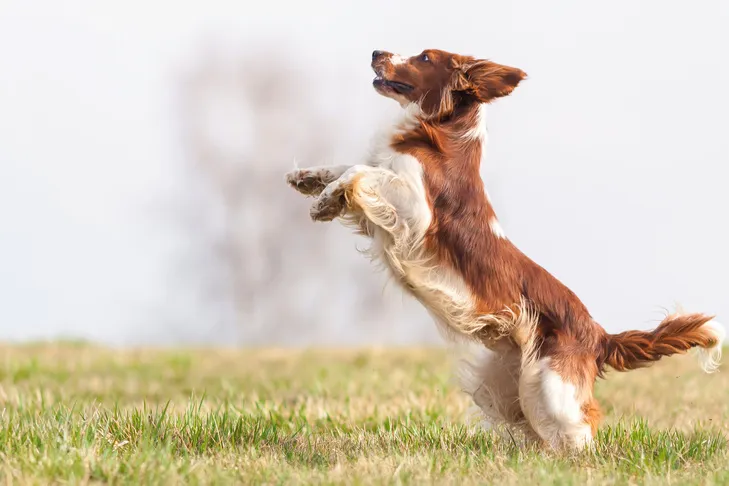 Welsh Springer Spaniel puppy enthusiastically jumping up outdoors towards its owner.
4. Strategically Set Your Puppy Up for Success
While ignoring jumping and rewarding proper greetings is effective, it can be a trial-and-error process that might be frustrating for your puppy. To expedite learning, set your puppy up for success by making it easy for them to follow your greeting rule. If your rule is for them to sit, ask them to sit as soon as you enter the door. If “four on the floor” is your preference, encourage them to maintain a standing position. A fantastic trick to prevent jumping is to scatter small treats on the floor as you greet them. Most puppies can’t resist a free treat, and they can’t jump and sniff the ground for food simultaneously. Be quick; if you offer the food before your puppy even considers jumping, you’re rewarding their “four on the floor” posture with both attention and a tasty reward. Over time, your puppy will understand the greeting rule, and you can gradually reduce the food rewards. For related training challenges, understanding crate training a puppy for potty training can also instill discipline.
5. Consistently Reward Proper Greeting Behavior
Your puppy will internalize proper greeting behavior more quickly if their actions reliably dictate your attention – paws on the floor earns attention, while jumping makes it disappear. This means you must always reward your puppy when they follow your greeting rule. Never withhold attention once your puppy’s feet finally touch the floor, even if you’re feeling irritated from a previous jumping episode. Inconsistent reinforcement will only confuse your puppy and hinder their learning progress. Clarity and consistency are paramount in puppy training.
6. Avoid Grabbing or Pushing Your Puppy Away
It’s crucial to remember that your puppy jumps primarily to gain your attention. Any form of physical interaction, even a negative one like grabbing, holding their paws, or pushing them away, still counts as attention. Consequently, this negative reinforcement can actually reward the jumping behavior, potentially increasing its frequency in the long run. Even worse, some energetic puppies might misinterpret such physical responses as an invitation to engage in roughhouse play, leading them to jump harder and stronger, thinking it’s all part of a fun game.
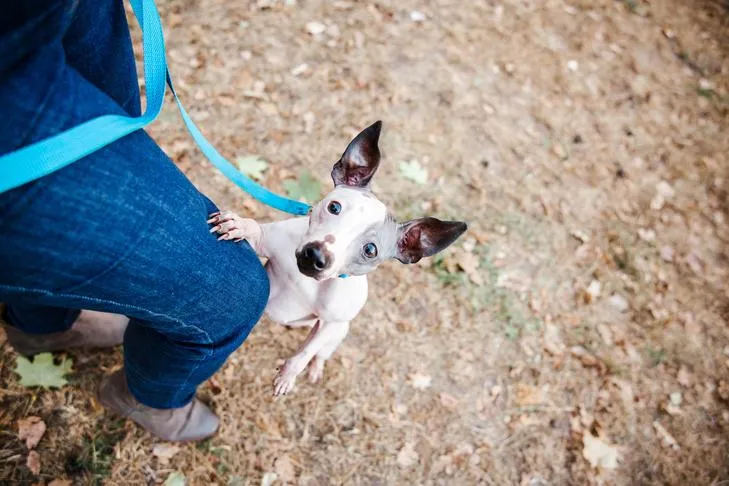 American Hairless Terrier puppy enthusiastically jumping up on its owner's leg outdoors.
7. Never Use Your Knee to Block Your Puppy
A common but outdated piece of advice is to raise your knee to block your puppy’s chest when they jump. As previously discussed, kneeing can be misconstrued as attention or a wrestling game by some boisterous puppies, resulting in the opposite of the desired effect. More importantly, for most puppies, this action can erode trust and damage the vital human-canine bond. Your puppy is merely trying to say “hello,” and responding with physical punishment can cause them to distrust you. This distrust can then lead to other behavioral issues, such as reluctance to come when called.
8. Maintain Calm, Low-Key Greetings While Your Puppy is Learning
A puppy’s sheer happiness upon seeing you can make it incredibly difficult for them to control their excitement. Resisting the natural urge to jump and instead obeying a new greeting rule requires significant emotional self-control. Help your puppy by keeping greetings calm and low-key initially. Puppies are adept at reading our emotions; if you’re overly excited, they will likely become equally aroused. Instead, remain calm and quiet, even when offering praise. As your puppy begins to grasp the concept, you can gradually increase your enthusiasm until you can match their joy without encouraging jumping.
9. Prevent Your Puppy From Jumping on Guests
You’re not the only one who might inadvertently reinforce your puppy’s jumping behavior. Other family members, guests, and even strangers encountered on walks can unknowingly reward jumping. To prevent this, employ management techniques. Leash your puppy when guests arrive so they cannot rush up and jump. Even better, teach your puppy a “go to your place” command, directing them to a mat or bed, or put your puppy in their crate when the doorbell rings, keeping them away from the entrance. A baby gate can also be an effective barrier to block off the front hall.
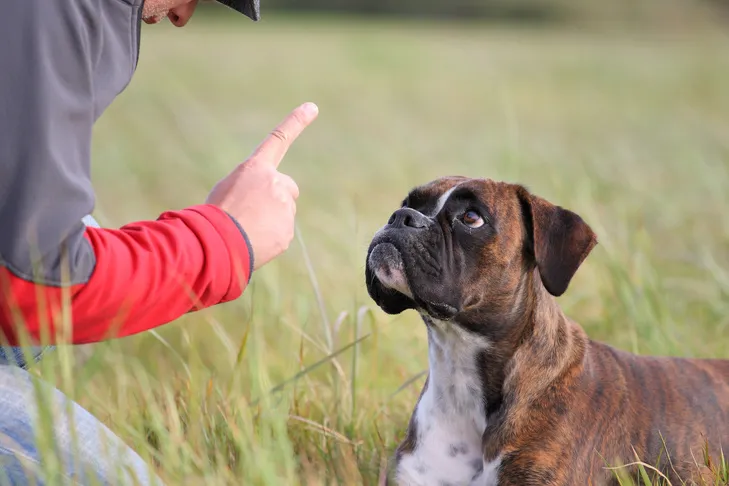 A man gently training a Boxer puppy to lie down outdoors.
10. Guide Guests and Strangers on Your Greeting Rules
Don’t hesitate to clearly communicate your puppy’s greeting rules to guests and even polite strangers. While your puppy is still in training, ask people to completely ignore them unless you give the go-ahead. It’s also wise to avoid interactions with unfamiliar people until your puppy has mastered polite greetings with friends and family who you know will cooperate with your training methods. When encountering strangers, use a “watch me” cue or distract your puppy with a favorite toy until the person has passed, redirecting their attention from the temptation to jump.
Teaching your puppy not to jump requires patience, consistency, and clear communication. By consistently applying these methods, you can transform an excitable jumper into a well-mannered greeter, fostering a more harmonious relationship for everyone involved.
