
Dogs jumping up to greet people is a widespread behavior challenge that many dog owners face. While it’s a natural canine expression of excitement and a common way for dogs to seek attention, it can quickly become an undesirable habit. A large, enthusiastic dog can easily knock over a child or an elderly person, potentially causing serious injury. Even smaller dogs can leave muddy paw prints on clothes or deliver accidental scratches. Essentially, your dog is trying to say “hello” face-to-face and get your undivided attention. Understanding this natural instinct is the first step toward effective training. This guide from Dog Care Story will provide you with proven strategies and practical tips to teach your dog polite greeting manners, ensuring a safer and more enjoyable interaction for everyone involved.
The key to resolving this common issue is to teach your dog an alternative, incompatible behavior – something they can do instead of jumping. For instance, they cannot jump if all four paws are firmly on the floor. Or, you might prefer them to sit or lie down calmly when greeting. By consistently reinforcing a clear greeting rule, you empower your dog with a constructive way to welcome you and earn your attention. These 10 essential tips will help you master the process of teach a dog a new trick for appropriate greetings, transforming excited leaps into calm, respectful welcomes.
1. Only Greet Your Dog When All Four Paws Are on the Floor
The most effective approach to addressing problematic behaviors is to substitute them with an incompatible alternative. Dogs learn more efficiently when they are shown what to do, rather than just what not to do. When it comes to jumping, the simplest alternative is to train your dog to keep all four paws on the ground. This ensures they cannot physically jump and stand simultaneously. Alternatively, you might decide to teach your dog to sit or lie down as their preferred greeting posture. Whatever rule you establish, it is crucial to only provide attention, praise, or affection when your dog is adhering to this specific guideline. Consistency is paramount; avoid confusing your dog by allowing jumping in some situations (e.g., when you’re casually dressed) but not in others (e.g., when you’re in formal attire).
2. Provide Immediate Attention When Your Dog’s Front Feet Are Down
Dogs are intelligent creatures who tend to repeat behaviors that yield positive outcomes and attention. Therefore, it’s essential to reinforce the desired greeting behavior as soon as it occurs. The moment your dog follows your established rule – for instance, having all four paws on the floor – immediately offer praise, gentle petting, or a quiet greeting. Your dog craves your attention as a reward, so ensure they receive it without delay when performing correctly, especially during the initial learning stages. If you postpone your greeting, perhaps while removing your coat or shoes, your dog might grow impatient and resort to jumping or other attention-seeking behaviors. Prompt reinforcement helps your dog understand the direct link between their calm behavior and receiving your affection. You can learn more about how to engage your dog with amazing tricks to teach your dog to channel their energy positively.
3. Remove Attention When Your Dog Jumps
Conversely, to extinguish jumping behavior, you must stop reinforcing it. Any form of attention, even negative, can inadvertently reward the behavior. If your dog jumps on you, swiftly withdraw what they are seeking: your attention. This can be achieved by calmly turning your back, walking away, or stepping behind a piece of furniture. The goal is to make your dog realize that jumping has the opposite effect of what they intended. However, as soon as your dog’s four paws are back on the floor, turn back and quietly offer praise and gentle petting. This consistent on/off switch for your attention will help your dog understand that calm behavior earns interaction, while jumping makes it disappear.
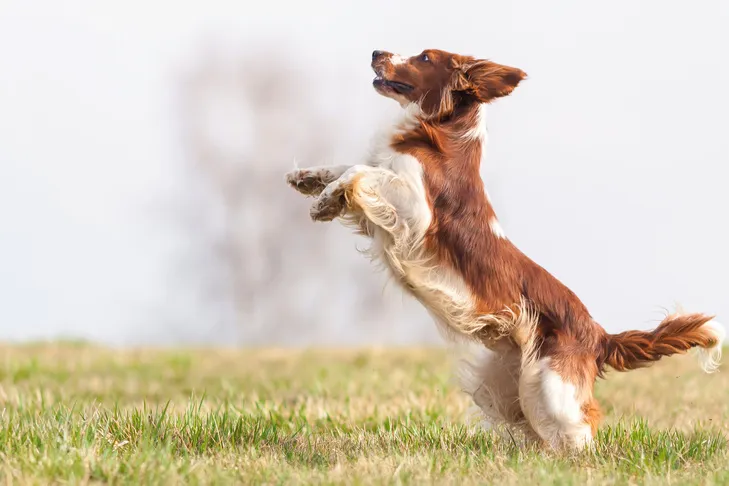 A lively Welsh Springer Spaniel playfully jumping up on its owner in an outdoor setting.
4. Set Your Dog Up for Success with Proactive Training
While ignoring jumping and rewarding appropriate greetings is effective, it can be a slow process that involves trial-and-error for your dog. You can accelerate their learning by proactively setting them up for success. If your greeting rule is for your dog to sit, ask them to sit the moment you enter the door, before they even have a chance to jump. If “four on the floor” is your preference, encourage them to maintain that standing position.
A highly effective technique to prevent jumping is to scatter small, high-value treats on the floor as you arrive. Most dogs can’t resist a free treat, and they cannot jump while simultaneously sniffing and foraging for food on the ground. You need to be quick and consistent; by providing the treats before your dog considers jumping, you reward the “four on the floor” behavior with both attention and a tangible treat. As your dog consistently understands and practices this greeting rule, you can gradually reduce and eventually phase out the food rewards, relying more on verbal praise and petting. Engaging your dog with various fun tricks to train your dog can also help build their focus and responsiveness to commands.
5. Always Reward for Proper Greeting Behavior
Your dog will learn appropriate greeting behavior much faster if their actions consistently and immediately influence your attention. When their front paws are on the floor, they gain your attention; when they jump, it disappears. This means you must always reward your dog when they follow your greeting rule. Even if you’ve had a long day and are feeling irritated after a brief period of jumping, do not withhold your attention once their feet touch the floor. Inconsistency will confuse your dog and undermine the training. Every instance where they display the desired behavior is an opportunity to reinforce the rule, making it stronger and more ingrained.
6. Avoid Grabbing or Pushing Your Dog Away
It’s important to remember that your dog is jumping to get your attention. Even a seemingly negative physical response, such as grabbing their paws, holding them down, or pushing them away, still constitutes attention from their perspective. This kind of interaction, instead of discouraging jumping, can actually reinforce it, leading to more frequent jumping in the long run. Worse still, for some dogs, particularly those with a playful or boisterous temperament, physical interventions can be misinterpreted as an invitation for roughhouse play. They might return to jumping with even greater intensity, believing it’s all part of an exciting game. This can damage trust and make effective training much harder.
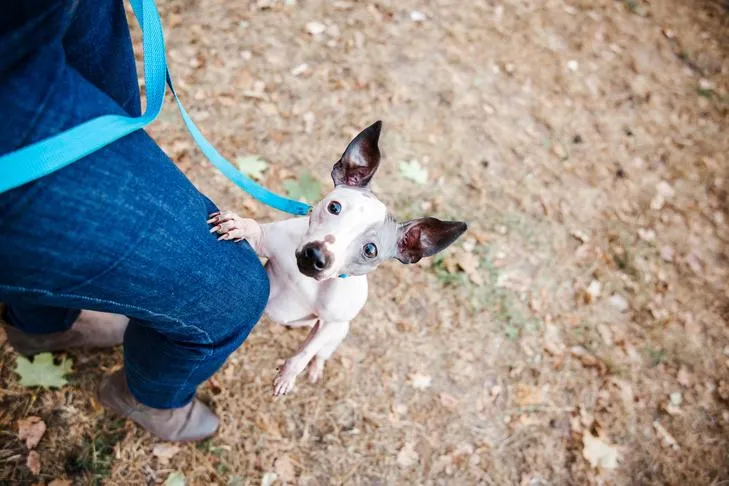 An American Hairless Terrier excitedly jumping up on its owner's leg in an outdoor setting.
7. Do Not Use Your Knee to Block Your Dog
A commonly advised method to stop dogs from jumping is to raise your knee to block their chest. However, this technique carries significant risks and is generally counterproductive. As with grabbing or pushing, your dog might perceive the knee block as a form of attention or an invitation to a physical game, potentially exacerbating the jumping behavior. More seriously, for most dogs, this physical confrontation can erode trust and damage the crucial human-canine bond. Your dog is merely attempting to greet you with enthusiasm, and responding with a perceived punishment can lead to confusion, fear, or distrust. This can, in turn, manifest as other behavioral problems, such as reluctance to come when called or general anxiety around you. Furthermore, there’s a risk of inadvertently injuring your dog. When looking for effective training, consider cool things to train your dog to do that build a positive relationship.
8. Maintain Low-Key Greetings During Learning Stages
Dogs often struggle to control their excitement when greeting their beloved humans. Resisting the natural urge to jump and instead obeying a new greeting rule requires significant emotional self-control. To make this easier for your dog, especially while they are still learning, keep your greetings low-key. Dogs are highly adept at reading human emotions, and if you become overly excited, your dog will likely mirror that heightened energy. Instead, strive to remain calm and quiet when you first arrive home, even when offering praise. Once your dog begins to consistently grasp the new greeting etiquette, you can gradually increase your enthusiasm bit by bit, allowing yourself to express more joy without triggering a jumping response. This measured approach helps your dog practice self-regulation in an environment that supports their learning. Learning tricks to teach an old dog also relies on a calm and consistent approach.
9. Implement Management to Prevent Jumping on Guests
It’s not just your own reactions that reinforce your dog’s behavior; other family members, guests, and even strangers can inadvertently reward jumping if not managed carefully. To prevent this, employ proactive management techniques. For example, keep your dog on a leash when guests arrive, which gives you control over their proximity and prevents them from physically approaching. Even better, teach your dog a “place” command, sending them to a designated mat or bed, or place them in their crate when visitors are at the door. You can also use baby gates to block access to entryways, creating a physical barrier that prevents jumping. These strategies ensure your dog can’t practice the unwanted behavior, giving you time to reinforce appropriate conduct.
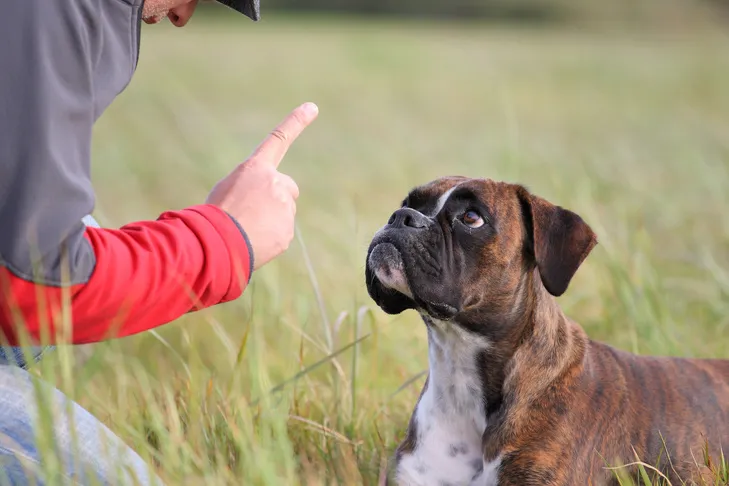 A man gently training a Boxer dog to lie down outdoors, emphasizing calm and focused behavior.
10. Educate Guests and Strangers on Your Greeting Rules
Don’t hesitate to clearly communicate your dog’s greeting rules to guests and even strangers you encounter. While your dog is still in training, politely ask people to completely ignore your dog unless you explicitly give permission for interaction. It’s often beneficial to avoid direct encounters with strangers until your dog has mastered polite greetings with familiar friends and family who understand and cooperate with your training methods. When passing strangers, you can use a “watch me” cue to divert your dog’s attention, or distract them with a hand touch target or a favorite toy until the person has passed. Clear communication and consistent expectations from everyone who interacts with your dog are crucial for reinforcing the desired behavior and ensuring lasting success.
Stopping dogs from jumping on you requires consistency, patience, and positive reinforcement. By following these practical tips, you can effectively teach your dog a polite way to greet, transforming an annoying habit into a joyful, respectful interaction. Remember that training is a journey, and every step taken contributes to a well-behaved and happier dog. Keep practicing, and celebrate every small victory!
