
Jumping up when greeting is a common and often frustrating behavior problem in young dogs. While your canine companion is likely just trying to express excitement and say “hello” face-to-face, this action can be more than just annoying. Larger breeds can easily knock people over, posing a significant risk, especially for children and seniors. Even smaller dogs can leave scratches or muddy paw prints on clothing. The root of this behavior often lies in your dog’s natural desire to get your attention, as jumping is a highly effective way to achieve this. The key to resolving this issue is to teach your dog an alternative, more polite greeting behavior.
Instead of focusing on what your dog shouldn’t do, teach them what to do, such as keeping all four paws on the floor. This approach is safer, more courteous, and provides your pet with an acceptable way to welcome you home and earn your affection. By implementing consistent training techniques, you can guide your young dog to understand and adopt appropriate greeting etiquette. Mastering this can also improve overall behavior, as it teaches dogs how to control their impulses, essential for things like how to get a puppy to go on a walk. The following 10 tips will help you instill proper greeting habits, ensuring your dog knows exactly how to politely say “hi” to humans.
1. Only Reward When All Four Paws are on the Floor
The most effective strategy for dealing with unwanted behaviors is to teach your dog an incompatible alternative. Your dog will grasp concepts much faster if you clearly demonstrate the desired action rather than simply correcting the undesired one. For jumping, this means teaching them to keep all four paws grounded. A dog cannot jump and stand simultaneously. You might also choose to teach them to sit or lie down for greetings. Whatever your chosen rule, only provide attention and positive reinforcement when your dog adheres to it. Consistency is paramount; avoid allowing jumping in certain situations (e.g., when you’re wearing casual clothes) but not others (e.g., when you’re dressed up).
2. Provide Immediate Attention for Correct Greetings
Dogs are highly motivated by outcomes; they tend to repeat behaviors that yield desired results. Therefore, as soon as your dog follows your greeting rule – for example, with all front feet on the floor – immediately offer praise and petting. Your dog craves your attention as a reward, so ensure they receive it without delay when demonstrating the correct behavior, especially during the learning phase. Avoid delaying your greeting while you perform other tasks like removing your coat or shoes, as this might lead your dog to become impatient and revert to jumping for attention.
3. Withdraw Attention When Your Dog Jumps
Conversely, the only way to eliminate jumping is to stop rewarding it entirely. Never reinforce a behavior you wish to extinguish. If your dog jumps on you, promptly remove what they seek: your attention. Try calmly turning your back or walking away. This communicates to your dog that jumping has the opposite effect of what they intended. However, as soon as your dog has all four paws on the floor again, turn back and quietly praise and pet them. This consistent on-off switch for your attention will help your dog understand which behaviors earn a reward.
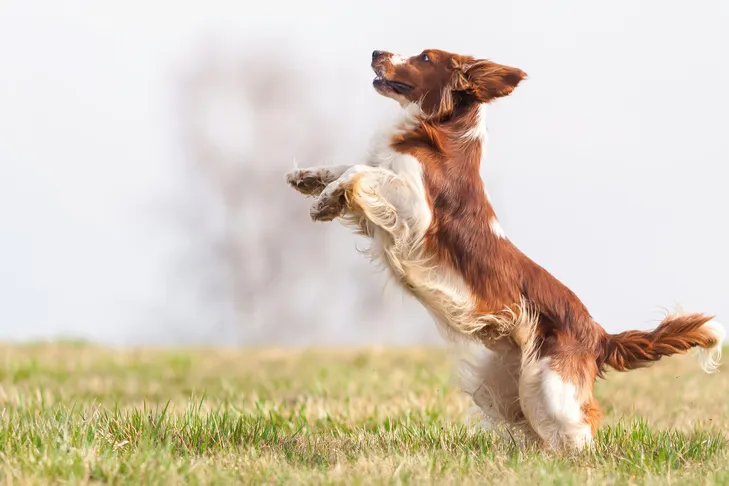 Welsh Springer Spaniel jumping up outdoors.
4. Set Your Dog Up for Success
While ignoring jumping and rewarding proper greetings is effective, it can be a trial-and-error process that might frustrate your dog. You can expedite their learning by making it easier for them to succeed. If your rule is for them to sit, ask them to sit as soon as you enter the door. If you require “four on the floor,” encourage them to remain standing. A fantastic technique to prevent jumping is to scatter treats on the floor. Most dogs find irresistible treats a strong motivator, and they cannot jump while sniffing the ground for food. Be quick; if you offer the food before your dog even considers jumping, you’re rewarding “four on the floor” with both attention and treats. Your dog will quickly learn the new greeting rule, and you can gradually reduce the use of food rewards.
5. Always Reward Proper Greeting Behavior
Your dog will learn appropriate greeting behavior more rapidly if their actions have an immediate and consistent impact on your attention – four paws on the floor earns attention, while jumping makes it disappear. This means you must consistently reward your dog every time they adhere to your greeting rule. Never withhold attention once your dog’s feet are on the floor, even if you’re feeling irritated after a bout of persistent jumping. Inconsistent reinforcement will confuse your dog and hinder their learning process, making it harder to reinforce other important commands like how to get your dog stop jumping.
6. Avoid Grabbing or Pushing Your Dog Away
Remember, your dog is jumping for attention. Even a seemingly negative reaction, such as grabbing their paws or pushing them away, still provides attention and, therefore, reinforces the jumping behavior. Instead of reducing the frequency, this can inadvertently lead to more jumping in the long run. Worse, many dogs might misinterpret such physical interaction as an invitation to roughhouse play, causing them to return with more vigorous jumps, believing it’s part of an enjoyable game.
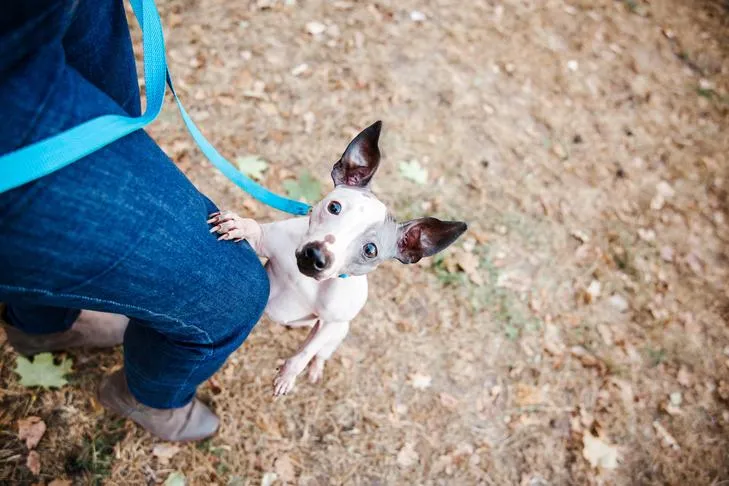 American Hairless Terrier jumping up on the leg of its owner outdoors.
7. Do Not Use Your Knee to Block Jumps
You may have heard the advice to raise your knee to block your dog’s chest when they jump to deter the behavior. However, similar to grabbing, this action can be perceived as attention or a wrestling game by some dogs, particularly those with boisterous personalities, leading to the opposite of the desired effect. More significantly, for most dogs, this physical confrontation can foster distrust and erode the human-canine bond. Your dog is merely attempting to say “hello,” and punishing them in response can be confusing and even cause injury. A dog that doesn’t trust you may develop other behavioral issues, making training more challenging, including getting them to wear the best leash for training a dog to walk.
8. Keep Greetings Low-Key During Learning
Due to their immense joy at seeing you, dogs often struggle to control their excitement. It requires considerable emotional self-control for them to resist the natural urge to jump and instead follow a new greeting rule. You can facilitate this by keeping your greetings low-key. Dogs are adept at reading our emotions, so if you are overly animated, they will likely mirror your excitement. Instead, maintain a calm and quiet demeanor, even when offering praise. As your dog begins to understand and comply, you can gradually increase your enthusiasm until your greetings match their natural excitement levels without triggering jumping.
9. Prevent Your Dog from Jumping on Guests
It’s not just you who can reinforce your dog’s jumping behavior. Other family members, guests, and even strangers encountered on walks can inadvertently reward jumping if you are not vigilant. To prevent this, employ management techniques. Leash your dog to restrict their ability to approach. A better strategy might be to send your dog to their designated “place,” such as a mat or bed, or place them in their crate, especially when someone is at the door. Utilizing a baby gate to block access to the front hall can also be an effective way to manage their interactions. This is a good way to reinforce discipline and prevent issues like my dog escapes her crate.
 A man training a Boxer dog to lie down outdoors.
10. Educate Guests and Strangers on Your Greeting Rules
Do not hesitate to clearly communicate your dog’s greeting rules to guests and even strangers. While your dog is still learning, ask people to completely ignore your dog unless you give permission. It’s also advisable to avoid interactions with strangers until your dog has mastered polite greetings with friends and family members who you know will cooperate with your training methods. When encountering strangers, consider using a “watch me” cue or distracting your dog with a hand touch command or a favorite toy until the person has passed. These proactive measures are vital for consistent training and can also help with other training endeavors, such as how to train puppy to run with you.
Conclusion
Stopping a young dog from jumping up requires patience, consistency, and a clear understanding of canine behavior. By teaching an incompatible alternative behavior, such as keeping all four paws on the floor, and consistently rewarding desired actions while removing attention for unwanted ones, you can effectively modify your dog’s greeting habits. Avoiding physical deterrents, maintaining low-key greetings during the learning phase, and enlisting the cooperation of others are crucial steps in this process. With dedication, your dog will learn polite manners, leading to a more harmonious household and more enjoyable interactions with everyone they meet. If you find yourself needing further guidance, consider consulting with experienced dog trainers who can offer personalized advice and support.
