
Welcoming a Great Dane puppy into your home is an exciting journey, but it also comes with unique training considerations, especially when it comes to leash manners. These gentle giants grow rapidly, and establishing good leash habits from a young age is paramount for a harmonious life together. Unlike smaller breeds, a Great Dane’s size and strength necessitate a solid foundation in leash training to ensure safety and control for both you and your canine companion. This guide will walk you through the essential steps to effectively leash train your Great Dane puppy, ensuring they become a well-behaved and confident walking partner.
Understanding Your Great Dane Puppy’s Growth and Training Needs
Great Danes are considered a working breed, known for their intelligence and generally calm demeanor as adults. However, like all dogs, their temperament is a blend of genetics and their environment. This is why positive reinforcement training is crucial. A Great Dane puppy will reach their full adult size between 18 months and two years of age. During this critical developmental period, it’s vital to introduce basic training commands and instill good habits that will last a lifetime.
The Crucial Early Weeks: 8 to 16 Weeks
The period between 8 and 16 weeks of age is a sensitive window for puppies, especially between 2 and 12 weeks. This phase is a biologically predetermined period for emotional and cognitive development. Seizing this time for focused training and socialization will lay a strong foundation for your Great Dane’s future.
Training Goal #1: Mastering Socialization
Socialization is paramount during these early stages. Your Great Dane puppy needs to be exposed to a wide variety of healthy life experiences. Seeking guidance from a certified behaviorist is highly recommended, as Hartstein emphasizes, “The larger the dog, the more social training the owner should be ready to provide.” Your puppy will quickly outgrow their adorable small size, and their developing strength means early socialization with diverse people and animals of different breeds and sizes is essential. Enrolling your puppy in a specialized training program or a puppy class can significantly aid this process, providing a safe and controlled environment for them to interact and learn.
Training Goal #2: The Power of Crate Training
Crate training offers numerous benefits beyond just aiding in potty training. When approached correctly, a crate can become a positive sanctuary for your dog. Hartstein stresses that a crate is a vital tool for house training and should never be used as a punishment. The objective is to create positive associations with the crate, making your Great Dane puppy eager to enter it. Employing positive reinforcement, such as offering treats and praise, will encourage a positive connection. Consider placing an interactive toy or a slow feeder inside the crate to further enhance their positive feelings towards this designated space. This can be a fantastic way to start the process of crate training a puppy for potty training.
Training Goal #3: Initiating House Training
House training requires significant patience and unwavering consistency. This process can often take up to six months, so it’s important to start early but manage your expectations. A common mistake owners make is giving their puppy too much freedom too soon. By consistently using the crate and fostering positive associations with it, you can effectively manage this.
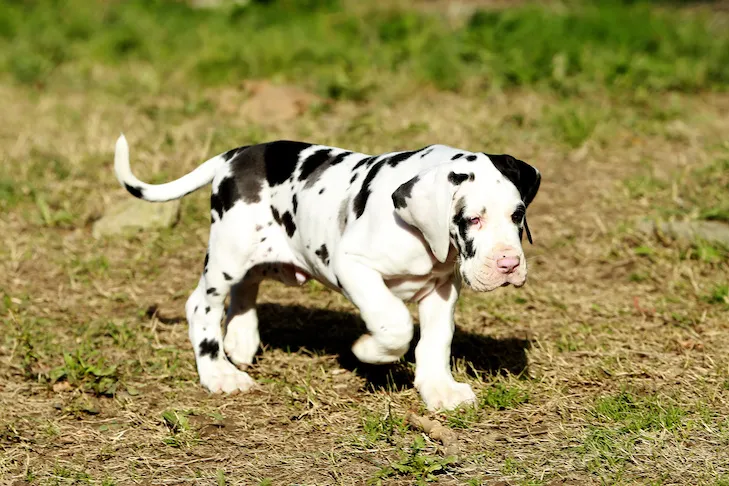 Great Dane puppy exploring outdoors.
The Growing Years: 3 to 9 Months
During this stage, your Great Dane puppy will become more attached to their environment, often developing a sense of ownership over their surroundings. This makes continued socialization and behavioral training even more critical.
Training Goal #1: Preparing for the Canine Good Citizen Test
Training a dog is less about a list of tricks and more about equipping them with essential life skills. The Canine Good Citizen Test by the AKC is an excellent framework for teaching these skills. It covers vital aspects like reacting appropriately to distractions, responding to recall commands, and navigating crowded environments – all experiences you and your dog will encounter daily. The methods promoted by the Canine Good Citizen program emphasize positive training techniques and guide owners in becoming responsible and appropriate pet parents.
Training Goal #2: Mastering Leash Training
Great Danes require ample exercise due to their size and energy levels. For walks, Hartstein suggests early morning or late evening strolls. When selecting equipment, opt for front-attaching harnesses that form an “H” shape over the dog’s body to avoid hindering their natural gait. A martingale or flat buckle collar is suitable for tags. It’s crucial to avoid shock or prong collars, as these can lead to fear-induced reactions. For a Great Dane puppy, a standard 6-foot leash provides sufficient length.
It’s advisable to walk your Great Dane puppy individually rather than with multiple dogs at once. Hartstein also highlights the importance of mentally stimulating your dog before a walk. Engaging in cognitive exercises beforehand will help ensure your puppy is calmer and more focused while on the leash. This mental workout is key to a successful leash-training experience.
Training Goal #3: Reinforcing Fundamental Commands
Mastering basic commands such as ‘Sit,’ ‘Down,’ ‘Stay,’ ‘Recall,’ ‘Drop it,’ and ‘Mat Training’ are fundamental. Instead of rushing through them, focus on gradually increasing the difficulty. For instance, asking your pet to ‘Sit’ when you are ten feet away at home is a different challenge than asking them to ‘Sit’ in a bustling public space. This gradual progression ensures a deeper understanding and reliability of the commands. If your puppy is struggling with commands like ‘sit’, you might find our guide on how do you teach a dog to sit helpful. Similarly, understanding how to get your dog to lay down is another crucial skill.
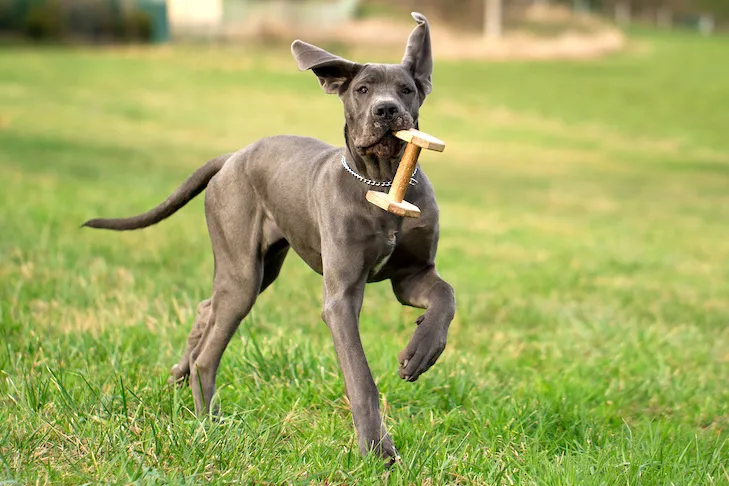 Great Dane puppy bring back an obedience dumbbell outdoors in the grass.
Lifelong Learning: 9 Months to 24 Months and Beyond
Training is an ongoing process, not a finite task. As Hartstein points out, it takes approximately 10,000 repetitions for a dog to truly master a behavior. This stage is less about introducing new skills and more about refining and reinforcing the basics.
Training Goal #1: Solidifying the Fundamentals
At this point, the focus shifts from learning new behaviors to perfecting existing ones. “The larger the dog, the more important it is for them to have the basics,” states Hartstein. Food can be a powerful motivator for training a large breed dog. Interactive feeders and toys are excellent for providing necessary stimulation, serving as an alternative to traditional feeding bowls. Ensure your Great Dane puppy is fed a complete and balanced large breed puppy formula that maintains the correct ratio of calcium and phosphorus to support their rapid growth. If your puppy exhibits unwanted behaviors, like jumping on visitors, understanding how to stop my dog jumping up at strangers or how to stop your dog from jumping on strangers can be beneficial.
In conclusion, leash training a Great Dane puppy is a rewarding endeavor that builds a strong bond between you and your dog. By implementing positive reinforcement, consistent practice, and a deep understanding of their developmental stages, you can equip your gentle giant with the confidence and skills to navigate the world on a leash with grace and good manners. Remember that patience is key, and celebrating small victories will make the journey enjoyable for both of you. If you encounter specific challenges, don’t hesitate to seek professional guidance.
