
As devoted cat owners, we aim to provide the best environment for our feline companions. While many cats are happy using an indoor litter box, some may exhibit a desire to toilet outdoors. Understanding their evolutionary instincts is key to encouraging this behavior. Our domestic cats are descendants of the African wildcat, a creature that thrived in arid, sandy environments. The ability to bury their waste was crucial for survival, masking their scent from potential predators. This innate behavior, though less critical for our pampered pets, remains a strong instinct. Thus, adapting our back gardens to mimic their ancestral terrain can facilitate a successful transition to outdoor toileting.
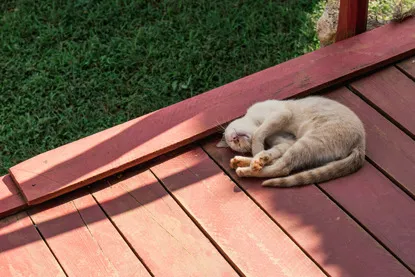 Ginger cat curled up relaxing on garden decking
Modern garden designs with decking and concrete are not ideal for cats who prefer to dig and bury their waste.
Providing the Right Toilet Type
The most critical factor in encouraging outdoor toileting is offering a suitable medium for your cat to dig and bury their waste. Fine play sand or natural soil are ideal choices, providing the right texture for digging and covering. You can create an outdoor toilet area by setting up a litter tray filled with your chosen material, or by digging a designated spot in the garden roughly the size of a standard litter tray, or even larger. It’s important to ensure this outdoor toilet is accessible year-round. However, if conditions in winter lead to freezing, you must provide an alternative indoor option to avoid discouraging your cat. For cats who are still adjusting to outdoor facilities, learning how to train a kitten to walk on a leash can also be a stepping stone to greater outdoor comfort and exploration.
Choosing the Ideal Location
For cats, the act of toileting is a vulnerable moment, demanding a sense of privacy and security. Therefore, the location of their outdoor toilet is paramount. It should be situated in a quiet area, away from excessive noise and the presence of unfamiliar cats. Ideally, position the toileting site close to your home, within their core territory, and at the garden’s edge rather than its center. Incorporating plants or shrubs around the area can provide additional visual shielding, enhancing your cat’s feeling of safety and seclusion.
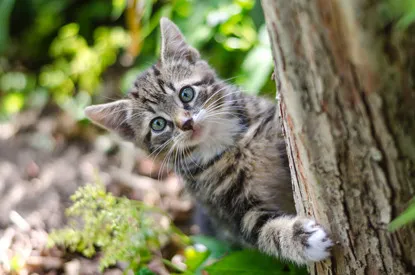 Tabby kitten peering around a tree
A private toilet, obscured from direct view, will be preferred by your cat.
Considering the Time of Year
When introducing your cat to a new outdoor toilet, commencing this process during warmer, drier months is most advisable. The appeal of an outdoor facility diminishes significantly during winter. To mitigate the impact of inclement weather, consider installing a shelter or windbreak around the outdoor toilet to offer protection from the elements. This can make the outdoor option more palatable even in less favorable conditions. If you’re interested in more advanced training, exploring easy cat tricks to teach your cat can be a fun way to bond and build your cat’s confidence in various situations.
Maintaining Their Indoor Toilet Option
Encouraging a cat to transition to outdoor toileting can be a gradual process, and it’s crucial not to alter their established indoor toileting habits. Always ensure their indoor litter box remains available and unchanged. This provides a fallback option, reducing stress and anxiety for your cat. By offering a perfect outdoor toilet while maintaining their familiar indoor facility, you increase the likelihood that they will, over time, choose to use the outdoor option. For cats who might be hesitant about venturing too far, understanding how to train a cat on leash can be a complementary skill, fostering confidence and a greater sense of security in the outdoor environment. Remember, patience and consistency are key. You might also find it helpful to explore how can I teach my cat tricks to further engage your cat and reinforce positive behaviors.
For further guidance on cat behavior and toileting issues, you can access more resources at Find more advice about cats and toileting.
