
Teaching your dog to lay down is a fundamental command, not just for obedience but also for promoting calmness and preventing unwanted behaviors. This essential behavior helps keep your dog out of trouble by providing a clear instruction to settle and relax in various situations. While some puppies naturally take to it, others might resist getting to the ground or staying there for more than a fleeting moment. If you’re wondering How To Get A Dog To Lay Down effectively, this guide will walk you through three proven techniques: luring, shaping, and capturing, along with valuable troubleshooting tips to ensure a smoother training journey. Mastering this command is crucial for any dog owner seeking to build a strong foundation of communication and control with their canine companion, ultimately enhancing their overall well-being and making them a more well-behaved member of the family. Learning to master commands like how to get your dog to lay down opens the door to more advanced training and a deeper bond.
Luring a Down
Luring is often the most straightforward method for teaching new behaviors, as it uses a treat or a favorite toy to guide your puppy into the desired position. Imagine holding a high-value treat to your dog’s nose and then moving it in a path that encourages them to perform the action. For instance, moving the treat in an “L” shape from their nose down to the ground and then forward can easily prompt them to lie down. The key is to fade the lure quickly so your dog learns to respond to a hand signal or verbal cue, rather than relying on seeing the treat itself.
Ensure you use a treat or toy that genuinely excites your puppy to maximize their willingness to follow the lure. Incorporating a clicker can also be highly effective, marking the precise moment your dog gets it right. Here are the steps to train the “down” command using a lure:
- Start in a Sit: With your puppy already in a sitting position, hold a treat directly to their nose.
- Guide Down: Slowly bring the treat down towards the ground, between your puppy’s front paws. Your puppy should naturally lower their head to follow the treat.
- Extend Forward: Continue moving the treat forward along the ground, away from your puppy, effectively creating an “L” shape. As they follow the treat, their body should naturally transition into a down position.
- Mark and Reward: The instant your puppy’s elbows touch the ground in the down position, click (if using a clicker) and offer verbal praise, then immediately give them the lured treat as a reward.
- Separate Lure and Reward: After several repetitions, begin to reward with a treat from your other hand, so the lure itself is no longer consumed. This helps differentiate the lure from the reward.
- Introduce Hand Signal: Next, lure your puppy with an empty hand, mirroring the “L” shape motion. Reward with a treat from your opposite hand. You’ve now established a hand signal for “down.”
- Add Verbal Cue: Once your puppy consistently responds to the hand signal, introduce the verbal cue by saying “Down” a second before giving the hand signal. Over time, your puppy will learn to associate the word with the action and respond to the verbal cue alone.
If your puppy hasn’t yet mastered the “sit” command, you can still lure a down from a standing position. Simply bring the treat straight down to the ground between their front paws. However, for dogs with a longer distance to travel into the down position, the shaping technique might prove more manageable. Engaging in various training activities, such as how to get a puppy to go on a walk, can also help tire them out and make them more receptive to learning new commands like down.
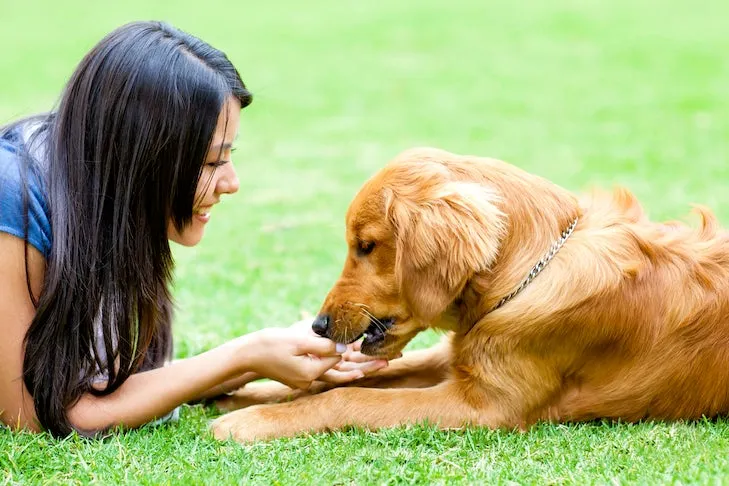 Golden Retriever receiving a treat from a woman while calmly lying in the grass
Shaping a Down
Shaping is a powerful training method that involves teaching a behavior incrementally, one small step at a time. For the “down” command, this means rewarding successive approximations of the desired behavior. You might start by rewarding your puppy for simply looking at the ground, then for lowering their head, next for bending their elbows, and finally for fully lying down. The essence of shaping is to set your puppy up for success by choosing initial steps that are easily achievable and gradually increasing the difficulty without overwhelming them. It’s always better to make the steps too easy than to risk frustration for both you and your dog by asking for too much too soon.
To begin, you might use a lure to encourage your puppy to glance at the ground. Click and offer praise, then immediately reward that initial look. Once your puppy consistently offers this, progress to luring their head further down towards the ground before clicking and rewarding. The next step could be rewarding when their elbows start to bend, indicating they are moving closer to a full down. Focus solely on teaching the final behavior through these small, achievable steps. Don’t worry about fading the lure or adding a verbal cue until your puppy reliably performs the complete “down” action. Patience and consistency are crucial with shaping, as it allows your dog to build confidence and understand exactly what is being asked of them. This method is particularly effective for complex behaviors or for dogs who might be hesitant about physical manipulation. If you’re also working on other manners, consider exploring resources on how to make my dog stop jumping on guests to ensure a well-rounded training approach.
Capturing a Down
Capturing involves rewarding your puppy whenever they spontaneously offer the desired behavior on their own. This technique leverages your dog’s natural actions, turning them into cued behaviors. Always be ready with a few treats or a small toy in your pocket. Whenever you observe your puppy lying down naturally – perhaps while relaxing after a play session or settling down for a nap – immediately click (if you use a clicker) and offer enthusiastic praise. Then, walk over and gently offer them a reward while they are still in the down position.
By consistently rewarding these natural downs, your dog will soon begin to offer the behavior intentionally in front of you, hoping to earn a reward. At this point, you can introduce a hand signal or verbal cue just before you anticipate they are about to lie down. For example, if you see them settling, say “Down” and then give the hand signal just as they begin to lower themselves. Your puppy will quickly learn to associate your word or gesture with their action. Eventually, you’ll be able to ask for the “down” command at any time, transforming a natural behavior into a reliable cue. This method is incredibly effective for building a strong association between the command and the action, as the dog is intrinsically motivated to perform the behavior. Additionally, mastering impulse control through capturing can aid in other areas, such as teaching how to get your dog stop jumping.
 Welsh Springer Spaniel calmly laying down inside a home
Tips for Training Down
Even with various training techniques at your disposal, teaching the “down” command can sometimes present challenges. These practical tips can help ease the process and increase your chances of success:
- Train When Your Puppy is Tired: Don’t expect your puppy to enthusiastically lie down when they’re bursting with energy. Schedule your training sessions after a stimulating walk or an active play session when they are naturally more inclined to settle and relax. A tired puppy is often a more cooperative learner.
- Never Force Your Puppy: While it might be tempting to gently push or physically guide your puppy into the down position, this approach is often counterproductive. Forcing them can create a negative association with the command, making them more resistant due to pressure or even frightening them. It’s always more effective to reward them for willingly performing the action on their own.
- Use a Lure to Encourage Crawling: For some dogs, especially smaller ones, using a lure to encourage them to crawl under an obstacle can be a clever way to achieve the down. Create a “bridge” with your legs (on the ground for small dogs, or using a stool for larger breeds). Guide the lure from your puppy’s nose to the ground and then pull it under your legs. Your dog will have to lie down to follow the treat. Reward them immediately as soon as they are in the correct position beneath the bridge.
- Reward in Position: The precise placement of your rewards is critical for clear communication during training. Always give your puppy their treat while they are still in the down position. If you consistently reward them only after they have sat back up, you are inadvertently rewarding the act of sitting up rather than lying down. This common error, known as the “push-up problem,” leads to your puppy lying down for just a brief moment before popping back up. Be quick and ready with your treats to ensure you reward the exact behavior you want to reinforce. For best results, consider using a best leash for training a dog to walk to help manage energy levels before training sessions.
Conclusion
Teaching your dog the “down” command is a cornerstone of responsible dog ownership, contributing significantly to their overall discipline, calmness, and ability to settle in diverse environments. By employing the techniques of luring, shaping, and capturing, coupled with patient and consistent practice, you can effectively teach your canine companion this invaluable skill. Remember to always use positive reinforcement, avoid physical force, and time your rewards precisely to reinforce the desired behavior. Whether your dog is a high-energy puppy or an older companion, understanding how to get a dog to lay down fosters a stronger bond and a more harmonious household. With dedication, your dog will not only master this command but also learn to associate it with a sense of calm and a positive interaction with you. Continue to integrate regular training into your routine, building upon this foundation for a well-behaved and happy dog.
