
Welcoming a new puppy into your home is an exciting time, filled with joy and the anticipation of a lifelong companion. While prioritizing early socialization to ensure your puppy grows into a confident and well-adjusted dog is crucial, good manners should be a close second. The ideal scenario is a dog that is happy to greet new people without jumping all over them. If you find yourself struggling to strike this balance, rest assured you are not alone. However, it is entirely achievable to have both a social butterfly and a well-behaved canine friend. The golden rule in dog training emphasizes that dogs learn best what they learn first. Correcting a puppy during crucial early socialization, for fear of creating negative associations with new experiences, can be counterproductive. Fortunately, with a little foresight and effort, you can cultivate both a well-socialized and well-mannered dog by focusing on two simple yet effective strategies: preventing bad habits and teaching an alternative, desirable behavior.
Preventing Bad Habits
A significant advantage of having a young puppy is the ability to physically manage their interactions. When greeting new people, keeping your puppy in your arms can effectively prevent the development of jumping behaviors. Dogs are highly motivated by rewards, and if your puppy learns that jumping up leads to the rewarding experience of human attention, they will continue this behavior. By holding your puppy, you can facilitate positive social interactions without the need for jumping. For larger breeds that may be too heavy to lift consistently, ensure visitors get down to the puppy’s level before interacting. Regardless of the method, the key is to stop undesirable behaviors before they become ingrained habits. Proactive prevention is far more effective than trying to correct established issues later.
Teaching an Alternative Behavior
This step is truly the cornerstone of successful puppy training and addresses a significant portion of common behavioral challenges. By teaching your dog a desirable alternative behavior, such as sitting, you create an action that is incompatible with jumping. If your puppy consistently learns to sit for attention, they will naturally refrain from jumping. This shift from jumping to sitting for attention is a highly desirable outcome that can be achieved with clear training.
Teaching Your Dog to Sit
Begin by utilizing high-value rewards to reinforce the act of sitting. It’s easy to underestimate the importance of mastering a basic command like “sit,” assuming puppies will inherently understand it. However, overlooking this foundational command can lead to significant training gaps. To your dog, “sit” should mean remaining in a seated position until released, even amidst distractions. Dedicate ample time to teaching and solidifying the concept of a stable, prolonged sit. Gradually introduce distractions and reward your puppy generously for making good choices.
Teaching Your Dog to Greet in a Sit
Once your puppy reliably holds a sit, begin incorporating greeting behaviors into the training. Start with simple steps, such as having a person approach or stand near your puppy while you reward them for maintaining their sit. Continue to use their favorite rewards to keep their motivation high as the greeting becomes more engaging. Progress from a person simply being nearby, to speaking to the dog, and then to gentle touching.
Generalizing Training Across Environments
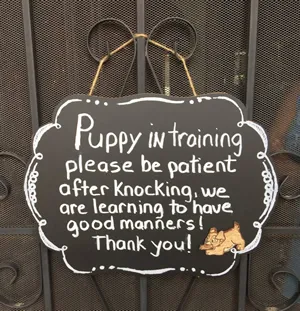 A sign offering guidance for puppy training
After your dog has learned to sit for greetings, it’s essential to practice this behavior in various locations and situations. The front door at home is often a trigger for excitement, making training in this context invaluable. Initially, set up these practice sessions with familiar people or household members. Begin with the person standing at the doorway with the door closed. Gradually progress to an open door, then have them ring the doorbell with the door open. Finally, simulate the entire sequence of a closed door, doorbell ring, and an open door. Controlled practice in these scenarios will build success and confidence. Avoid waiting for a real guest to test your dog’s training; be prepared by practicing in advance. This sign, for example, illustrates an excellent proactive approach to puppy training, showcasing thoughtful planning.
Ultimately, the principle that dogs repeat rewarding behaviors holds true. By strategically setting up situations to your advantage, your dog will learn to exhibit both excellent social skills and impeccable manners. Happy training!
Shannon Viljasoo joined the McCann team in 1999, initially training her spirited Rottweiler, Quincey, in good listening skills. As the Director of Online Training and Content for McCann Professional Dog Trainers, she is passionate about writing on canine behavior and training for the McCann blog. Shannon currently shares her home with two Tollers, Reggie and Ned, and finds immense satisfaction in helping individuals build the strongest possible bond with their canine companions.
