
Cats can’t be trained. How many times have you heard that statement? It’s a common misconception, but the truth is that most cats can learn and benefit from learning a few simple tricks. Teaching your cat tricks is not only a fun way to provide mental stimulation but also a fantastic method for deepening the bond between you and your feline companion. Cats naturally learn through routines, so introducing trick training is simply a matter of establishing a new, engaging routine. This guide will focus on three foundational tricks: coming when called, sitting, and giving a high five.
To begin your training journey, you’ll need a quiet, comfortable space for both you and your cat. Essential supplies include your cat’s favorite treats – something special they don’t usually get, reserved only for training sessions. This could be commercial treats, freeze-dried chicken, or even a small piece of low-sodium deli turkey or roast chicken. If your cat isn’t highly food-motivated, a favorite toy can serve as an effective reward. For cats who particularly enjoy physical affection, a couple of gentle pats might suffice. While training non-food-motivated cats may take a little longer, consistency will lead to success. Allocate about 15 minutes for each session, although actual training will likely be shorter, allowing time to gather your cat and rewards. An optional, but helpful, tool is a clicker or any object that makes a distinct clicking sound, like a ballpoint pen. If you don’t have a clicker, you can simply make a clicking sound with your tongue.
Getting Started with Training
Begin by having your cat, treats, and clicker (or chosen clicking sound) in your designated quiet training area. Start by clicking and treating once to ensure your cat is comfortable with the sound. Then, focus on rewarding a specific behavior, such as looking in your direction. The moment your cat looks at you, click and immediately offer a treat. Repeat this process each time she looks at you. Once your cat understands that offering you attention leads to a click and a treat – often within a single session – you can begin to gradually increase the distance between you.
As your cat starts to approach you, continue to click and treat. While she is enjoying her treat, move around the room and repeat the click-and-reward process as she follows you. When your cat consistently comes to you, it’s time to introduce the verbal cue. This cue should be a specific word, not her name (though you can use her name to get her attention initially), something simple like “Come” or “Here.” Say the cue as she looks up after finishing her treat, and click as she moves toward you. Eventually, you’ll want to practice calling her from a different room. When she successfully finds you, click and reward her. Once she reliably comes to you from various parts of your home, the precision of the clicker becomes less critical for communication. Simply reward her with a treat, praise, play, or whatever she loves most when she responds to the cue.
Teaching “Sit” and “Sit Pretty”
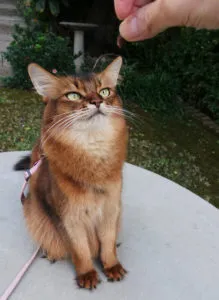 Sit on the floor with your cat, or if that’s uncomfortable, place her on a slightly raised surface like a table. When she sees you holding a treat, she might approach you. Say the cue “sit” and move the treat slowly over her head. Her natural inclination will be to stop and sit to follow the treat. The moment her rear end touches the floor or surface, click and immediately give her the treat. Offer verbal praise like, “Good kitty!” Repeat this process a few times before concluding the session. Sit training can be a bit more challenging for cats than coming when called, so keep these sessions short and engaging. Once your cat reliably sits on the verbal cue, you can gradually phase out the clicker and simply reward her for a job well done.
Once your cat has mastered the “sit,” teaching “sit pretty” is a natural progression. This involves holding the treat high enough above her head so that she needs to balance on her hind legs to reach it. While she is in a sitting position, say “Pretty” as you present the treat upwards. Click and reward her when she successfully accomplishes the pose. Remember to keep these sessions brief.
The “High Five” Trick
The “high five” might look impressive, but it’s surprisingly straightforward to teach. Similar to teaching “sit,” ensure you and your cat are at a similar eye level. Hold a treat in your hand at her shoulder height. When she naturally reaches out a paw to touch the hand holding the treat, click and then give her the treat. Over time, she will learn that touching your hand is the prerequisite for receiving the treat. At this point, you can remove the treat from the hand you’re offering, and when she touches it, click and give her the treat with your other hand. Once she’s consistent with this, begin offering your hand in a palm-up position (the classic high five) and use the verbal cue, “High five!” When she touches your palm, click and provide the reward. As with the other tricks, you can eventually wean her off the clicker and simply reinforce her for responding to the cue.
Essential Training Tips
For optimal results, repeat each trick only four to six times per session. Shorter, more frequent sessions (two or three times a day) are far more effective than lengthy ones that can lead to boredom. Always use positive reinforcement when training your cat. Never scold or punish her for incorrect attempts or lack of participation. If she performs a trick incorrectly, simply ignore it and try again. If your cat decides to walk away, it likely means the session is over for her, so try again later or the next day.
Patience is key. Some cats will pick up tricks in just a few sessions, while others may take considerably longer. Allow your cat the space to learn at her own pace. Most importantly, enjoy the process as much as the outcome. View these training sessions as dedicated time for bonding and playing with your cat. The tricks themselves are a bonus, but the strengthened relationship should be the primary goal. This approach ensures that both you and your cat will look forward to your training sessions, regardless of how each one goes.
This article was reviewed/edited by board-certified veterinary behaviorist Dr. Kenneth Martin and/or veterinary technician specialist in behavior Debbie Martin, LVT.
