
Horses, while magnificent creatures, do not instinctively understand the human world. It is our role as caretakers to guide them through compassionate and consistent training. Every interaction, not just formal training sessions, shapes their understanding and behavior. Horses learn through the consequences of their actions; positive outcomes, like a treat, reinforce a behavior, while negative consequences, like discomfort or pain, deter it. It is crucial to remember that horses lack the cognitive ability to deduce our expectations. We must provide clear cues, break down training into manageable steps, and offer rewards for desired actions. When selecting training methods, effectiveness must be balanced with the horse’s well-being, avoiding any techniques that risk physical or emotional harm, as these can damage the bond between horse and handler.
Methods that induce fear or stress significantly hinder learning. Horses’ natural responses to perceived threats include flight, fight, and freeze. During these heightened emotional states, learning is impossible. Therefore, understanding equine learning theory is paramount for effective and ethical training.
Equine Learning Theory: Key Concepts
Equine learning theory is a fundamental aspect of horse training. While some terms can be confusing due to their similarities, a clear understanding of each is vital.
Non-Associative Learning
This category encompasses habituation and sensitization, describing a horse’s response to repeated exposure to a stimulus.
- Habituation: When a horse’s reaction to an object, person, or situation diminishes over time with repeated exposure. For example, a horse may initially be wary of a new object in the arena, but habituation occurs as they become accustomed to it and their reaction decreases.
- Sensitization: Conversely, sensitization involves an increased reaction to a stimulus through repeated exposure. This can lead to a horse becoming more responsive to even subtle aids.
Desensitisation
Desensitization is a specific process aimed at reducing a horse’s fearful reaction to an object, person, or situation through gradual exposure. A common example is training a horse to tolerate the sound and sensation of clippers without fear.
Associative Learning
This branch of learning theory involves creating associations between a cue and an outcome, typically through classical or operant conditioning.
- Classical Conditioning: Occurs when a horse learns to associate two events where one predicts the other. For instance, a horse might anticipate feeding time and display certain behaviors upon hearing the feed room door open, having linked that sound with receiving food.
- Overshadowing: This happens when two stimuli or actions are applied simultaneously, and one diminishes the response to the other. An example is when a horse is being treated for a wound, and the discomfort of the treatment is overshadowed by the anticipation of food.
- Flooding: This method involves exposing a horse to something they fear until they stop reacting, without considering their emotional state. It pushes the horse beyond their coping threshold and is ethically questionable and often unhelpful.
- Learned Helplessness: This occurs when a horse is repeatedly subjected to inescapable aversive situations, leading them to stop trying to escape even when in pain or distress. A horse that accepts constant rein pressure without release, despite showing signs of discomfort, may be exhibiting learned helplessness.
Operant Conditioning: Shaping Behavior
Operant conditioning focuses on the association between a horse’s behavior and its outcome, utilizing four quadrants: positive and negative reinforcement, and positive and negative punishment. Reinforcement aims to increase the likelihood of a behavior, while punishment aims to decrease it. ‘Positive’ refers to adding something to the situation, and ‘negative’ refers to removing something.
Reinforcement Methods
- Positive Reinforcement (R+): This highly effective method involves rewarding a desired behavior with something the horse likes, such as a treat, thereby increasing the likelihood of that behavior recurring. For example, rewarding a horse with a treat for standing calmly at the mounting block.
- Negative Reinforcement (R-): Here, something the horse dislikes is removed when they perform a desired behavior. An example is releasing leg pressure once the horse responds correctly to the cue. This also aims to increase the desired behavior.
Punishment Methods
- Positive Punishment (P+): This method involves adding something the horse dislikes when they perform an undesired behavior, aiming to make it less likely in the future. For example, a sharp correction for nipping. However, nipping can be a sign of pain or discomfort, and consulting a vet or equine behavior professional is recommended before resorting to punishment. This strategy is often unhelpful and ethically questionable.
- Negative Punishment (P-): In this approach, something the horse likes is removed when they perform an undesired behavior. For instance, if a horse attempts to bite as its feed is being delivered, the feed is temporarily removed. This method is not recommended as removing resources can lead to frustration and aggression.
Effective and Ethical Training Practices
The diagram below illustrates the key differences between these operant conditioning methods. The most ethical and effective approach, where possible, is to underpin training with positive reinforcement (R+). Positive punishment (P+) should be avoided due to its ethical concerns and limited effectiveness. Horses thrive on patience and reward, which are essential for building trusting relationships.
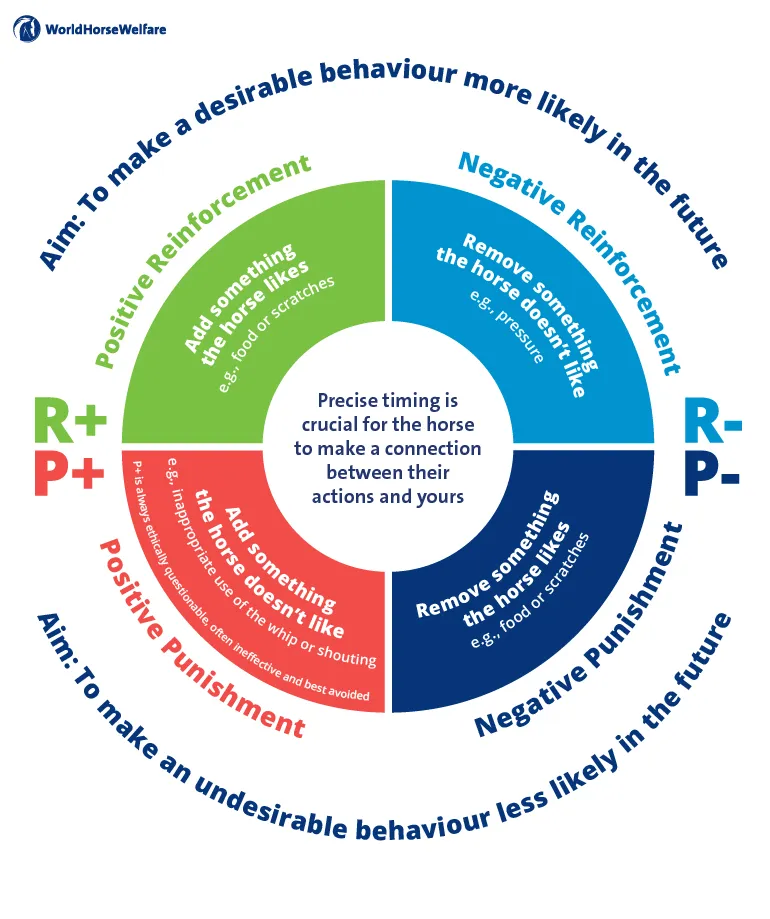 Infographic showing positive and negative reinforcement and punishment examples in training a horse
For further practical guidance on training methodologies and addressing common behavioral issues, our downloadable PDF provides a comprehensive overview of key terms and examples.
