
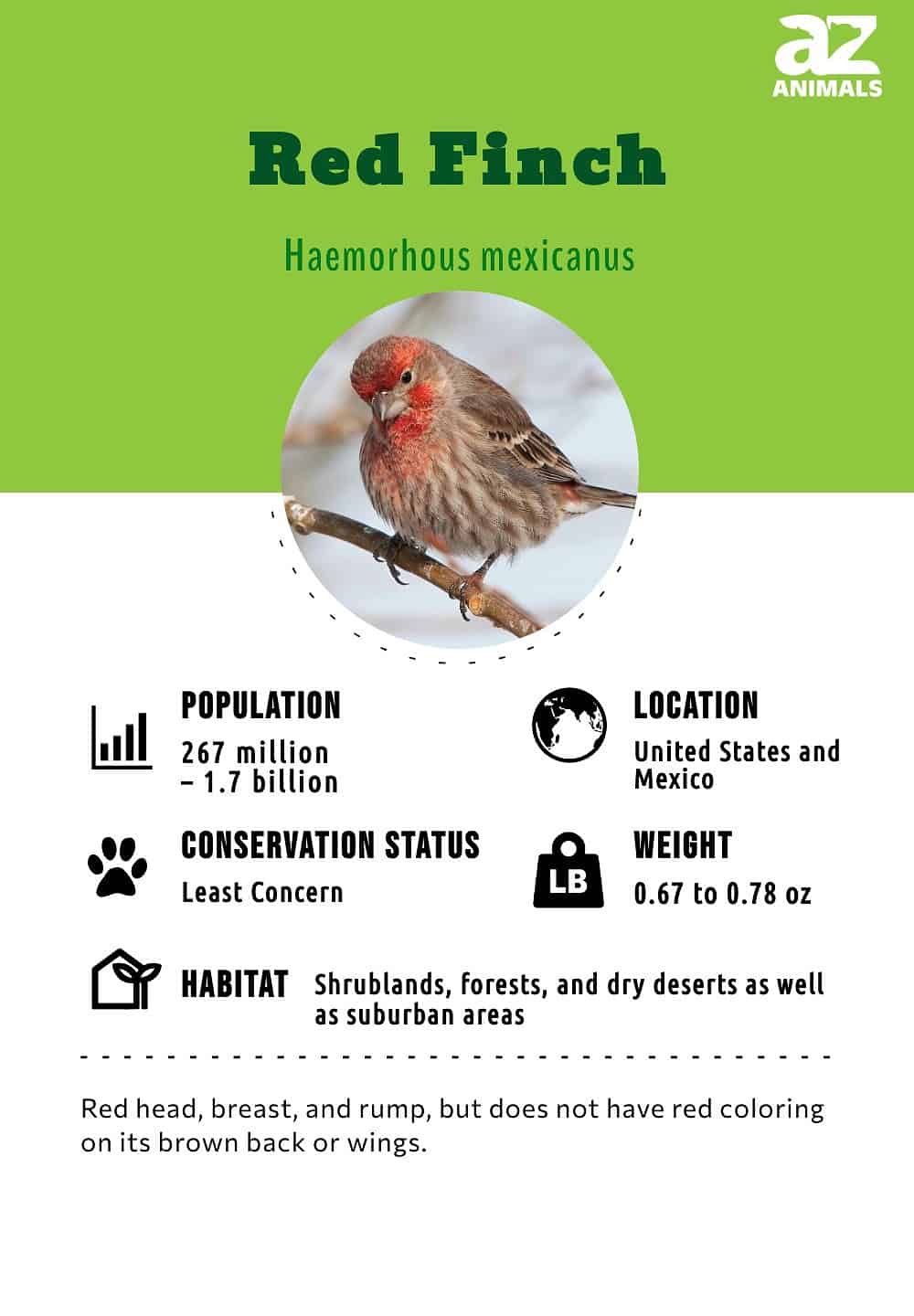
The House Finch (Haemorhous mexicanus) is a familiar sight in human-altered landscapes across North America. Thriving in diverse environments from urban centers to rural farmlands, these adaptable birds offer a fascinating glimpse into avian life. This article delves into the essential aspects of the House Finch, covering their preferred habitats, dietary habits, nesting behaviors, social interactions, and conservation status, providing a comprehensive overview for bird enthusiasts and nature lovers.
Habitat
House Finches are highly adaptable and commonly found in areas shaped by human activity. Their preferred environments include buildings, lawns, small coniferous trees, and urban centers. In more rural settings, they can be spotted around barns and stables. Within their native Western range, House Finches also inhabit natural landscapes such as dry deserts, desert grasslands, chaparral, oak savannahs, and open coniferous forests, typically below elevations of 6,000 feet. Their ability to integrate into various ecosystems highlights their resilience and success as a species.
Food and Feeding Habits
The diet of the House Finch consists almost exclusively of plant materials, with seeds, buds, and fruits forming the bulk of their meals. They consume a wide variety of wild foods, including seeds from wild mustard, knotweed, thistle, and various berries and fruits from species like mulberry, poison oak, and cactus. In agricultural and orchard areas, House Finches are known to feed on cherries, apricots, peaches, pears, plums, strawberries, and figs. When visiting bird feeders, they show a preference for black oil sunflower seeds over larger striped varieties, and also readily eat millet and milo.
Nesting Behavior
Nest Placement and Description
House Finches exhibit flexibility in their nesting choices. They construct nests in a wide array of deciduous and coniferous trees, as well as on cacti and rock ledges. Their adaptability extends to nesting in and on human structures, utilizing sites such as vents, ledges, street lamps, ivy, and hanging planters. Occasionally, House Finches will repurpose the abandoned nests of other bird species. The nest itself is a cup-shaped structure meticulously crafted from fine stems, leaves, rootlets, thin twigs, string, wool, and feathers. The lining is made from similar, yet finer, materials. An average House Finch nest measures 3 to 7 inches in overall width, with the inner cup being 1 to 3 inches across and up to 2 inches deep.
Nesting Facts
- Clutch Size: Typically 2 to 6 eggs.
- Number of Broods: Can raise 1 to 6 broods per year.
- Egg Dimensions: Eggs measure approximately 0.6 to 0.8 inches (1.6 to 2.1 cm) in length and 0.5 to 0.6 inches (1.3 to 1.5 cm) in width.
- Egg Appearance: Pale blue to white, speckled with fine black and pale purple markings.
- Incubation Period: Lasts for 13 to 14 days.
- Nestling Period: Young birds remain in the nest for 12 to 19 days.
- Hatching Condition: At hatching, nestlings are naked with sparse white down along feather tracts, their eyes are closed, and they are quite clumsy.
Behavior
House Finches are highly social birds, seldom seen alone outside the breeding season. They often form flocks that can number in the hundreds. Their foraging activities primarily occur on the ground, at bird feeders, or in fruiting trees. When at rest, they frequently perch on the highest available point in a tree, and flocks commonly gather on power lines. A notable courtship behavior involves the male feeding the female. This display begins with the female gently pecking at the male’s bill and fluttering her wings. The male will then simulate regurgitating food to the female multiple times before actually feeding her.
Conservation Status
House Finches are widespread throughout the United States, parts of Canada, and Mexico. While their populations have shown a slight decrease between 1966 and 2019 according to the North American Breeding Bird Survey, they are generally considered a species of low conservation concern. Partners in Flight estimates a global breeding population of 40 million and rates them favorably on the Continental Concern Scale. These birds have largely benefited from human development.
However, certain populations have experienced a significant decline since January 1994 due to a disease known as mycoplasmal conjunctivitis. This illness causes respiratory problems and leads to red, swollen eyes, leaving affected birds vulnerable to predators and harsh weather. Initially observed in feeders in the Washington, D.C. area, House Finch conjunctivitis has since spread rapidly through eastern populations and into the western United States. Learning more about this disease can help in understanding and mitigating its impact on House Finch populations.
References
- Badyaev, Alexander V., Virginia Belloni, and Geoffrey E. Hill. (2012). House Finch (Haemorhous mexicanus), version 2.0. In The Birds of North America (P. G. Rodewald, editor). Cornell Lab of Ornithology, Ithaca, New York, USA.
- Dunne, P. (2006). Pete Dunne’s essential field guide companion. Houghton Mifflin Harcourt, New York, USA.
- Ehrlich, P. R., D. S. Dobkin, and D. Wheye (1988). The Birder’s Handbook. A Field Guide to the Natural History of North American Birds, Including All Species That Regularly Breed North of Mexico. Simon and Schuster Inc., New York, NY, USA.
- Lutmerding, J. A., and A. S. Love. (2020). Longevity records of North American birds. Version 2020. Patuxent Wildlife Research Center, Bird Banding Laboratory 2020.
- Partners in Flight (2019). Avian Conservation Assessment Database, version 2019.
- Sauer, J. R., D. K. Niven, J. E. Hines, D. J. Ziolkowski Jr., K. L. Pardieck, J. E. Fallon, and W. A. Link (2019). The North American Breeding Bird Survey, Results and Analysis 1966–2019. Version 2.07.2019. USGS Patuxent Wildlife Research Center, Laurel, MD, USA.
- Sibley, D. A. (2014). The Sibley Guide to Birds, second edition. Alfred A. Knopf, New York, NY, USA.
For further details, you can explore resources like Birds of the World: Learn more at Birds of the World.
