
Welcome to the world of horses, a place where a unique language fosters the incredible bond between human and animal. Whether you’re taking your first lesson or have spent years in the saddle, understanding Horse Training Terms is the key to clear communication, effective partnership, and safe riding. Think of this glossary as your translator, turning confusing jargon into confident horsemanship. Learning this vocabulary is the first step in a deeper conversation with your horse, paving the way for trust and mutual understanding.
This journey begins with the basics, much like learning how to start training a horse, where a solid foundation is everything. From the equipment we use to the subtle cues we give, every word has a purpose. Let’s saddle up and explore the essential terms that will guide you on your equestrian path.
The Building Blocks: Fundamental Horse Terminology
Before diving into complex training concepts, every equestrian needs to know the basics. These are the words you’ll hear every day at the barn, from identifying horses to understanding their basic anatomy.
Types of Horses
- Foal: A horse of either sex that is under one year old.
- Yearling: A horse that is between one and two years of age.
- Filly: A young female horse under the age of four.
- Colt: A young male horse under the age of four that has not been castrated.
- Mare: An adult female horse, four years of age or older.
- Stallion: An adult male horse, four years or older, that has not been castrated.
- Gelding: A male horse of any age that has been castrated. Geldings are often preferred for their typically calmer and more predictable temperaments.
Essential Anatomy
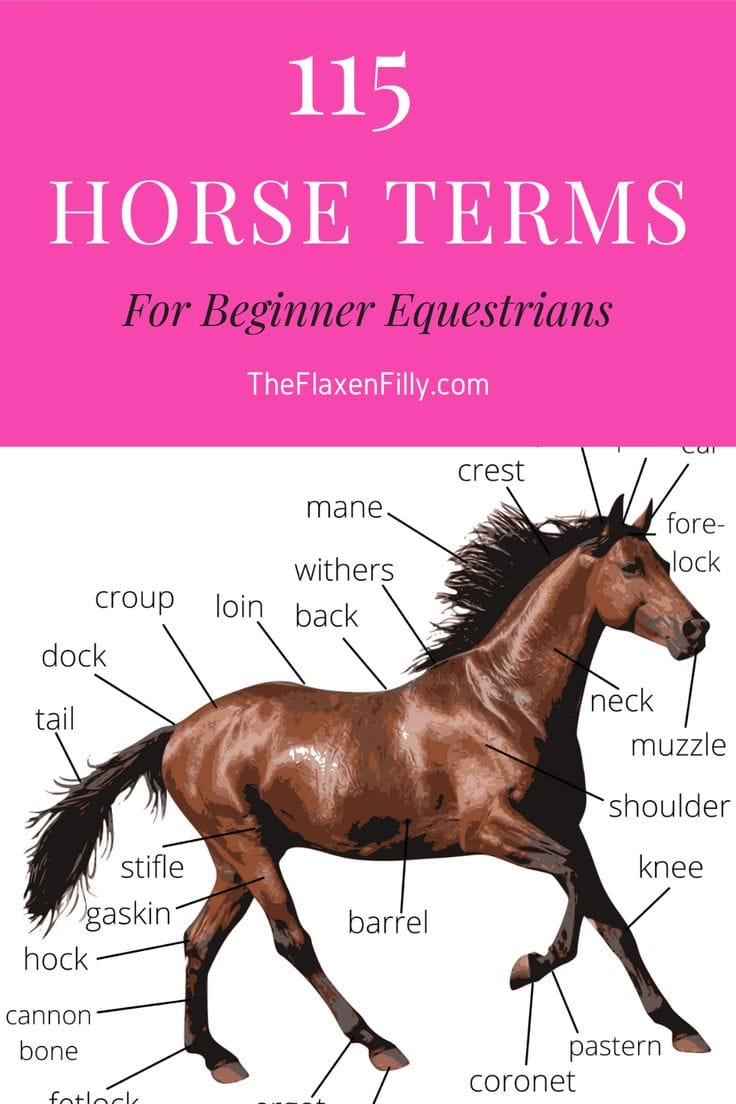
- Withers: The highest point on a horse’s back, a bony ridge between the shoulder blades. This is the point from which a horse’s height is measured.
- Poll: The area at the very top of the horse’s head, located between the ears. It’s a sensitive pressure point relevant to how a bridle fits.
- Hock: The large, angular joint on a horse’s hind leg, equivalent to the human ankle. It is a crucial joint for propulsion and power.
- Fetlock: The joint located just above the hoof on all four legs, similar to the ball of a human foot.
- Pastern: The sloping bone that connects the fetlock joint to the top of the hoof.
- Croup: The area over the top of the hindquarters, from the highest point of the hip to the dock of the tail.
The Language of Movement: Gaits Explained
A horse’s gaits are its different ways of moving. Understanding the name, rhythm, and feel of each one is fundamental for any rider.
- Walk: A slow, four-beat gait where each hoof lifts and lands independently. It’s the most stable and relaxed of the gaits.
- Trot: A two-beat diagonal gait. The horse springs from one diagonal pair of legs to the other (e.g., right front and left hind move together), with a moment of suspension between each beat. In English riding, riders often “post” at the trot, rising and sitting in rhythm with the horse’s stride.
- Canter (or Lope): A rhythmic, three-beat gait. One hind leg strikes the ground first, followed by the diagonal pair of the other hind leg and one foreleg, and finally the remaining foreleg. This creates the classic “rocking horse” motion. In Western riding, this gait is typically called a lope.
- Gallop: The fastest gait, a four-beat movement with a moment of complete suspension where all four feet are off the ground.
The Rider’s Toolkit: Tack and Equipment
“Tack” is the general term for all the equipment used on a horse for riding and handling. Knowing the correct terms is essential for safety and proper use.
The Saddle and Bridle
- Saddle: The leather or synthetic seat for the rider, placed on the horse’s back. It’s designed to distribute the rider’s weight comfortably and securely.
- Girth (or Cinch): The strap that fastens around the horse’s barrel (just behind the front legs) to hold the saddle in place.
- Stirrups: The footrests attached to the saddle by straps, providing support and leverage for the rider.
- Bridle: The headgear a horse wears, which includes the bit and reins, used by the rider to communicate with the horse.
- Bit: The metal, rubber, or synthetic mouthpiece that sits in the horse’s mouth. It connects to the reins and is a primary tool for communication.
- Reins: The long straps attached to the bit, which the rider holds to guide and control the horse’s speed and direction.
- Halter: A piece of headgear used for leading or tying up a horse. Unlike a bridle, it does not have a bit.
The Art of Conversation: Understanding the Aids
The “aids” are the signals a rider uses to communicate with their horse. True horsemanship lies in using these aids with subtlety and precision, creating a nearly invisible dialogue.
As equine ethologist Dr. Alistair Finch notes, “Language is the bridge between rider and horse. Every term we learn is another stone in that bridge, creating a clearer, more compassionate path for communication.”
The Natural Aids
- Seat: Your body in the saddle. Shifting your weight, engaging your core, and following the horse’s motion all send signals about balance, speed, and direction.
- Legs: Your legs, applied at or behind the girth, are the horse’s “gas pedal.” They ask the horse to move forward, move sideways, and bend.
- Hands: Your hands connect to the horse’s mouth through the reins. They are used to ask the horse to slow down, stop, turn, and flex, but should be used with gentle finesse.
- Voice: Spoken commands or soothing sounds can be used to calm a horse or reinforce another cue.
Key Concepts in Communication
- Contact: The light, steady connection felt through the reins between the rider’s hands and the horse’s mouth. The goal is a soft, elastic feel, not a heavy pulling.
- Cue: Another word for an aid or signal. A rider gives a cue to ask for a specific response.
- Half-Halt: A momentary, subtle action of the seat, leg, and hand aids used to rebalance the horse and prepare it for a change of speed or direction. It’s like tapping the brakes lightly to get the horse’s attention before giving the next instruction.
- On the Bit: A more advanced concept where the horse accepts the rider’s contact and works in a soft, rounded frame, with energy flowing from its hindquarters through its body into the rider’s hands.
In the Training Arena: Core Concepts and Terms
These terms describe the exercises and principles used to educate a horse. Whether you’re working in a round pen or a large arena, these concepts are universal.
Foundational Training
- Groundwork: Any training done with the horse from the ground, rather than from the saddle. This includes leading, lunging, and desensitizing exercises, which build respect and trust. Many trainers, even a well-known horse trainer in texas, will attest that a horse’s education starts here.
- Lungeing (or Lunging): An exercise where the handler has the horse move in a circle around them on the end of a long line, called a lunge line. It’s used for exercise, training, and assessment.
- Round Pen: A small, circular enclosure with no corners, designed for training horses. Its shape encourages the horse to focus on the handler.
- Desensitization: The process of exposing a horse to potentially scary objects (like tarps, flags, or plastic bags) in a safe, controlled way until it no longer reacts with fear.
Advanced Riding and Movement
- Collection: The act of shortening the horse’s frame by asking it to bring its hind legs further underneath its body, shifting more weight to the hindquarters. This creates a lighter, more agile, and more powerful horse.
- Engagement: The degree to which the horse steps under its body with its hind legs. Good engagement is the engine that powers all athletic movements.
- Impulsion: The controlled, forward-moving energy generated by the horse’s hindquarters. It’s not just speed, but powerful, energetic movement.
- Straightness: A horse is “straight” when its hind feet follow in the exact same track as its front feet. Achieving this is a core goal of many disciplines and a key focus of horse straightness training.
- Transition: A change from one gait to another (e.g., walk to trot) or within a gait (e.g., working trot to extended trot). Smooth, balanced transitions are a hallmark of a well-trained horse.
Frequently Asked Questions (FAQ)
1. What is the difference between a canter and a lope?
A canter and a lope are essentially the same three-beat gait. The term “canter” is typically used in English riding disciplines, while “lope” is the term used in Western riding. The lope is often performed at a slightly slower, more relaxed pace.
2. What does it mean if a horse is “green”?
A “green” horse is one that is inexperienced or new to training. It understands the basics but is not yet a finished, reliable mount. It requires a skilled and patient rider to continue its education.
3. What are “aids” in horse riding?
Aids are the signals a rider uses to communicate with their horse. They are categorized as natural aids (seat, legs, hands, and voice) and artificial aids (like crops or spurs, which should only be used to reinforce the natural aids).
4. What is the “near side” of a horse?
The “near side” is the left side of the horse. By tradition, it is the side from which riders mount and handle the horse. The right side is called the “off side.”
5. What does the term “tack” refer to?
“Tack” is the collective term for all the equipment used for riding and handling a horse, including the saddle, bridle, girth, and any other gear like martingales or breastplates.
A Language of Partnership
Mastering these horse training terms does more than just expand your vocabulary—it deepens your connection with your horse. Each word represents a concept, a cue, or a goal that builds the bridge of communication between you and your equine partner. The more fluent you become, the clearer and more compassionate your conversations will be. Continue to listen, learn, and practice, and you’ll find that you and your horse are speaking the same language.
