
Centuries ago, the arrival of Spanish horsemen, known as vaqueros, in North America marked the beginning of a profound horsemanship legacy that continues to influence Western riding culture today. Their impact is evident not only in the evolution of the English language, with words like “chaps” and “rodeo” tracing their roots back to Spanish origins, but more significantly, in the foundational principles of horse training and stockmanship that laid the groundwork for modern ranching. The introduction of Spanish horses and cattle in the early 1500s set the stage for the development of refined bridle horses, which were essential working partners—responsive, agile, and deeply connected to their riders. This meticulous training process, starting with the hackamore (bosal), progressing through the two-rein stage, and culminating in a horse ridden “straight up in the bridle” with a spade bit, produced an unparalleled working partner.
Many contemporary riders still adhere to this vaquero philosophy, embracing classical methods for training their horses. However, the demands of modern ranching have led to a decline in the prevalence of this traditional style. To gain deeper insight into this time-honored approach, we spoke with Martin Black, a fifth-generation rancher from Idaho. His family has dedicated nearly 150 years to raising and training horses in the vaquero tradition, earning Black widespread respect for his horsemanship and his commitment to preserving the bridle horse legacy.
Black defines the bridle horse as an “all-around stock horse,” with the ultimate aim of creating a horse adept at working cattle. The ideal bridle horse, he explains, allows the rider to hold a rope in one hand while steering the horse with the other, ideally without needing to pull on the reins. He continues to start all his horses in a hackamore, then transitions them to the two-rein, and finally to the spade bit, emphasizing that this bit acts as both a leverage and a signal bit, designed for the horse to respond to the slightest pressure.
The origins of the bridle horse tradition can be traced back to the Moors of Africa, who brought their horsemanship to Spain. Following the conquest of Mexico, vaqueros and cattle ranching practices spread northward into the southern United States. By the mid-1800s, the vaquero style of riding, tack, rawhide reatas (lariat ropes), and cattle-roping techniques were well-established in California. This distinct horsemanship then migrated northeast into Nevada, Oregon, and Idaho, aligning with the movement of cattle into the Great Basin. Martin Black’s family, deeply involved in the horse business, continued this tradition, with his great grandfather and uncles largely following this path.
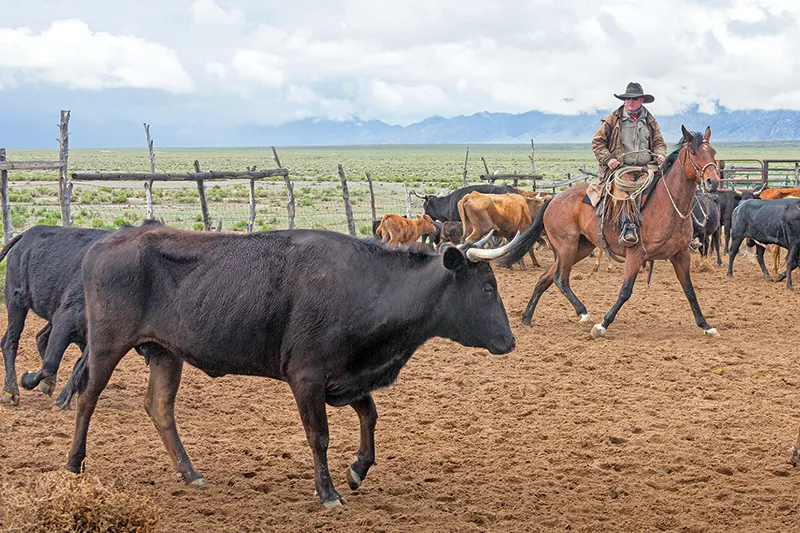 Bridle horse riding, with Martin Black and Spanish cowboys*Martin Black’s well-trained bridle horse tracks a cow on a loose rein, executing a complex maneuver independently. Photo: Kim Stone Shinanatu Photography*
Black’s introduction to California-style vaquero horsemanship came through his great uncle. He distinguishes the traditional bridle horse from what is often seen in modern show pens. “When I was growing up, the goal was to make a good bridle horse, not go in a three-year-old futurity,” he recalls. His approach involves a patient development process, akin to a child’s education, with the expectation of eventual mastery. He dedicates less time to riding very young horses, focusing more on five- and six-year-olds as they begin to “blossom” into capable partners.
This extended training period allows bridle horses to readily accept new challenges without becoming resistant or “closed-minded,” a potential outcome of excessive repetition in other training methods. Black explains that while repetitive training can achieve a desired maneuver, it may limit the horse’s decision-making capacity. In contrast, the bridle horse training emphasizes developing a horse that thinks and collaborates with the rider.
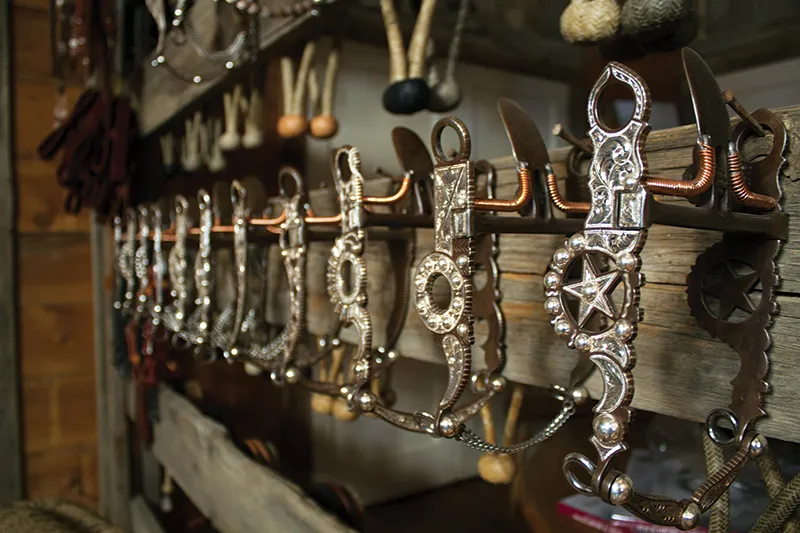 Bridle horse riding, with Spanish cowboys and traditional tack*Finished bridle horses are ridden with minimal cues in a spade bit, similar to these examples. Photo: Kim Stone Shinanatu Photography*
The dedication to preserving these bridle horse traditions is evident in the Black family’s history, with fascinating family photos showcasing generations of horsemen. These images depict the evolution and continuity of the practice, from Joe Black in 1900 using a silver spade bit and rawhide reata, to Albert Black in 1926, and further generations employing the traditional tack and methods. [cite:8, cite:9, cite:10, cite:11, cite:12]
The unique training style of the bridle horse tradition also attracts riders outside of traditional cowboy circles. Stefanie Travers, a British Columbia-based horse philosopher, has been training her horses in this manner for 12 years. She articulates her perspective: “What I do is not a sport, it’s an art — and in the horse world, that’s a pretty big distinction.”
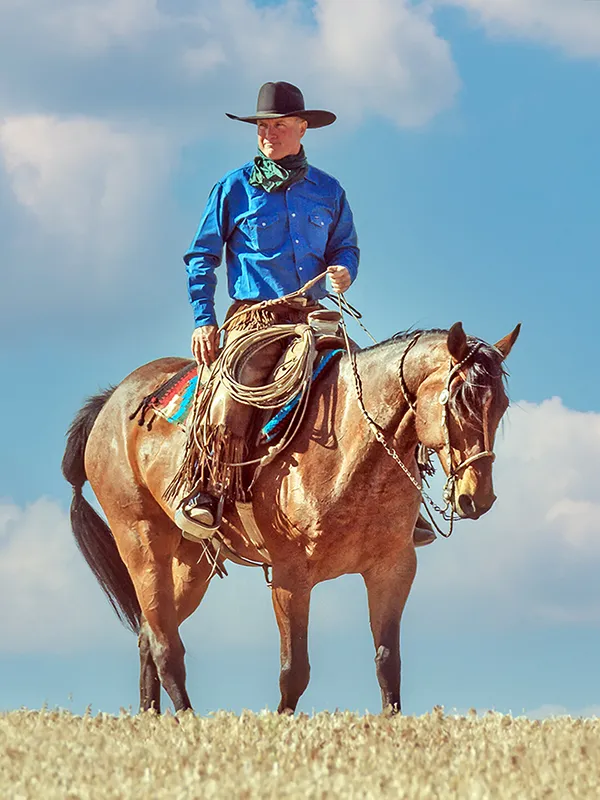 Martin Black, passionate about bridle horse traditions, with historical family photos*Martin Black is dedicated to preserving bridle horse traditions. His family’s nearly 150-year history in this practice is chronicled in these family photos. Photo: Kim Stone Shinanatu Photography*
A significant departure from other training methods, Travers notes, is the absence of a rigid timeline in bridle horse training. Unlike the common “three-day colt starts” or “90-day training” programs, the vaquero approach prioritizes the horse’s development, embracing the philosophy of “Who cares? There’s always tomorrow. It’s the horse that matters.” Historically, California vaqueros had the leisure to refine their horsemanship and horsemanship skills by observing their cattle and patiently working with their horses, turning the process into an art form.
While interpretations of bridle horse training may vary, Travers emphasizes that all practitioners aim to allow their horses to reach their full potential as stock horses, fostering a strong human-horse relationship. The training is centered on the horse’s well-being and development, with the horse dictating the pace. This communication involves understanding the horse’s language and working collaboratively.
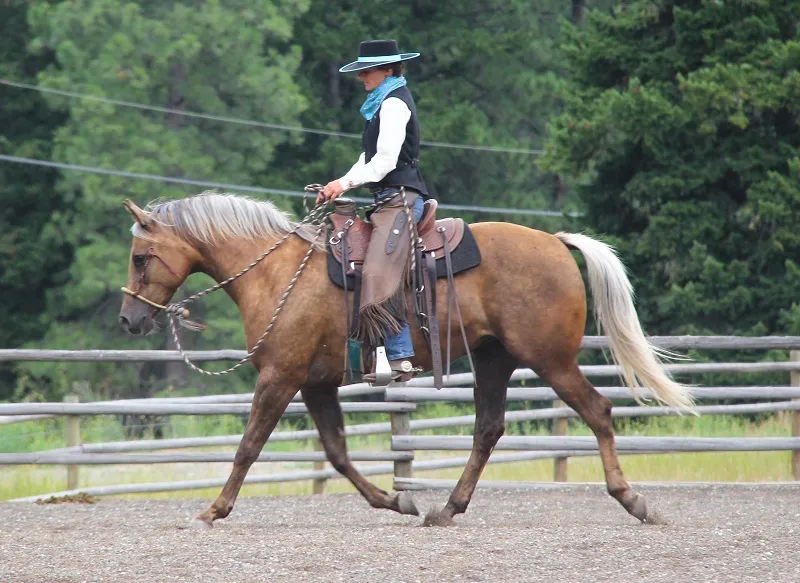 Stefanie Travers riding in a hackamore*Stefanie Travers is shown riding in a hackamore. Photo: Danielle Wegelin*
Travers explains that the core principle is “staying in the centre of the horse,” emphasizing balanced and centered body language for both horse and rider. She views the horse as a horizontal being and humans as vertical, finding their shared center is crucial. This connection allows the horse to willingly engage with the rider and move together harmoniously through space. This “bizarre interpretation” from a working cow horse perspective, she believes, is understood by truly skilled horsemen who recognize the importance of finding their horse’s center.
Beyond the training methods, the tack used in the bridle horse tradition is integral. Travers highlights the brilliance of the equipment, noting its origins with working cowboys who crafted their gear with meticulous care. Black corroborates this, recalling evenings spent with his uncles and friends innovating and refining their equipment. Today, much of this gear is crafted by skilled artisans, including silver makers, mecate traders, and rawhide braiders.
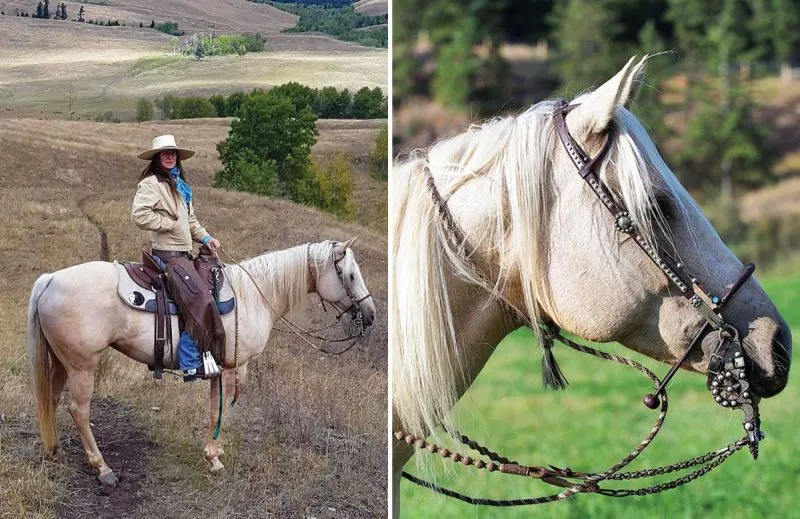 Artisan-crafted horse equipment, including rawhide braids and reins*Stefanie Travers notes the exceptional quality of the equipment, explaining that working cowboys historically crafted their gear to be improved. Left photo: Wojtek Kwiatkowski Equine Photography; Right photo: Vicki Travers*
The construction of the tack, such as mecate reins made from spun mane hair and rawhide braids on the bosal, is significant. Travers explains that these elements act as “fibre optics” transmitting subtle yet clear communication between the rider’s hands and the horse’s mouth. While the equipment facilitates communication, the rider’s body remains the primary tool, outweighing the saddle. Mastering the use of one’s body, energy, breath, presence, and awareness allows the tack to effectively complete the conversation with the horse.
Travers believes the bridle horse tradition appeals to non-cowboys who may have experienced disillusionment with other equestrian pursuits. She suggests it attracts individuals fascinated by horses and driven to self-discovery through their equine partners. The horse, she posits, acts as a mirror, and the development of a bridle horse calls for the rider to become a better horseman.
For dedicated bridle horsemen, the ultimate achievement is training a horse to perform “straight up in the bridle.” This level of connection and responsiveness is honored by the use of silver-adorned spade bits, symbolizing the dedication invested in cultivating this unique relationship. Travers describes the spade bit’s function: it requires the horse to be balanced, driving from behind with elevated shoulders, while the bit rests neutrally in the mouth. This state is achieved through sensitive hands and a rider’s awareness, resulting in a relaxed, engaged horse with an almost vertical head carriage, indicative of happiness and trust.
The principle that “the horse will teach you if you listen” is central to the bridle horse tradition. The curiosity to understand the horse’s center, move them effectively, avoid causing offense, and transform the rider’s idea into the horse’s own, embodies the essence of this practice. It is this pursuit of excellence and deep connection that inspires horsemen and women to continue training horses in the centuries-old bridle horse tradition.
