
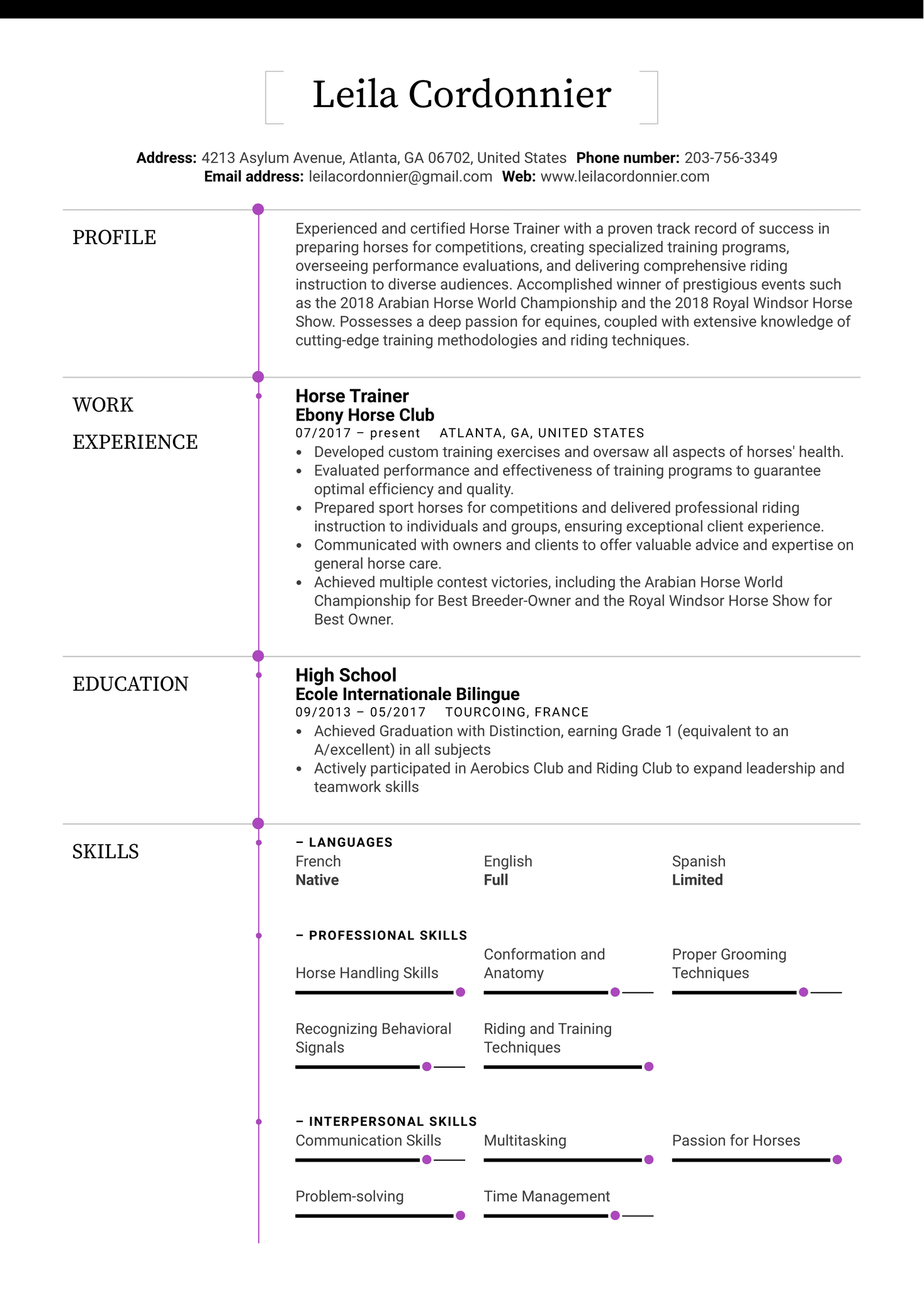
Are you passionate about horses and possess a knack for training them? A well-crafted resume is your ticket to landing your dream job as a horse trainer. This guide will walk you through creating compelling Horse Trainer Resume Examples that highlight your skills, experience, and dedication to equine excellence. We’ll cover everything from essential sections to tailoring your resume for specific roles, ensuring you stand out in a competitive field.
Understanding the Role of a Horse Trainer
Before diving into resume examples, it’s crucial to understand what employers look for in a horse trainer. This role demands a blend of practical skills, theoretical knowledge, and a deep understanding of equine behavior and welfare. Key responsibilities often include:
- Developing and implementing training programs for horses of various breeds and disciplines.
- Assessing a horse’s temperament, health, and athletic potential.
- Teaching riding skills to owners or handlers.
- Maintaining the health, safety, and well-being of the horses under their care.
- Managing stable operations, including feeding, grooming, and exercise.
- Building strong relationships with clients and their horses.
Essential Sections for Your Horse Trainer Resume
A strong horse trainer resume should be clear, concise, and effectively showcase your qualifications. Here are the essential sections to include:
1. Contact Information
Ensure this is accurate and easy to find at the top of your resume.
- Full Name
- Phone Number
- Email Address
- LinkedIn Profile URL (Optional, but recommended)
- Location (City, State)
2. Professional Summary or Objective
This is your elevator pitch.
- Professional Summary: Ideal for experienced trainers. Briefly highlight your years of experience, key skills, and career achievements. Focus on what you can bring to the employer.
- Objective Statement: Better for entry-level or career-changing individuals. State your career goals and the specific type of position you are seeking, emphasizing your enthusiasm and relevant transferable skills.
Example Professional Summary:
Highly dedicated and experienced Horse Trainer with over 8 years of expertise in developing and executing comprehensive training programs for dressage and show jumping disciplines. Proven ability to improve horse performance, foster strong client relationships, and ensure optimal equine welfare. Seeking to leverage advanced training methodologies and a passion for equine development at [Name of Establishment].
Example Objective Statement:
Enthusiastic and reliable individual with a lifelong passion for horses and foundational knowledge in equine care and basic riding techniques. Eager to begin a career as a Horse Trainer, seeking an opportunity to learn from experienced professionals and contribute to a reputable stable environment. Committed to providing exceptional care and developing strong training skills.
3. Skills
This section should be a mix of hard and soft skills relevant to horse training.
Hard Skills:
- Equine Behavior Analysis
- Training Program Development
- Riding Disciplines (e.g., Dressage, Show Jumping, Western, Eventing)
- Groundwork Techniques
- Gait Analysis
- Nutritional Planning
- Equine First Aid & Health Management
- Stable Management
- Horse Grooming & Tack Care
- Trailer Loading and Transport
- Specific Breed Knowledge
Soft Skills:
- Patience and Empathy
- Communication (with horses and humans)
- Problem-Solving
- Observation Skills
- Physical Fitness and Stamina
- Responsibility and Reliability
- Client Relations
- Teamwork
- Time Management
4. Professional Experience
List your work history in reverse chronological order. For each role, include:
- Job Title
- Employer Name and Location
- Dates of Employment
- Key Responsibilities and Achievements (use bullet points and action verbs)
Focus on accomplishments, not just duties. Quantify your achievements whenever possible.
Example:
Assistant Horse Trainer | Greenfield Stables | Anytown, USA | June 2018 – Present
- Assisted head trainer in daily exercise and conditioning of 20+ horses.
- Successfully trained young horses (2-3 years old) in basic groundwork and introductory ridden exercises.
- Managed feeding schedules and administered medications as prescribed by the veterinarian.
- Provided riding instruction to beginner and intermediate students, improving their horsemanship by an average of 25%.
- Maintained the cleanliness and organization of stables and training facilities.
5. Education and Certifications
Include relevant degrees, diplomas, and certifications.
- Degrees (e.g., Equine Science, Animal Behavior)
- Vocational Training Programs
- Certifications from recognized equine organizations (e.g., Certified Horsemanship Association – CHA, British Horse Society – BHS)
- First Aid/CPR Certifications
Example:
Certified Equine Nutrition Specialist | EquiNutrition Academy | Online | 2022
Bachelor of Science in Equine Studies | State University | Big City, USA | 2018
CHA Certified Instructor (Level 3) | [Organization] | [Year]
6. Volunteer Work and Affiliations (Optional but Recommended)
Highlighting volunteer experience at rescue farms, therapeutic riding centers, or involvement in equestrian associations demonstrates your commitment to the equine community.
Tailoring Your Resume for Specific Roles
When applying for a horse trainer position, it’s essential to customize your resume to match the job description.
- Identify Keywords: Look for keywords in the job posting (e.g., “dressage,” “eventing,” “stallion handling,” “rehabilitation,” “client relations”) and incorporate them naturally into your resume, especially in the skills and experience sections.
- Highlight Relevant Experience: If the job emphasizes starting young horses, ensure your experience with “breaking” or “starting” young stock is prominent. If it’s a therapeutic riding center, emphasize your experience with rehabilitation or special needs.
- Quantify Achievements: Instead of saying “Trained horses,” say “Successfully trained 15+ young horses from initial groundwork to ridden capabilities, resulting in X% increase in successful sales.”
Creating Effective Bullet Points
Use the STAR method (Situation, Task, Action, Result) to craft compelling bullet points for your experience section:
- Situation: What was the context?
- Task: What needed to be done?
- Action: What did you do? (Use strong action verbs)
- Result: What was the outcome? (Quantify if possible)
Example:
Instead of: “Responsible for feeding horses.”
Use: “Developed and implemented a precise feeding schedule for 20+ horses, catering to individual dietary needs and ensuring optimal health, which led to a measurable decrease in digestive issues.”
Resume Examples for Different Horse Trainer Roles
Here are examples tailored for common horse trainer specializations:
Example 1: Dressage Trainer Resume Snippet
Professional Summary:
Accomplished Dressage Trainer with 10+ years of experience specializing in developing horses from young prospects to Grand Prix level. Expertise in classical training methods, FEI competition preparation, and client coaching. Proven track record of success in national and international competitions.
Skills:
Classical Dressage Training, FEI Level Competitions, Young Horse Development, Longeing, Long-Reining, Equine Biomechanics, Rider Biomechanics, Client Mentorship, Competition Coaching.
Professional Experience:
Head Dressage Trainer | Elite Equine Academy | Wellington, FL | 2015 – Present
- Successfully trained and competed multiple horses to Grand Prix level, earning numerous championship titles.
- Coached riders of all levels, including national and international competitors, to achieve personal bests and competition success.
- Developed and managed training plans for up to 15 horses simultaneously, focusing on soundness and longevity.
Example 2: Western Pleasure/Reining Trainer Resume Snippet
Professional Summary:
Dedicated Western Trainer with 7 years of experience in reining and pleasure disciplines. Skilled in starting colts, training performance horses, and preparing them for NRHA and AQHA events. Passionate about building trust and communication with horses.
Skills:
Colt Starting, Reining Maneuvers (spins, lead changes, sliding stops), Western Pleasure Training, Ranch Horse Work, Natural Horsemanship Techniques, Trailer Loading, Client Instruction.
Professional Experience:
Western Performance Horse Trainer | Dusty Trails Ranch | Scottsdale, AZ | 2017 – Present
- Specialized in starting and training young Quarter Horses for reining disciplines, with numerous horses placing in regional competitions.
- Developed effective training programs for pleasure horses, enhancing their responsiveness and smooth gaits.
- Provided foundational training and horsemanship lessons to clients.
Example 3: Equine Rehabilitation Trainer Resume Snippet
Professional Summary:
Compassionate and knowledgeable Equine Rehabilitation Trainer with 5 years of experience assisting veterinarians in the recovery and conditioning of horses post-injury or surgery. Proficient in various therapeutic modalities and exercise protocols.
Skills:
Equine Physical Therapy Techniques, Post-Surgical Rehabilitation, Injury Management, Hydrotherapy, Therapeutic Exercise Prescription, Equine Massage, Client Education on Home Care, Collaboration with Veterinarians.
Professional Experience:
Rehabilitation Assistant & Trainer | Healing Hooves Equine Center | Lexington, KY | 2019 – Present
- Worked closely with equine veterinarians to implement customized rehabilitation plans for horses recovering from injuries.
- Administered therapeutic treatments, including water treadmill sessions and specific exercise regimens.
- Monitored horses’ progress, documented recovery milestones, and communicated updates to owners and vets.
Final Tips for Your Horse Trainer Resume
- Proofread meticulously: Errors in grammar or spelling can be a major red flag. Have someone else read your resume before submitting it.
- Keep it concise: Aim for one page if you have less than 10 years of experience, and a maximum of two pages for extensive experience.
- Use a clean, professional format: Avoid overly flashy templates. Choose a clean, easy-to-read font and layout.
- Save as a PDF: This preserves your formatting across different devices and operating systems.
By following these guidelines and utilizing these horse trainer resume examples, you can create a powerful document that effectively showcases your expertise and passion for working with horses, paving the way for a successful career in equine excellence.
